
Right, let's cut the fluff. The business model behind cam platforms isn't some dark art wrapped in mystery. At its core, the platform is a digital landlord. They build the stage, provide the lights and sound, pull in a crowd, and for that privilege, they take a hefty slice of every single transaction.
Think of them as a cross between a high-tech talent agency, a concert promoter, and a very specialised payment processor. They're the middleman, and their entire business is built on taking a commission. That's the short and simple answer to how cam platforms make money.
How Cam Platforms Actually Make Their Money
At its heart, a cam platform is just a very specific kind of marketplace. It connects two groups: creators broadcasting live and viewers who want to watch and interact. The entire business is engineered to facilitate, and monetise, those interactions. This isn't a passive service like Netflix; it's a living ecosystem where money changes hands with every tip, every private chat, and every subscription.
The platform provides the nuts and bolts. This means heavy-duty servers to stream video to thousands of people, secure payment gateways to handle cash from all over the globe, and the software creators use to manage their shows. In exchange for keeping this whole circus running, they take a commission on pretty much every penny a creator earns.
The Landlord and Tenant Dynamic
A good way to picture this is to think of the platform as a landlord renting out a stall in a massive, bustling digital market. The creator is the tenant, selling their product—in this case, their performance, their time, and their interaction. The platform is responsible for bringing in footfall, keeping the lights on, and managing security. In return, it takes a big chunk of the sales revenue as its "rent".
This rent isn't a fixed monthly fee. It’s a percentage of the creator's earnings, a cut that can range from 30% to a whopping 70%, depending on the site, the creator's status, and the type of transaction. This model means the platform's success is directly tied to the success of its creators; they only make serious money when the talent does.
Platform Revenue Streams at a Glance
So, where does the platform's income actually come from? It’s generated through several key activities, each designed to give viewers different ways to spend and creators different ways to earn.
Here's a quick breakdown of the main money-makers.
| Revenue Stream | How It Works | Typical Platform Cut |
|---|---|---|
| Tokens & Tips | Viewers buy a site-specific virtual currency (tokens) with real money, then use them to tip creators in public chats. | 40% – 60% |
| Private Shows | A viewer pays a per-minute rate for an exclusive one-on-one video session with a creator. This is a premium service. | 30% – 50% |
| Subscriptions/Fan Clubs | Viewers pay a recurring monthly fee to a specific creator for access to exclusive content, private messages, or other perks. | 20% – 40% |
| Pay-Per-View (PPV) | Creators sell access to pre-recorded videos or photo albums for a one-off payment from a viewer. | 30% – 50% |
In every single case, the platform handles the transaction. It takes the payment from the viewer, deducts its commission, and passes the rest to the creator. This simple, commission-based structure is precisely how these platforms have grown into multi-million pound businesses.
Understanding the Token Economy
If you want to grasp how cam platforms make their money, you have to get your head around tokens. They're the digital lifeblood of this entire world.
Think of tokens as the in-house currency for each platform, a bit like poker chips at a casino. A viewer can't just toss a fiver at the screen. First, they need to convert their real-world money into the platform’s specific tokens.
This isn't just for show. Creating a virtual currency is a smart business move that solves several problems at once. It makes tiny micro-transactions easy, encourages a bit of impulse spending ("it's only 50 tokens!"), and—most importantly—it creates a buffer between a viewer's credit card and a creator's bank account.
It’s in this buffer that the platform works its magic, taking its cut before the money ever gets to the performer. Every single tip, private show, or paid-for action is funded by these tokens.
From Your Wallet to Theirs: A Token's Journey
Let’s follow the money. Imagine a viewer—we'll call him Dave—wants to support a creator he's watching. He doesn't just send them a tenner; he buys a token package.
Here’s a typical play-by-play:
- The Purchase: Dave buys a £20 token package and gets, say, 200 tokens. His bank statement will show a charge from the platform's company, not from the individual creator.
- The Tip: Dave is enjoying the public stream and decides to tip the creator 100 tokens (the equivalent of £10) to show his appreciation.
- The Platform's Cut: The platform’s software instantly registers this tip. Before those 100 tokens land in the creator’s account, the platform skims its commission right off the top. This fee is often around 50%.
- The Creator's Share: The creator receives the remaining 50 tokens in their platform wallet. This is now their money, but it’s still held as the platform's virtual currency.
This process is absolutely central to the business model. It guarantees the platform gets paid instantly and automatically for every single transaction.
This flow chart shows the basic journey of money from a viewer, through the platform's systems, and finally to the creator.
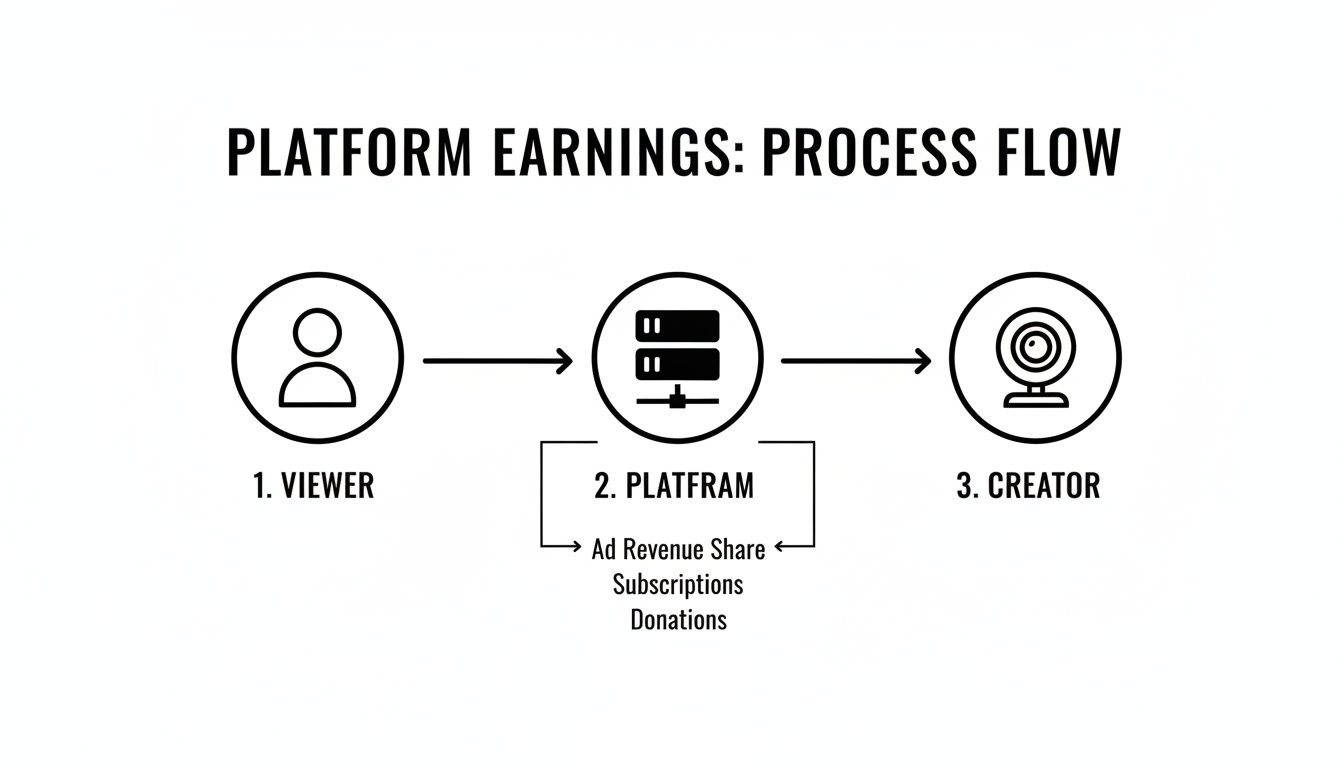
As you can see, the platform sits firmly in the middle, acting as the essential intermediary that processes all payments and takes its fee before the creator sees a penny.
Why Not Just Use Real Money?
So, why the fuss? Why not just use pounds and pence? Well, this token system adds a crucial layer of abstraction that hugely benefits the platform. For one, it standardises payments across dozens of countries and currencies, making global transactions feel seamless.
More cynically, it also disconnects the viewer from the real-world cost of what they're spending. Tipping "100 tokens" feels a lot less significant than tipping "£10," a psychological trick that can lead to higher spending over time. It’s a tactic used everywhere from mobile games to coffee shop loyalty apps, and it works. If you want to dive deeper into how these sites are built, our guide on how webcam sites work offers more context.
The token isn't just a currency; it's a control mechanism. It ensures the platform is the central bank, the processor, and the tax collector for every single interaction, guaranteeing their revenue before anyone else gets paid.
Finally, tokens provide a vital layer of privacy and security for everyone. Viewers’ payment details are shielded from creators, and creators don't have to expose their personal banking information to thousands of individual viewers. The platform takes on the risk of payment processing, chargebacks, and fraud—and the token system is the engine that makes this entire arrangement possible. Without it, the whole model would be far more chaotic and risky for everyone involved.
The Real Money: Private Shows and Exclusive Content
Public streams are great for building a following, but think of them as the window display of a shop. The real business happens inside, where the high-value transactions take place. This is where private shows, pay-per-view (PPV) content, and fan club subscriptions come into their own.
If tokens are the pocket change of the cam world, these premium features are the direct debits and big-ticket purchases. For both creators and the platforms themselves, this is where the business model matures. It’s a strategic shift from earning small, frequent tips from a big crowd to securing larger, more reliable payments from a smaller group of dedicated fans.
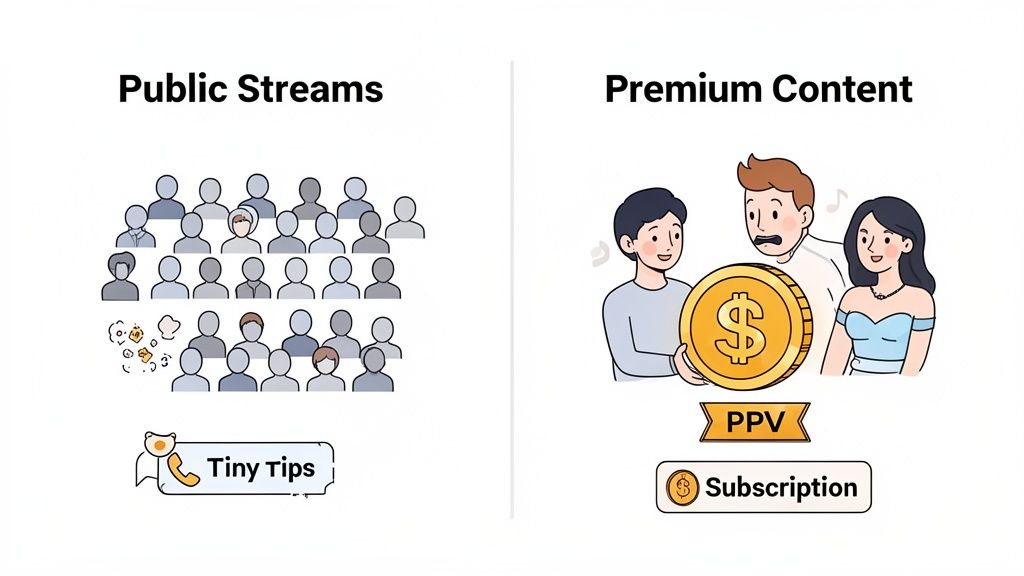
This is how platforms engineer a consistent revenue flow. They provide the tools for creators to build a tiered business within the larger ecosystem, and of course, they take their cut from every single one of those premium transactions.
From Public to Private
The journey from a free public stream to a paid private show is the core sales funnel for almost every cam platform. Private shows are the top-tier offering, billed by the minute, where a viewer gets exclusive, one-on-one time with a creator. While the rates are set by the performer, they're often significantly higher than what can be earned through tipping alone.
The platform's role here is crucial. It facilitates the secure connection, processes the per-minute billing automatically, and guarantees its commission. A typical private show might cost anywhere from £1 to £10 per minute. The platform might take a 30-50% cut of this, which adds up incredibly quickly for both parties during a 10 or 20-minute session. It’s a powerful incentive for creators to convert casual viewers into paying clients.
Subscriptions and the Power of Recurring Revenue
The subscription or 'fan club' model is another major pillar of how these platforms make their money. It’s essentially the "Netflix model" applied to the creator economy. Viewers pay a recurring monthly fee—say, £10-£50—for access to a creator's exclusive content feed, private messaging, or other perks.
For the platform, this is golden. Recurring revenue is predictable and stable. They collect the fee every month, take their slice (often a lower percentage like 20-30% to incentivise creators to build their base), and pass the rest on. This model has proven to be incredibly successful, creating a far more sustainable financial relationship than relying solely on impulsive tips. Understanding its potential is key, as highlighted by discussions around the average OnlyFans income, which is built almost entirely on this very framework.
For a platform, a single £20 monthly subscription is often more valuable than a dozen small, one-off tips. It represents predictable income, lower transaction costs, and a more engaged customer who is likely to spend more on other features.
The growth of this model isn't happening in a vacuum. A key revenue driver for UK cam platforms is subscriptions and PPV content, mirroring the booming mainstream video sector. Research from PwC projects this market to grow to £8.3 billion by 2028, with platforms earning via tiered subscriptions and taking significant cuts from PPV sales.
Selling Content A La Carte with PPV
Pay-per-view (PPV) is the final piece of the premium puzzle. This lets creators sell access to pre-recorded videos or photo sets for a one-off fee. It’s a fantastic way to monetise content without having to be live on camera.
Here, the platform acts as a digital storefront and payment handler. A creator uploads their content, sets a price—£5, £20, £50—and the platform processes the payment from any viewer who wants to unlock it. The commission here can be higher, sometimes up to 60%, because the platform is hosting the content and handling all the sales infrastructure. It's another vital income stream that allows a creator to earn money 24/7, long after their live stream has ended.
Why Platform Fees Are So High
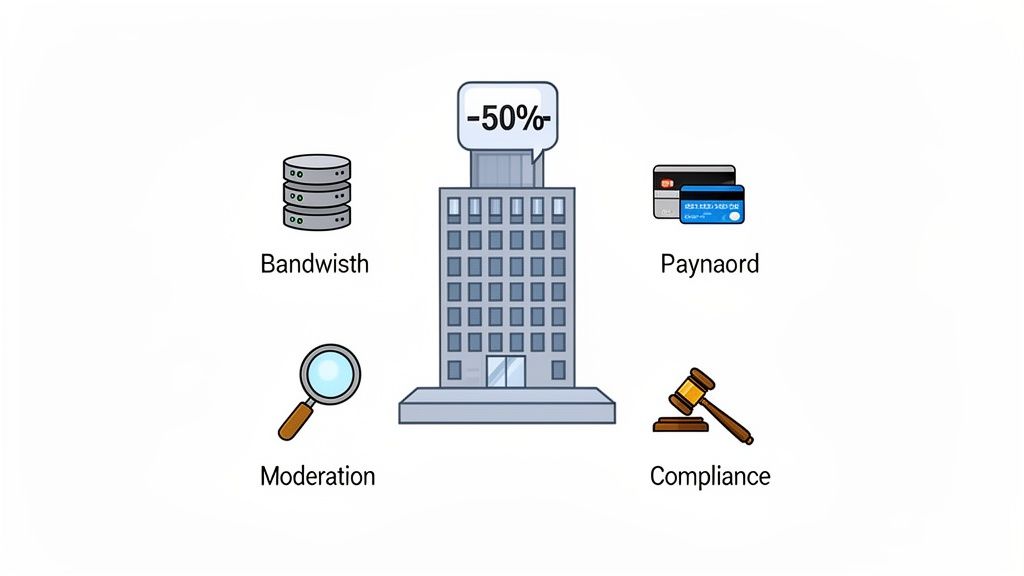
Seeing a 50% commission vanish from your earnings can feel like a punch to the gut. It's a massive point of frustration for creators, and from the outside, it often looks outrageously steep. But that hefty fee isn't just pure profit for the platform; it's buying a whole lot of operational infrastructure, legal cover, and technical support that makes the entire business possible in the first place.
This isn't just about hosting a website. It’s about running a massive, high-demand, and legally complex global operation. When you break down where that money actually goes, the high platform fees start to make a bit more sense. It's not a simple transaction fee; it's a payment for an entire ecosystem of services.
The Heavy Cost of Keeping the Lights On
First, let's talk about the raw technical costs. Streaming high-definition video to thousands, sometimes millions, of users at the same time requires an astronomical amount of server power and bandwidth. This isn't like running a simple blog; it's a resource-hungry operation that costs a fortune to maintain 24/7.
Then you've got the money side of things.
- Payment Processing: Every time a viewer buys tokens, the platform pays a fee to credit card companies and payment processors like Visa or Mastercard. These fees are often higher for adult-oriented businesses, which get classified as "high-risk."
- Chargeback Risk: A chargeback is when a viewer disputes a transaction with their bank. More often than not, the platform has to eat this cost, which can add up to huge losses.
- Global Payouts: Managing payouts to creators in dozens of different countries involves currency conversion fees and complex banking logistics, all of which come with a price tag.
Moderation and the Legal Minefield
This is where the costs really start to stack up. Unlike mainstream platforms like YouTube, cam sites operate in a heavily regulated and scrutinised area. Staying on the right side of the law, especially with strict UK regulations, requires a massive investment.
The platform isn't just taking a cut; it's acting as a legal and financial shield. It absorbs the risk of payment fraud, manages age verification compliance, and deals with the immense legal complexities of adult content, allowing creators to operate with a layer of protection.
In the UK, cam platforms typically generate revenue through a 50-70% commission model on performer earnings, a structure that's been pretty standard since around 2016. Data on the UK's social media and creator economy shows that industry revenue is substantial and growing, with video advertising becoming a huge segment as platforms work to monetise every aspect of viewer engagement. You can learn more about the scale of the UK's creator economy on researchandmarkets.com.
Payouts in Practice
So, after all these deductions, how does the money actually get from the platform to a creator? Platforms have very specific rules about when and how you can withdraw your earnings.
- Payout Schedules: Most platforms pay out on a set schedule, like bi-weekly or monthly. You don’t just get your money instantly.
- Minimum Thresholds: You almost always need to reach a minimum earnings threshold before you can request a payout. This could be anything from £50 to £200. If you don't hit that minimum, your money stays with the platform until you do.
To help visualise this, let's walk through a simple example of how a creator's earnings are processed.
Example Payout For £100 In Creator Earnings
| Item | Description | Amount (£) |
|---|---|---|
| Gross Creator Earnings | Total value of tips, private shows, etc. generated. | £100.00 |
| Platform Fee (50%) | The platform's commission for providing the service. | -£50.00 |
| Subtotal | Creator's share before other deductions. | £50.00 |
| Payout Processing Fee | A typical fee for bank transfer or payment service. | -£2.50 |
| Final Payout to Creator | The actual amount received by the creator. | £47.50 |
This breakdown shows that from an initial £100 earned, the creator might only see £47.50 land in their bank account. These systems are in place to streamline the platform's accounting and reduce the number of small transactions they have to handle. For a creator, it means earnings aren't immediate, and careful management is needed to ensure a steady income flow that accounts for both the platform's cut and these practical payout rules.
The Hidden Revenue Streams You Don't See
While the creator-viewer transaction is the main event, smart platforms don't just rely on one income stream. The commission on tokens and private shows is their bread and butter, but there are several other revenue channels humming away in the background.
To really understand the business model, you have to look beyond the obvious. These platforms aren't just passive marketplaces; they're complex operations built to extract value from every corner of the ecosystem they’ve created.
The Power of Referrals and Affiliates
One of the biggest money-makers that often goes unnoticed is the affiliate and referral programme. This is a clever system that basically turns the platform's own users—both creators and viewers—into a volunteer marketing army.
It works like this:
- Creator Referrals: A model gets a unique link. If a new creator signs up with that link and starts earning, the original model gets a small percentage of the new person's income, often for life.
- Viewer Referrals: A fan can share their link to bring new spenders to the site. In return, they might get a cut of that new user's first token purchase or a slice of their spending for a set period.
For the platform, this is a win-win. They only pay a commission when a new, paying customer is acquired, which is far cheaper and more effective than traditional advertising. It creates a self-fuelling cycle of growth.
Selling the Shovel in a Gold Rush
Another smart, though less common, play is selling white-label platform software. Instead of just running their own site, some of the bigger tech players in the industry will license out their entire setup—the streaming tech, payment gateways, and moderation tools—to entrepreneurs who want to launch their own branded cam site.
Think of it as selling shovels during a gold rush. The company profits not just from its own operation but by equipping others to start their own, taking a hefty licensing fee or a share of the new site’s revenue. This lets them cash in on the industry's growth without the headache of managing another consumer-facing brand.
The most sophisticated platforms aren't just in the content business; they're in the technology business. Licensing their software creates a B2B revenue stream that is completely separate from the volatile world of creator earnings.
Finally, while it's a tricky area governed by strict privacy laws like GDPR in the UK, there's the potential for data monetisation. This isn’t about selling personal user info. It’s about analysing broad, anonymous trends—like when the site is busiest, which features get the most use, or what spending patterns look like across different regions. They can use these insights to optimise their own platform or sell high-level trend reports to other companies in the space. It’s a subtle but powerful way to make money from the sheer volume of data they handle every day.
Making the System Work for You
Knowing how platforms make their money is one thing; figuring out how to make that system work for you is the real game. Whether you're a creator trying to build a career or a viewer wanting to support performers safely, you need a strategy. This world is built on specific incentives, and knowing how to play to them makes all the difference.
For creators, it’s not about working harder; it’s about working smarter. For viewers, it’s about making conscious choices that protect your privacy while ensuring your support actually lands where you intend it.
Advice for Creators: Maximising Your Earnings
The single biggest trap for new creators is pouring all their energy into the free public chat. It's great for building an audience, but it's a very low-margin activity. The consistent, reliable income is tucked away in the premium features.
- Prioritise Private Shows: This is where you'll find your highest per-minute earning potential. Actively encourage regulars to book one-on-one time. The platform's cut is often lower on private shows, meaning more of that premium rate lands in your pocket.
- Build a Fan Club: Recurring revenue from subscriptions is the holy grail of a stable income. You need to offer genuine value—exclusive photos, behind-the-scenes chats, priority access—to make that monthly fee a no-brainer for your top fans.
- Use Pay-Per-View (PPV) Wisely: Create high-quality content that sells over and over. A well-produced video or unique photo set can generate income for months, literally earning you money while you sleep.
- Understand Payout Schedules: Don’t get caught out by minimum withdrawal limits and payment dates. Knowing the rules is crucial, and you can learn more about how to avoid payout delays on cam sites in our detailed guide.
The most successful creators treat their stream like a business, not a hobby. They have a sales funnel—they convert free viewers into tippers, tippers into subscribers, and subscribers into high-paying private clients.
Advice for Viewers: Staying Safe
As a viewer, your spending fuels the entire ecosystem. It supports creators and keeps the platform running. But it’s vital to engage in a way that protects your own privacy and security.
- Never Share Personal Information: Keep your real name, location, and any other identifying details to yourself. Use a username that has zero connection to your real-life identity or other social media accounts.
- Use Secure Payment Methods: Always stick to the platform’s official payment channels. If a creator ever asks for payment through an external app or a direct bank transfer, that’s a massive red flag and almost certainly against site rules.
- Be Aware of Your Digital Footprint: Using a VPN is a smart move for an extra layer of privacy. You might even consider using a separate web browser just for these sites. Check your privacy settings regularly.
At the end of the day, both sides of the screen hold the power. Creators can build a business on their own terms by strategically using the tools the platform provides. Viewers can support them responsibly while fiercely protecting their own digital safety.
Frequently Asked Questions
Even with the business model laid bare, a few questions always pop up. Let's tackle some of the most common ones to paint a clearer picture of how this world works in practice.
Why is the platform commission so high?
Seeing a platform take a 40-60% cut can feel shocking, especially compared to services like YouTube or Patreon. So, what gives?
The answer lies in the huge hidden costs of running a live adult streaming site. We're talking about high-bandwidth video streaming for thousands of users at once, managing countless tiny payments happening every second, and navigating the complex legal landscape that comes with adult content.
On top of that, these platforms invest heavily in content moderation and face a much higher risk of payment chargebacks from "high-risk" merchant accounts. That hefty commission isn't just a simple fee; it’s what keeps the entire high-risk, high-tech operation running smoothly and legally.
Do creators pay tax on their earnings in the UK?
Yes, absolutely. If you're a creator in the UK, your earnings from cam platforms count as self-employed income. You are responsible for registering with HMRC, completing a Self Assessment tax return each year, and paying your Income Tax and National Insurance.
It's a huge misconception that the platform handles this. They don't deduct tax for UK creators. It's entirely up to you, as the creator, to manage your own tax affairs correctly.
Are free cam sites really free for viewers?
You can watch countless public streams without spending a penny, so in that sense, yes. But the 'free' aspect is a deliberate part of the business model. The entire system is designed to convert a small fraction of those free viewers into paying customers who tip, buy tokens, or book private shows.
Think of the free content as a digital shop window. It’s a powerful marketing tool to draw in a massive audience. The real business starts the moment someone decides to spend money.
So, while you can be a passive observer for free, any meaningful interaction or access to exclusive content comes at a price. The free streams are the foundation, but the paid features are what actually make the business tick.