
Let's cut to the chase. Cam models don't get a monthly salary. Think of it as running your own one-person online business where your income is a direct result of viewer payments, all handled by the platform you're streaming on. Every penny earned comes from your audience. It's part digital tip jar, part pay-per-minute performance.
The Basic Financial Loop of Camming
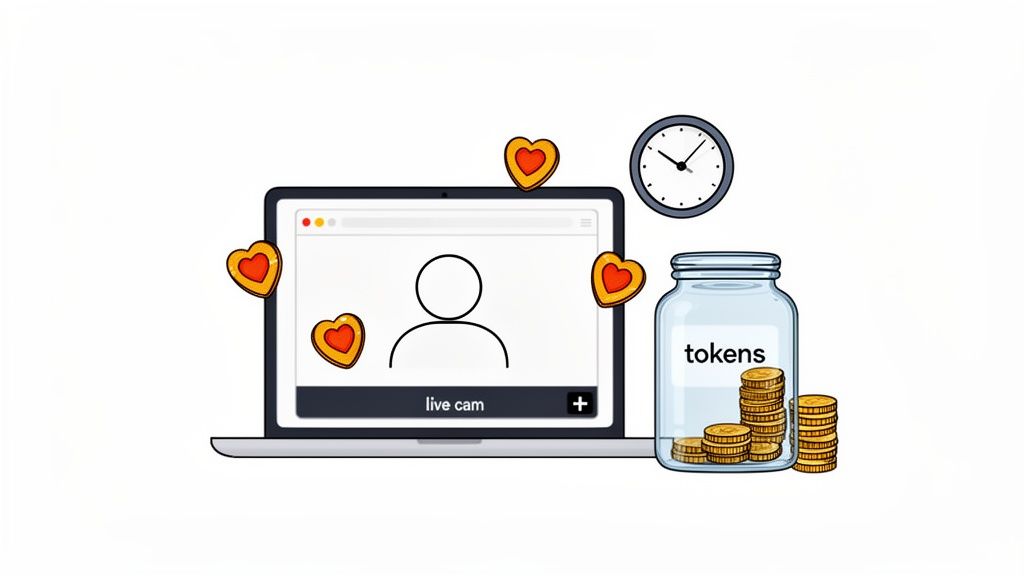
So, how does money get from a viewer's wallet into your bank account? The entire system runs on a virtual currency, usually called tokens. You'll also see them called 'credits' or 'coins', but the concept is identical. Viewers buy these tokens with real money, then spend them on the platform to interact with performers.
It’s like buying chips at a casino. You exchange cash for a stack of chips, which you then use at the tables. Cam sites operate on the same logic: viewers purchase a bundle of tokens and then use them to tip you, pay for a private show, or unlock specific content.
As a model, you accumulate these tokens in your platform account. Once you hit the site's minimum payout threshold, you can request a cash-out. The platform handles the payment processing, takes its cut for providing the tech and audience, and converts your share into real money – pounds, euros, or dollars.
Key Earning Concepts
This core cycle—viewer buys tokens, viewer spends tokens on you, you cash out tokens—is the engine powering all earnings. It's a direct transaction between you and your audience, with the platform acting as the essential (and expensive) middleman.
Here's how that plays out in practice:
- Tokens: The universal currency of most platforms. A viewer might buy 100 tokens for around £10.
- Tipping: The simplest way for a viewer to show appreciation or get noticed. They can send a few tokens in the public chat to say thanks, make a request, or just stand out from the noise.
- Private Shows: Often the biggest earner. A viewer pays a per-minute rate, say 30 tokens per minute, for an exclusive, one-on-one video chat.
This system creates a direct, powerful link between your performance and your pay. Unlike a 9-to-5, your income isn’t tied to the hours you clock in but to the connection and value you build with your audience in real-time.
At its heart, every income-generating action is initiated by a viewer consciously deciding to spend their tokens on you. Getting your head around this dynamic is the first, most crucial step to understanding how to build a sustainable income.
Decoding Your Earnings: From Tokens to Take-Home Pay
So, how does the money actually find its way into your bank account? If your camming business is a car, that financial loop is the engine. Now, let's look at the individual gears. Getting paid isn't a one-size-fits-all deal; it’s about creating a menu of options that appeals to different viewers and their spending habits.
The best way to think about it is like a digital 'à la carte' menu. Some people are happy just to hang out in your free public chat, while others are willing to pay a premium for a personal, one-on-one connection. The most successful creators learn how to cater to both.
The Foundation: Public Tips and Tokens
The lifeblood of most public streams is tipping. It’s the most common way viewers interact financially in a busy chat room. A viewer sends you a certain number of tokens, often with a message attached, right there for everyone to see.
But why do people tip? It usually boils down to a few core motivations:
- Simple Appreciation: They genuinely enjoy your stream and want to show support.
- Getting Your Attention: In a chat with hundreds of users, a tip is the fastest way to make their username pop.
- Making Requests: Many models have a 'tip menu' on display, where specific token amounts correspond to specific actions, from a dance to controlling a remote-controlled toy.
This system transforms a passive broadcast into an interactive experience. You'll often see creators set a token goal – that visual progress bar that fills up as tips roll in. When the goal is hit, maybe you’ll do a special show, change an outfit, or whatever the audience voted for. It gamifies the experience and encourages everyone to chip in.
Private Shows: The Big-Ticket Item
While public tips create buzz and keep the energy high, private shows are frequently where the real money is made. This is a one-on-one session where a viewer pays a set per-minute rate to have you all to themselves.
Think of it as the VIP service. The viewer gets your complete, undivided attention, away from the prying eyes of the public chat. In return, you earn a much higher rate per minute than you could from casual tipping. The dynamic shifts entirely—it’s less about performing for a crowd and more about creating an exclusive, personal experience for one individual.
The numbers back this up. A significant 33% of webcam models earn more from private shows than from all their public stream viewers combined. It's a stark reminder of how critical that exclusive, premium content is for your bottom line.
This model helps build deeper connections and often creates loyal, repeat customers who value that direct interaction. For many top earners, mastering the art of the private show is what elevates camming from a side hustle into a full-time, lucrative career.
Diversifying Your Income Streams
Relying solely on public tips or private shows is a bit of a gamble. The smartest models know that multiple income streams are key. This strategy creates a far more stable and predictable income, smoothing out the natural peaks and troughs of live streaming.
Here are a few other common ways to earn:
- Pay-Per-View (PPV) Content: This is about selling pre-recorded videos or photo sets. Viewers can buy this content directly from your profile, meaning you can make money even when you’re offline.
- Fan Club Subscriptions: Much like Patreon, this lets your most loyal fans pay a monthly fee for special perks. This could be anything from behind-the-scenes content and a private group chat to discounts on other services.
- Third-Party Wishlists: Once established, you can use approved services like WishTender, a wishlist platform built for creators. It allows fans to safely contribute towards specific goals or buy you gifts without either party sharing personal info.
Building a varied income portfolio is incredibly common. In fact, 42% of models report having multiple income sources, blending live performances with content sales to create a robust business. If you want to get into the nitty-gritty of how the platforms handle all this, our guide on how webcam sites work takes a closer look at the operational side of things. At the end of the day, you don't want to put all your eggs in one basket; you want a whole portfolio of earning opportunities.
Understanding The Platform's Cut and Your Payouts
Seeing that pile of tokens grow is a great feeling, but it's only half the story. The real work is turning that digital currency into actual cash in your bank account, and that means understanding a few non-negotiable truths. The first is that the platform you're on isn't just a free stage – it's your business partner.
And like any business partner, it takes a cut.
This is usually called the platform fee or commission. Think of it as paying rent for a prime high-street shop. The platform provides the virtual storefront, the marketing that brings in traffic, the tech to process payments from all over the world, and the immense server power needed for live streaming. In exchange for all that, they take a percentage of your earnings.
This is fundamental to understanding how cam models get paid, because what you earn and what you take home are two very different numbers.
The Maths Behind Your Take-Home Pay
The percentage platforms take varies, but it often lands somewhere between 30% and 50%. It is crucial to read the terms and conditions of any site you're considering, as this figure directly impacts your bottom line.
Let's break it down with a simple, real-world example:
- You have a great session and earn 2,000 tokens.
- On this platform, each token is worth £0.05 to you, making your gross earnings £100.
- The platform has a 40% commission rate.
- This means they'll take 40% of that £100, which is £40.
- Your net payout – the money that's actually yours – is £60.
This basic calculation is the most important piece of financial admin you'll do. Always get into the habit of thinking in terms of your net earnings, not just the token count on screen. This is a business, and knowing your profit margin is everything. To see how this fits into the bigger picture, you can learn more about how cam platforms make money in our dedicated guide.
This flowchart shows the basic journey from a viewer's wallet to your earnings, highlighting the different ways money comes in.
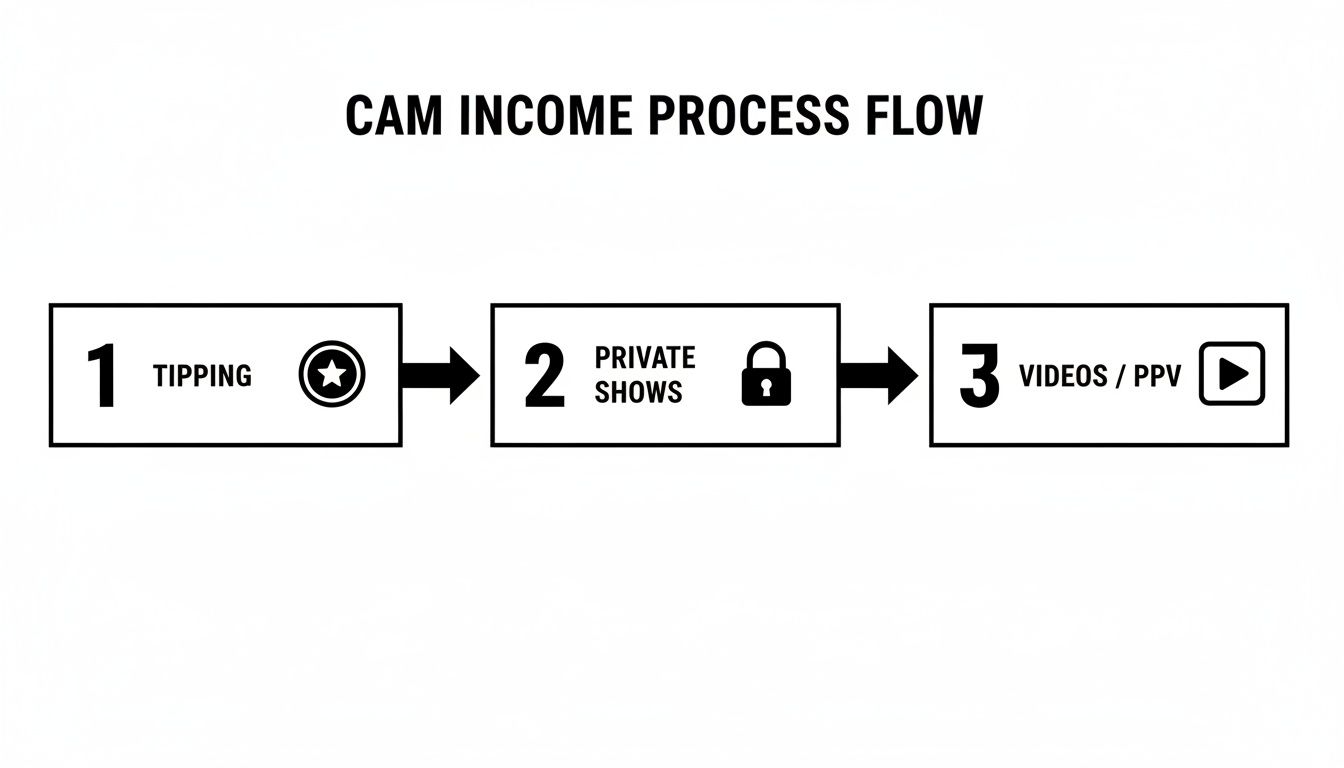
As you can see, income from various sources like tips and private shows all flows into your account, and that's where the platform fee is applied before you see the final figure.
Cashing Out Your Earnings
Once the platform has taken its share, the rest is yours to withdraw. But you can't just pull out a tenner whenever you feel like it. Platforms have structures in place to keep the process organised and secure.
Try to think of the platform's cut not as money you're losing, but as the cost of doing business. You're paying for access to a global audience, secure payment processing, and technical infrastructure that would be impossible to set up on your own.
Every platform will have a minimum withdrawal threshold. This is the smallest amount you need to have earned before you can request a payout. It could be as low as £20 or as high as £100, depending on the site and the payout method you choose.
You also need to think about timing. Payouts are never instant. Most sites process them on a set schedule—weekly, fortnightly, or monthly. Even after the platform sends your money, it can still take a few business days to actually land in your account. It's vital to plan your finances around these schedules instead of expecting on-demand cash.
Choosing Your Payout Method Securely
Alright, you’ve put in the hours, your token balance is looking healthy, and now it’s time for the best part: getting paid. But moving that money from the platform to your own pocket isn't just a simple click. It's probably the most critical financial decision you'll make, directly impacting your privacy and security.
Getting this right is non-negotiable. You need a reliable, discreet method that fits your life. For UK creators, there are a few established options, and each has its own pros and cons. The path you choose determines how your income shows up on paper and, crucially, who sees those transactions.
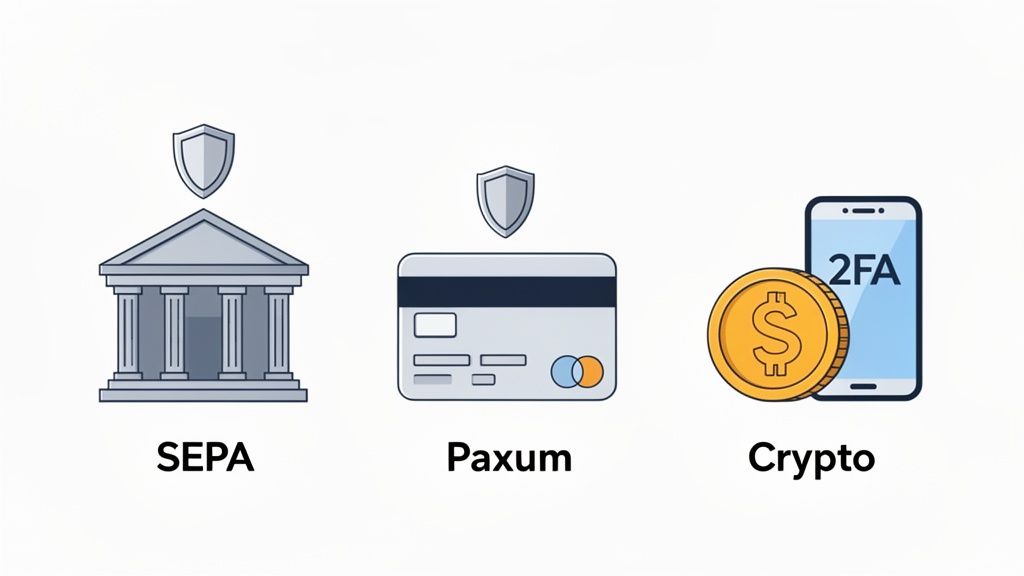
Direct Bank Transfers (SEPA)
For many, the most straightforward option is a direct bank transfer, often through the SEPA (Single Euro Payments Area) network. It’s familiar, easy to set up, and feels like getting paid from any other job. You simply provide your bank details, and the platform wires your earnings to your account.
But there's a catch: privacy. The transaction will appear on your bank statement with a descriptor from the payment company or the platform itself. If that's your personal current account that you use for groceries and bills, it creates a paper trail connecting your cam work to your daily life. Not always ideal.
This is precisely why most experienced models open a separate business account from day one. It builds a clean firewall between your personal finances and your business income, making everything from budgeting to tax returns infinitely simpler.
Third-Party Payment Processors
This is where things get more professional and a lot more private. Services like Paxum or Cosmo Payment are industry standards for a good reason: they act as a buffer.
Think of a third-party processor as a financial middleman. The cam site pays them, and then they pay you. This simple extra step adds a powerful layer of privacy, as your personal bank statement will show a transaction from the processor (e.g., "Paxum"), not the cam platform itself.
These services are built for the digital creator economy. They understand the need for discretion and often come with features like prepaid debit cards, letting you spend your earnings without ever moving the money to your main bank account. They do charge fees, but for many creators, it's a small price to pay for that peace of mind.
Cryptocurrency Payouts
For the more tech-savvy, some platforms offer payouts in cryptocurrencies like Bitcoin or Ethereum. This method offers the highest level of potential anonymity, as transactions exist on a decentralised blockchain instead of being tied directly to your name and address.
Be warned, though: this path is not for the faint-hearted. Crypto is famously volatile, meaning the value of your payout could plummet between when it’s sent and when you convert it back to pounds. It also demands a solid understanding of crypto wallets, exchanges, and security. One wrong move, and your funds can be lost forever. It’s a high-risk, high-privacy option best left to those who truly know what they’re doing.
Comparing Common Payout Methods
Choosing the right method is a balancing act between speed, privacy, and convenience. The table below breaks down the key differences to help you decide what works for your situation.
| Method | Typical Speed | Privacy Level | Key Consideration |
|---|---|---|---|
| Direct Bank Transfer (SEPA) | 2-5 business days | Low | Creates a direct link on your bank statement. Best used with a business account. |
| Third-Party Processor | 1-3 business days | High | Acts as a discreet buffer between the site and your bank, but involves fees. |
| Cryptocurrency | Varies (minutes to hours) | Very High | Extremely volatile and technically complex. Only for experienced users. |
Ultimately, the best choice depends on your personal comfort level with privacy, technology, and financial management.
Your Payment Security Checklist
No matter which method you pick, keeping your financial information locked down is paramount. Payout delays and security problems are a nightmare, so a little prep goes a long way. For a deeper look at common issues, our guide on how to avoid payout delays on cam sites is essential reading.
Here’s a quick checklist to keep your earnings safe:
- Use a Separate Bank Account: Never mix your cam income with your personal funds. A dedicated business account is your best friend for privacy and organisation.
- Enable Two-Factor Authentication (2FA): Switch this on for everything—the cam platform, your payment processor, your crypto wallet. It's the single most effective barrier against someone getting into your accounts.
- Check Statement Descriptors: Before you choose a payout method, find out what the transaction will actually say on your bank statement. You don't want any surprises.
- Keep Meticulous Records: You are running a business. Track every single payout, including the date, amount, and platform. You'll thank yourself come tax time.
Managing Your Finances Like a Pro
Right, let’s talk about the part that separates the hobbyists from the professionals. Earning the money is the fun bit; keeping it, managing it, and making it work for you is the real job. This is where you have to think like a business owner, because that’s exactly what you are in the eyes of HMRC.
The less-glamorous side of camming is all financial admin. We’re talking spreadsheets, receipts, and getting your head around your legal obligations. Nail this from day one, and you’ll save yourself a world of pain later and ensure you're protecting every penny you earn.
Getting to Grips with UK Taxes
Here’s the big one: in the UK, when you work as a cam model, you are self-employed. You are not an employee of the platform. This means you are entirely responsible for handling your own tax and National Insurance.
Your first step is to register with HMRC as a sole trader. Once you're set up, you'll need to file a Self Assessment tax return every year—this is a legal requirement, not an optional extra. On this return, you’ll declare all your income, which is then used to calculate how much tax and National Insurance you owe.
The golden rule is to set aside a portion of every single payout for your future tax bill. A good rule of thumb is to squirrel away at least 25-30% into a separate savings account that you never touch. This way, you’re never caught short when the tax deadline looms.
Ignoring your tax obligations is a recipe for disaster. HMRC can and will issue hefty penalties for late filing and unpaid tax, so treat this as the most critical part of your business from the start.
Tracking Income and Claiming Expenses
Being self-employed does have its perks. The best one is that you can deduct legitimate business expenses from your income, which lowers your taxable profit and thus the amount of tax you pay. But to do this, your record-keeping has to be immaculate.
Get into the habit of tracking every payout in a detailed spreadsheet. Note the date, the gross amount, the platform’s fee, and the final net amount that lands in your account. This is your essential income record.
At the same time, keep a close eye on everything you spend to run your business. Some common allowable expenses for a cam model include:
- Equipment: Laptops, webcams, lighting rigs, and microphones.
- Internet and Utilities: A percentage of your home internet and electricity bills can usually be claimed.
- Outfits and Props: Lingerie, costumes, and any other items you buy specifically for your streams.
- Subscriptions: Software you use for editing, streaming, or business organisation.
- Accountancy Fees: If you hire an accountant to help with your tax return, their fee is a deductible expense.
Keep every single receipt, either as a physical copy or a digital scan. Without proof of purchase, you can't claim the expense. This simple habit is what defines a professional approach to your finances.
The Unavoidable Risk of Chargebacks
Now for a reality check. One of the biggest financial headaches you can face is the dreaded chargeback. This happens when a customer disputes a payment with their bank, often claiming it was fraudulent or unauthorised. The bank reverses the transaction, and the money is clawed back from the platform.
When a chargeback happens, the platform loses money. To protect their bottom line, they will almost always pass that loss on to you by deducting the equivalent amount from your earnings. It can feel incredibly unfair, especially when you’ve delivered the service, but it’s a standard risk of doing business in this industry.
To manage this, platforms use a holdback period. They’ll often hold a small percentage of your earnings for a set time (typically 60-90 days) to cover any potential chargebacks that pop up later. It’s frustrating, but it’s a necessary evil to ensure the platform remains financially stable. You can’t avoid chargebacks completely, but knowing they exist helps you manage your financial expectations.
What You Can Realistically Expect to Earn
Let's have a straight talk about the money. It's easy to get dazzled by stories of top earners, but the reality for most creators is a broad spectrum. This isn't a lottery; your income is a direct result of the strategy, effort, and business acumen you bring to the table.
The simple truth is that your earnings are tied to time and consistency. Someone streaming a couple of hours a week will see a very different bank balance than someone treating this as their full-time career. It's a business built on showing up.
The Real Factors Behind Your Pay Cheque
Getting online is just step one. Several key factors determine how much you can make, and it’s about so much more than just your appearance.
Your ability to build a genuine community is everything. People come back for the person and the experience you create, not just a silent broadcast. Finding your niche also plays a huge part. You can build a smaller but much more loyal (and generous) audience by catering to a specific interest, rather than trying to be everything to everyone.
At the end of the day, this is an entertainment and service business. Your potential to earn is directly linked to your knack for building relationships, maintaining a reliable schedule, and giving viewers something they feel is worth paying for.
A Look at the Numbers
So, what do the figures actually look like? The potential earnings for webcam models vary wildly. For instance, some data shows an average model in the United States working 18 hours per week earns around $4,470 per month.
However, creators who commit to a more full-time schedule of 40 hours per week or more often see a significant jump, with averages climbing to $11,250 per month. The link is clear: more dedicated hours on screen tend to bring in a much higher income. You can dig deeper into these earnings statistics and the factors behind them.
Of course, these are just averages. The top 1% can report annual incomes well into six figures, while someone just starting out might make a modest amount while they find their footing and build a following. The main thing to remember is that income isn't guaranteed—it's earned. Your pay reflects the time, skill, and consistency you pour into your work, just like any other self-employed career.
Your Top Questions About Cam Model Payments, Answered
Let's clear the air and tackle some of the most common questions—and a few myths—about how the money side of camming really works.
How Often Can I Get Paid?
This comes down to the platform you choose. Don't expect to cash out instantly after every stream; most sites operate on a fixed schedule, like weekly or bi-weekly.
There's also usually a minimum amount you need to earn before you can request a payout, often around £50. This means you can't just withdraw a few quid whenever you fancy. It's a proper business transaction, not a cash machine, so it pays to plan your finances around their schedule.
Do I Have To Show My Face To Make Money?
Absolutely not. While plenty of top earners build their brand around showing their face, it’s not a deal-breaker. Many successful models make a great living without ever revealing their full identity.
They get creative with masks, clever camera angles, or by focusing on other aspects of their performance. Success is about the unique vibe you create and the connection you build with viewers, not just one part of your appearance. For some fans, the mystery is part of the appeal.
Are My Payments Anonymous?
This depends entirely on how you set things up. If you link your personal bank account directly, the payment from the platform will show up on your statement, leaving a very clear paper trail.
For more privacy, most experienced models use a third-party payment service like Paxum. The cam site pays them, and they pay you. This adds a layer of discretion, so your bank statement just shows a payment from the processor, not the cam platform's name.
What Percentage Does The Platform Usually Take?
This is a big one. The platform's cut, or commission, varies but typically lands somewhere between 30% and 50%. This fee is how they cover their own costs—marketing to bring in viewers, processing global payments, site maintenance, moderation, and support.
Before you commit to a platform, always dig into their terms and conditions to find this number. It directly affects how much of your hard-earned money you actually get to keep.