
Let's cut right to the chase: watching cams is never truly anonymous. If you’re picturing yourself in an invisible digital cloak, a better image is a crowded room where the bouncers, the bar staff, and the CCTV all know you're there. Even if you're just browsing as a guest without an account, the platform and your internet provider are logging data. Complete privacy is, frankly, a myth.
The Myth of True Anonymity on Cam Sites
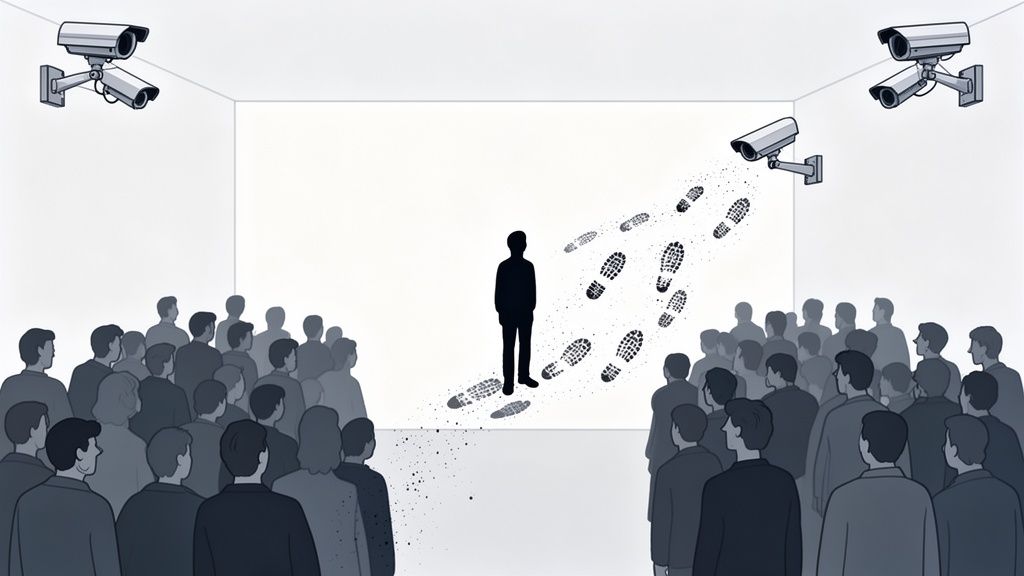
The idea that you can dive into adult streams without leaving a single trace is one of the internet's oldest and most stubborn fantasies. The reality is that every click, every stream, every chat message contributes to your ‘digital footprint’—a unique trail of data left by your device, your connection, and your browser.
Think of it like walking on a sandy beach. No matter how you try to cover your steps, you're still leaving impressions. Your IP address is the unique tread of your shoes, browser cookies are the grains of sand that cling to them, and your payment details are your name written boldly in the wet sand for all to see.
Why Perfect Anonymity Is a Pipe Dream
True anonymity would mean nobody—not the cam site, not your Internet Service Provider (ISP), not any third party—could ever connect your online activity back to you. On modern, interactive websites, especially ones that handle financial transactions, this is practically impossible to achieve.
Here’s the reality check:
- Platform Logging is Standard Practice: Cam sites, just like any other online service, log data. They have to for security, to troubleshoot problems, and for legal reasons. They record IP addresses to ban troublesome users and analyse behaviour to make their platform better.
- Payments Create a Paper Trail: The second you spend money, you forge a direct link between your online alias and your real-world identity. A credit card transaction is a clear, documented, and often permanent connection.
- Legal and Regulatory Hurdles: In the UK, platforms have serious legal duties. These often include strict age verification checks, which by their very nature require some form of identifiable information to prove you're an adult.
The key thing to understand is that online privacy isn't a simple on/off switch; it’s a spectrum. You are never completely invisible, but you can definitely control how visible you are.
The point of this guide isn't to scare you off. It’s about setting realistic expectations and equipping you with the knowledge to make smart choices. Once you understand what data you’re leaving behind, you can take practical steps to protect your identity and enjoy these platforms on your own terms. A strong, practical level of privacy is well within your grasp.
What Cam Platforms Actually Know About You
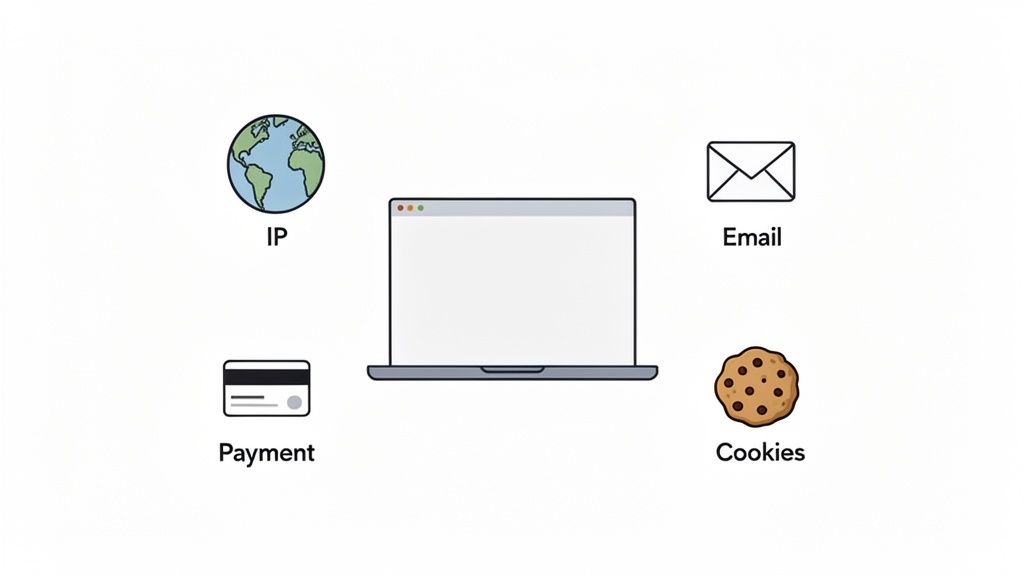
So, if 100% anonymity is out the window, what are you actually giving away? Every time you land on a cam site, you’re leaving a trail of digital breadcrumbs. This isn't some shady back-end operation; it's simply how the modern internet is built, especially for sites that handle user accounts, payments, and security.
Getting a handle on what's being logged is the first real step toward managing your online footprint. Let's break down the key bits of information these platforms are collecting.
Your Digital Postcode: The IP Address
Your IP (Internet Protocol) address is a unique number that identifies your connection to the internet. Think of it as the digital version of your home's postcode. Every single website you visit, cam platforms included, logs this address automatically.
It's not just for snooping. Platforms need it for practical reasons:
- Geographic Targeting: To serve you content relevant to your country or show you models who speak your language.
- Security: To identify and block users who are breaking the rules or trying to commit fraud.
- Analytics: To get a broad picture of where their audience is coming from.
While an IP address won't reveal your name and exact street, it does point to your general area (like your city) and identifies your Internet Service Provider (ISP). It's the most fundamental piece of the puzzle connecting your online session to your real-world internet connection.
The Paper Trail of Payments
This is the big one. The second you decide to tip a model or buy a token package, you create a hard, undeniable link between your viewing habits and your real-world financial identity.
Using your personal credit card, debit card, or a linked PayPal account immediately shares your real name and billing address with the payment processor and, in many cases, with the cam site itself.
This financial transaction is the single most common way viewers accidentally de-anonymise themselves. No VPN or clever username can erase a payment made with a card that has your legal name on it.
This data is essential for the platform to prevent fraud and stay compliant with financial regulations. But it also means that in the event of a data breach or a legal inquiry, your viewing history could be tied directly to you through those payment records.
Account Details and Browsing Habits
When you sign up, you’re obviously handing over information. Even if you use a completely made-up name, the email address you register with is a key identifier. If that email is your personal or work address, you've just created a bridge between your cam activity and other parts of your life.
On top of that, platforms use cookies—tiny files stored on your browser—to track what you do on their site. They're keeping an eye on things like:
- Which models you watch the most.
- How long you spend on the site per visit.
- Your tipping history and spending patterns.
This isn't malicious; it's mostly to personalise your experience by recommending performers you might like and making logging in easier. If you're curious about the nuts and bolts, you can learn more about how webcam sites work and the technology they use. Still, it's worth remembering that every click and every preference adds another layer to the digital profile the site has on you.
How You Give Yourself Away
A site’s privacy policy tells you what they promise to do, but it can’t protect you from yourself. The hard truth is that the biggest risk to your privacy isn't some elite hacker or a nosy platform. It's usually your own habits. Simple, everyday missteps can dismantle your anonymity far quicker than any complex cyber-attack.
Think of it like this: the platform might build a solid privacy fence, but that doesn't help much if you leave the gate wide open. Let’s break down the most common ways viewers accidentally give themselves away.
Common Anonymity Fails:
- Using a Personal or Work Email: The most direct link possible. Always use a separate, anonymous "burner" email for any adult platform.
Dave.Jones1985@gmail.comis a terrible idea. - Recycling Usernames: If you use the same handle on a cam site that you do on Twitter, Reddit, or a gaming forum, you're practically wearing a name tag. Anyone with basic googling skills can connect the dots.
- Casual Chat Oversharing: It's surprisingly easy to let slip details about your job, your city, or even your favourite local pub in a chat. This is a goldmine for anyone looking to doxx you.
- Unsecured Wi-Fi: Watching cams on public Wi-Fi at a café or airport is a huge gamble. These networks are notoriously unsecured, making it child's play for someone on the same network to snoop on your activity.
Data breaches are another unfortunate reality. A determined attacker could steal a platform's user database, which might contain usernames, email addresses, and payment details. While sites invest heavily in security, no system is ever 100% bulletproof. Taking a moment to explore a site’s security features and understanding how cam platforms moderate content can give you a better feel for their commitment to keeping users safe.
The UK live streaming market was valued at USD 5.5 billion in 2023 and is projected to explode, meaning more user data is being collected than ever. You can read more on Grand View Research's market analysis.
A Practical Toolkit for Safer Cam Viewing
Knowing what’s being tracked is one thing; doing something about it is another. If you've decided a bit of practical privacy is worth the effort, it’s time to assemble your toolkit. This isn't about becoming some off-grid cyber-ninja; it's about making smart, deliberate choices to reduce your digital footprint where it counts.
Think of it as a series of trade-offs. More privacy often means a little less convenience or a slightly higher cost, but the peace of mind can be well worth it. You don't have to do everything, but implementing even one or two of these steps will significantly improve your anonymity.
The following flowchart illustrates the key decision points where your privacy is most at risk—your account setup, payment method, and network connection.
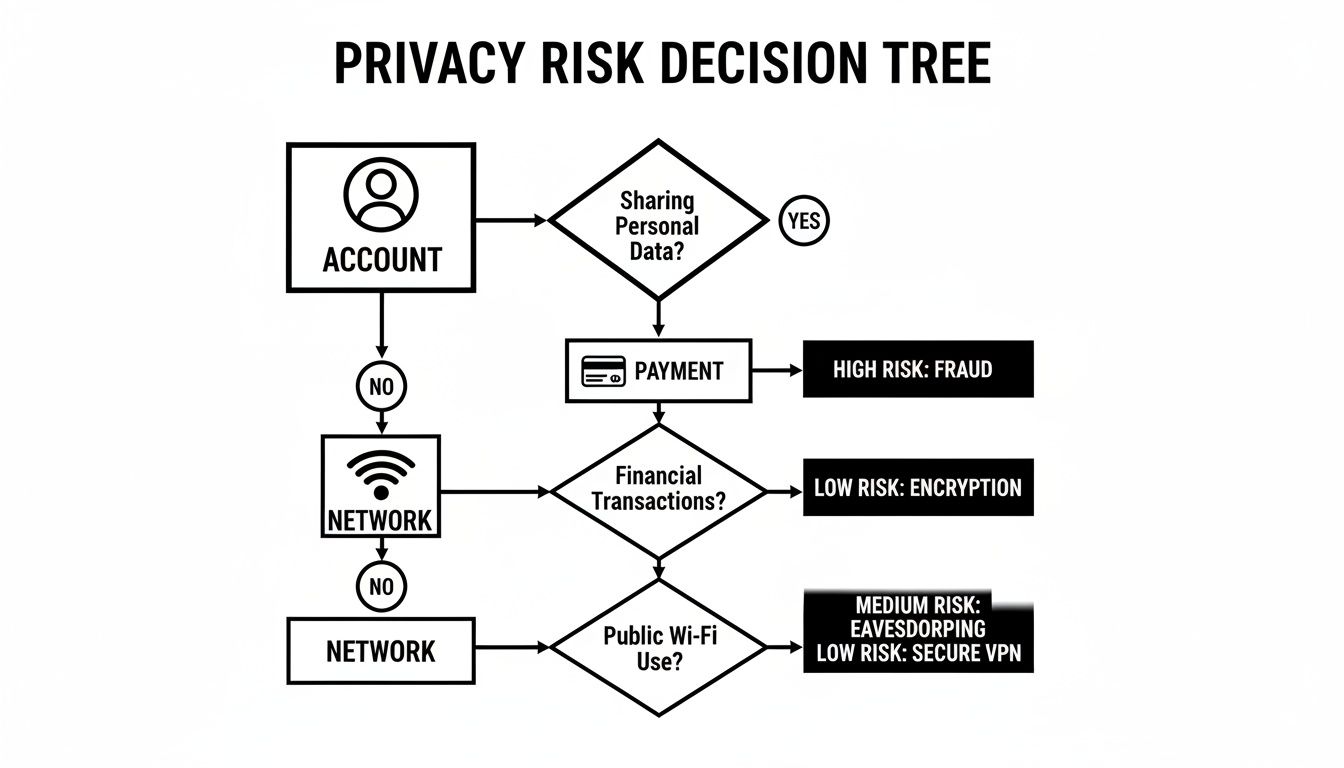
As you can see, your payment method is often the most direct link to your real identity, while your network connection is your first line of defence.
Step 1: Use a Reputable VPN
A Virtual Private Network (VPN) is your foundational tool. It routes your internet traffic through an encrypted server, effectively masking your real IP address from the cam site. To the platform, it looks like you’re connecting from the VPN server's location, not your living room.
This single step prevents the platform, and even your own Internet Service Provider (ISP), from linking your activity directly to your home network. It’s the digital equivalent of drawing the curtains.
Be sure to choose a paid, no-logs VPN service. "Free" VPNs often make their money by selling your browsing data, which completely defeats the purpose. A few pounds a month is a small price for breaking that initial link between the site and your IP.
Step 2: Create a Burner Identity
This is a non-negotiable step for anyone serious about privacy. Before you even think about signing up for a site, create a completely separate, anonymous identity.
- Burner Email: Set up a new email address with a privacy-respecting provider like ProtonMail. Don't use your name, date of birth, or any recognisable information in the email address itself.
- Unique Username: Create a username you have never used anywhere else. Don't use your name, nickname, or anything that could be traced back to your social media or other online profiles.
FootieFan_Dave82is a terrible choice;GreyCatWalkingis much better.
This simple act of separation ensures that even if the platform's database is compromised, the leaked information doesn't lead back to your personal or professional life. The growing UK webcam market, expected to reach USD 704.4 million by 2035, highlights the sheer volume of user data being stored, making such precautions more vital than ever. You can learn more about the market trends and security concerns that come with this growth.
Step 3: Choose Your Payments Wisely
Your payment method is the final and most crucial link in the privacy chain. A credit card transaction with your real name will undo all the good work of a VPN and burner email.
- Best for Privacy: Prepaid gift cards (like Visa or Mastercard gift cards) bought with cash are the gold standard. They carry no personal information.
- Good Alternative: Some privacy-focused cryptocurrencies can be effective, but they come with a steep learning curve and market volatility.
- Avoid at All Costs: Your personal credit/debit card or a PayPal account linked to your bank. These offer zero payment anonymity.
Each of these tools plays a different role in protecting your privacy. Here’s a quick breakdown to help you decide which ones fit your needs.
Comparing Privacy Tools: Strengths and Weaknesses
| Tool | Primary Function | Best For | Things to Consider |
|---|---|---|---|
| VPN | Hides your real IP address from the site and your activity from your ISP. | Everyone. This is the foundational first step for basic network privacy. | Choose a paid, no-logs service. Free VPNs are often a privacy risk themselves. |
| Burner Email | Separates your cam account from your real-world identity. | Anyone creating an account. Essential for preventing database leaks from affecting you. | Use a privacy-focused provider. Avoid using any personal details in the email or password. |
| Prepaid Gift Cards | Decouples your payment from your personal financial information. | Maximum payment anonymity. The closest you can get to using cash online. | Requires buying them in person with cash to be truly anonymous. Some sites may not accept them. |
| Cryptocurrency | Provides a degree of payment anonymity, depending on the coin used. | Tech-savvy users who understand how crypto transactions work. | Not all coins are private. The process can be complex and the value is volatile. |
No single tool is a magic bullet, but they work best when layered together. A VPN + a burner identity + an anonymous payment method = multiple layers of separation between your online activity and your real life.
This layered approach lets you confidently answer the question "is watching cams anonymous?" with a "no, but I've made mine as private as it gets."
Navigating UK Laws and Platform Rules
Alright, let's talk about the rules of the road. While using privacy tools is a savvy move, it’s crucial to understand they aren’t a magic shield against legal or platform-level consequences. Knowing the landscape helps you engage confidently and respectfully.
First, the big question: is watching adult webcams legal in the UK? For consenting adults, the answer is a straightforward yes. The law isn't concerned with adults privately viewing adult content. However, this legality comes with serious responsibilities, particularly for the platforms themselves.
The Non-Negotiable Reality of Age Verification
You'll notice that any reputable platform has a robust age verification system in place. This isn't just a box-ticking exercise; it's a firm legal requirement designed to protect minors and a cornerstone of their right to operate in the UK.
For you, this means you might need to provide some form of identification to access certain content or features. While this can feel at odds with the goal of anonymity, it's an absolutely mandatory safeguard. For a closer look at the mechanics, you can explore the specifics of how an age verification app functions and why it’s so critical.
This reality is underscored by just how integrated live streaming has become across all age groups. With research from a UK Live Streaming Survey showing that 24% of UK children have broadcast a live stream themselves, the need for stringent access controls on adult platforms becomes crystal clear.
Playing by the House Rules
Beyond national laws, every single platform has its own set of rules—the Terms of Service (TOS). Think of this as the contract you agree to when you sign up. Violating it can get you banned, no matter how anonymous you think you are.
Your VPN and burner email are irrelevant if you break the rules. Platforms can and will ban your account, IP address, and payment details, effectively blacklisting you from their service.
Common violations that will get you kicked out in a heartbeat include:
- Harassment or Abuse: Being disrespectful, threatening, or abusive towards performers or other users is a zero-tolerance issue.
- Chargebacks: Trying to reverse a legitimate payment through your bank is viewed as fraud by most platforms. They will ban you instantly and may dispute it.
- Illegal Activity: Using the site to solicit or engage in any illegal acts will not only get you banned but could also bring the law to your door.
Ultimately, your privacy toolkit is for protecting your identity from outside threats, not for breaking the rules from the inside. Respect the performers, follow the platform’s guidelines, and you can navigate this world safely and without any drama.
Got Questions? We’ve Got Answers (FAQ)
To wrap things up, let's go through some of the most common questions people have about staying private on cam sites. Think of this as a quick reference guide to clear up any lingering doubts and bust a few myths.
Can a cam model see my real name or where I live?
In short, no. A performer can only see the username you've picked for that site. They have absolutely no access to your IP address, your email, or any other personal details.
The only way they'd know who you are is if you accidentally reveal it yourself. This could be by using your real name in your username, or simply by sharing too much personal information in the chat. The platform's administrators and security teams are the only ones with access to sensitive data, and that’s strictly for things like processing payments and keeping the site secure.
Is using a VPN enough to make me completely anonymous?
A VPN is a fantastic first step, but it’s not a magic invisibility cloak. It does an excellent job of hiding your real IP address from the cam site, but that's where its protection ends. If you log into an account tied to your personal email or use your own credit card while on that VPN, you've just created a clear trail right back to yourself.
True privacy on these platforms is all about a layered approach. Think of the VPN as layer one. On top of that, you need a separate burner email, a unique username that's used nowhere else, and a private payment method.
What's the most private way to pay for tokens?
Using your normal credit or debit card is easily the least private option, as it creates a direct, named financial record. For much stronger privacy, your best bets are:
- Prepaid Gift Cards: A prepaid Visa or Mastercard, bought with cash from a physical shop, is pretty much the gold standard here. It has no personal information attached to it and is almost impossible to trace back to you.
- Cryptocurrency: While some privacy-focused cryptocurrencies are an option, they can be complicated to use and their value can swing wildly. It's a viable route, but not for the faint of heart.
For most people, a prepaid gift card strikes the perfect balance between solid privacy and practical, real-world convenience.
Does my Internet Provider know I'm on a cam site?
Yes, your Internet Service Provider (ISP) can see the domain names of the websites you connect to. However, if the site uses HTTPS encryption (and virtually all reputable ones do), they can't see the specific pages you look at, what's in the streams, or what you're typing in chat.
This is where a VPN really shines. When you switch it on, it encrypts your entire connection. All your ISP can see is that you're connected to a VPN server—the actual websites you visit beyond that point are completely hidden from them.