

At its core, an age verification app is simply the digital bouncer that websites and platforms use to make sure you are who you say you are, age-wise. It’s a serious step up from the old, trust-based systems, using modern tech like ID scans or AI-powered selfie analysis to confirm a user's age before they can access certain content.
The End of the 'I Am 18' Tick-Box Era
Let's be honest, the classic "I am over 18" tick-box was never much of a barrier. It was more of a polite suggestion, a digital equivalent of a quick nod and a wink. For years, that was the standard for accessing adult content, but that era of flimsy self-declaration is officially over, especially if you're operating in the UK.
The game changed dramatically with the introduction of serious new regulations. Suddenly, relying on a simple checkbox wasn't just lazy; it became legally and financially toxic for platforms. This shift is forcing everyone in the creator economy, from the largest streaming sites down to individual streamers, to get serious about robust age verification.
The New Rules of the Game
The main driver behind this change is the UK's Online Safety Act, a hefty piece of legislation that finally put some real teeth into age assurance. Ofcom, the UK's communications regulator, now has the power to enforce these rules, and they aren't messing around. This isn't about choice anymore; it's about compliance.
Platforms that fail to implement 'highly effective' age checks face colossal fines that could genuinely threaten their entire business. This pressure from the top trickles down, meaning creators and users alike have to navigate a new reality of ID scans and biometric checks. For a deeper dive, check out our ongoing coverage of the Online Safety Act.
The transition wasn't just theoretical. When the Online Safety Act's rules fully kicked in, the impact was immediate and massive. It served as a stark warning to the entire industry that the age of casual access was well and truly finished.
The consequences became clear almost overnight. For instance, when the rules were enforced on July 25, 2025, the effect on major adult sites was staggering. Data from Similarweb showed that Pornhub, a dominant player, saw its UK traffic plummet by a massive 47% in just two weeks. That's over a million daily visitors who were either unwilling or unable to complete the new, stricter checks. As you can read about the sharp drop in traffic, it proved that robust verification was a market-altering force.
How These Age Verification Apps Actually Work
So, what’s really going on when a site or app asks you to prove your age? We're way past simple tick-boxes now. Think of an age verification app as a digital bouncer, and it has a few different ways of checking your ID before letting you past the virtual velvet rope.
It's a huge shift. The old 'I am 18' button was based on the honour system. Then, laws like the UK's Online Safety Act came along, forcing platforms to take it seriously. Now, technology provides the tools to actually do the checking.
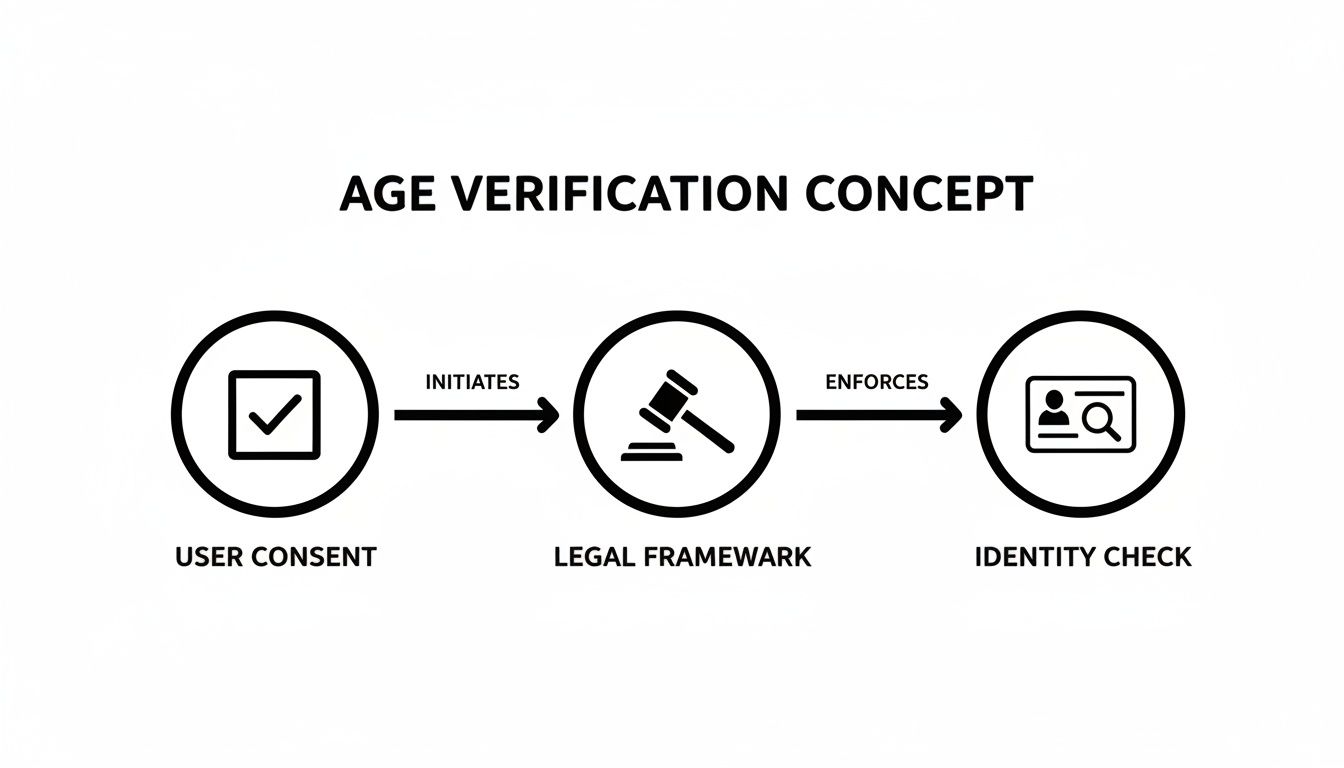
This process isn't just a pop-up anymore; it's a structured, legally-mandated identity check. Let's pull back the curtain and look at the main technologies making this happen.
Comparing Age Verification Methods
Here’s a quick look at the pros and cons of the most common age verification technologies used by online platforms.
| Verification Method | How It Works | Pros | Cons |
|---|---|---|---|
| Document Scanning | You upload a photo of an official ID (driving licence, passport). Software scans it for details and security features. | Very accurate with a legitimate ID. It's a familiar process for many people from online banking. | Shares a lot of sensitive data (name, address, ID number), raising major privacy risks if not handled correctly. |
| Biometric Age Estimation | An AI analyses a live photo or video of your face to estimate your age based on facial features. | Privacy-friendly as it doesn't need your name or personal details. Quick and easy for the user. | Accuracy can vary based on ethnicity, gender, and lighting. Not 100% foolproof and may have biases. |
| Database Checks | Your personal details (name, address, DoB) are cross-referenced against trusted sources like credit files or the electoral roll. | Less intrusive than sharing an ID document. Quick if you have a digital footprint. | Doesn't work for everyone, especially younger adults or those without credit history. |
As you can see, there’s no single perfect solution. Each method comes with its own set of trade-offs between privacy, accuracy, and accessibility.
Document Scanning: The Digital Bouncer
The most traditional method is document scanning. It’s pretty straightforward: you’re prompted to take a photo of your government-issued ID, like a driving licence or passport.
From there, sophisticated software takes over. It uses Optical Character Recognition (OCR) to read your date of birth and then double-checks the document’s security features—think holograms, watermarks, and specific fonts—to make sure it’s not a fake. Often, you’ll also be asked for a quick selfie to match your face to the photo on the ID. This is called a ‘liveness check’, and it proves you’re a real person holding your own document right now.
The big downside? You’re handing over a treasure trove of personal data. Your full name, address, date of birth, and ID number are all on that document, which creates significant privacy concerns if the service handling it gets breached.
Biometric Age Estimation: The AI Guessing Game
This is where things feel a bit more sci-fi. Biometric age estimation uses artificial intelligence to analyse a photo or a short video of your face and, well, guess your age. The AI has been trained on millions of faces to recognise the subtle markers of aging, like skin texture and facial geometry.
The clever part is that it doesn’t need to know who you are, just how old you look. The system simply gives a "yes" or "no" answer on whether you appear to be over the required age, like 18 or 25.
This method is a fantastic example of ‘data minimisation’ in action. The goal is to verify age with the least amount of personal data possible—ideally, without ever needing your name or date of birth.
But this tech isn’t perfect. Studies have shown that its accuracy can be affected by things like ethnicity, gender, and even poor lighting, which introduces the risk of bias. It's an impressive tool, but it's not infallible.
Database Checks: The Cross-Reference
The third key method is all about cross-referencing. The system takes the details you provide—name, address, date of birth—and checks them against existing, trusted databases. These could be credit reference agencies, mobile phone contract records, or even the UK electoral roll.
If the information you entered matches what's in an official database, you're verified. This approach is much less intrusive than uploading your passport but relies on you having a digital footprint to check against. For younger adults or anyone without a credit history, this method can easily fall short.
Ultimately, each of these technologies has its place. The best platforms often offer a choice or use a combination of methods to meet their legal obligations while giving users some control. Understanding what’s happening behind the screen is the first step to navigating these new digital gatekeepers safely.
Understanding the UK Online Safety Act
If you’re a creator or viewer in the UK, you’ve probably noticed your favourite platforms suddenly asking for ID at the door. The reason for this sudden shift is one piece of legislation: the Online Safety Act. Forget the dense legal jargon; all you really need to know is that this law has completely rewired how adult content is policed online in the UK.
At its core, the Act handed the reins to Ofcom, the body that used to just regulate TV and radio. They've essentially become the new sheriff of the internet, with a mandate to ensure platforms keep minors away from adult content. This isn't just a friendly suggestion—it's a legal duty with some seriously steep penalties.
The New Sheriff and Their Very Big Stick
Under these rules, a simple "I am over 18" tick-box just doesn't cut it anymore. Platforms are now required to implement what the law calls 'highly effective' age assurance measures. In plain English, that means using technology that can actually verify someone's age, like document scanning or biometric facial analysis, rather than just taking their word for it.
The real driver behind this change is, of course, money. The financial consequences for platforms that don't comply are severe enough to make anyone sit up and pay attention.
- Massive Fines: Ofcom has the power to issue fines of up to £18 million.
- Global Turnover Penalty: Even more terrifying for big companies, the fine can be as high as 10% of their total global turnover. For a major platform, that could easily run into the billions.
This huge financial risk is exactly why you're seeing verification prompts everywhere. It’s not that these companies suddenly developed a conscience; it's that the cost of ignoring the law is now far too high.
How the Act Changes Your Daily Reality
The Online Safety Act 2023 officially became law on 26 October 2023, but its teeth really started to show when Ofcom began enforcing the rules. This forced a massive, industry-wide shift away from the flimsy, trust-based systems of the past. To give you an idea of the scale of this change, a 2023 Statista survey found that before the Act, a whopping 75% of age checks were just simple tick-boxes. As you can see from the pre-law verification data, robust methods like biometrics were used in only 7% of cases.
For creators, this means verification is no longer optional. It's become a fundamental requirement for getting paid and keeping your account in good standing. Platforms have to demonstrate to Ofcom that they know who is on their site, and that responsibility now falls on everyone—creators and viewers alike.
The core change is this: the burden of proof has shifted. Previously, it was up to the user to be honest. Now, it's up to the platform to prove the user's age, creating a new and complex tightrope of privacy, security, and compliance that everyone has to walk.
This new legal reality is directly shaping your online experience. It might feel like just another hassle, but it’s the direct result of regulators finally getting serious about age assurance. It’s a system that’s closely tied to other platform policies, so understanding the full picture is crucial. For more context, it’s worth reading up on how cam platforms moderate content under these new pressures. The Online Safety Act has brought the era of plausible deniability to a close, pushing the entire creator economy into a new, more heavily scrutinised reality.
The Privacy Risk of Handing Over Your Data
So, we’ve established that proving your age online is becoming standard practice. But before you click 'upload', let’s stop and ask the most important question: when you use one of these age verification apps, who are you actually giving your data to, and can you really trust them?
This is the big, unspoken risk in the world of online age checks. You're not just showing your ID to the cam site or streaming platform you want to use. More often than not, you're handing it over to a third-party company you’ve probably never even heard of.
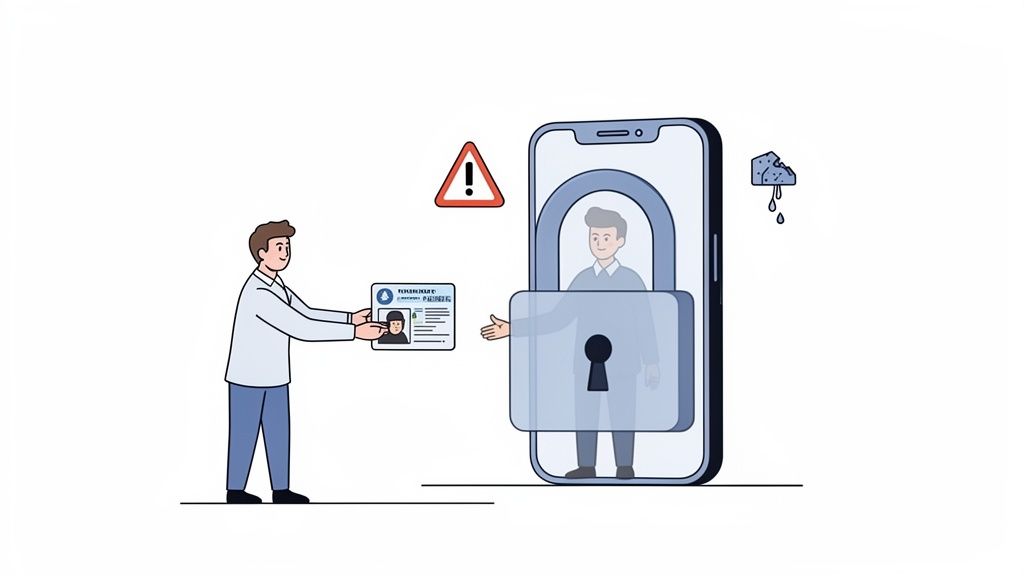
When you hand over a copy of your passport or a biometric scan of your face to a specialised verification provider, you’re trusting them completely. If that provider has flimsy security or a dodgy privacy policy, your most sensitive information is suddenly vulnerable.
The nightmare scenarios are exactly what you'd imagine. A data breach could expose not just your name and date of birth but could also link your real-world identity to your online activities. This isn't just some abstract worry; it's a direct threat of identity theft, blackmail, or harassment.
Understanding Data Minimisation
The key principle that separates a trustworthy verification service from a sketchy one is data minimisation. It's a surprisingly simple idea: a service should only ask for the absolute bare minimum of information it needs to do its job, and nothing more.
Think about it. If the only goal is to confirm you're over 18, the service doesn't need your exact address or the long number on your driving licence. A good system using facial age estimation, for instance, just needs a quick look at your face. It doesn't need to store the image or tie it to your name. It just needs to give a "yes, this person looks over 18" and then immediately forget it ever saw you.
A reputable age verification app is designed to forget you. It confirms your age and then discards the personal data used to do so. A service that wants to hold onto your ID or biometric data indefinitely is a massive red flag.
This is precisely why it's so important to know what you're agreeing to. Before you upload anything, take a minute to find out who is handling your data and what their policy is on keeping it.
Spotting the Red Flags
Trying to figure this out can feel like reading legal jargon in the dark, but there are clear warning signs you can look for. Spotting them can save you a world of trouble down the line. All kinds of adult streaming platforms are now relying on these third-party systems, so knowing what to look for is essential.
Here are some of the biggest red flags to watch out for:
- Vague Privacy Policies: If you can't easily find or understand how your data will be used, stored, and deleted, that’s a bad sign. Legitimate companies are upfront and transparent about this.
- Excessive Data Requests: Is the app asking for way more info than it needs? For example, demanding access to your contacts or location data just to verify your age is completely unnecessary and highly suspicious.
- No Information on Data Deletion: The provider should clearly state how long they hold onto your data. Best practice is to delete it immediately after verification is complete.
- Poorly Designed Interface: While not a guarantee, a clunky, unprofessional-looking app or website can be a sign of a less-than-reputable operator who might be cutting corners on security.
At the end of the day, your personal data is a valuable asset. Handing it over to an unknown age verification app without doing your homework is a gamble. By choosing services that respect data minimisation and are transparent about their practices, you can meet these new requirements without putting your privacy on the line.
A Practical Checklist for Safe Verification
Alright, we've talked about the theory, but what does this all look like in practice? When that pop-up appears asking for your ID, it's easy to feel a bit on edge.
This is your practical, no-nonsense guide to getting through the age verification process without giving away too much information or losing your sanity. Whether you're a streamer trying to unlock payments or a viewer wanting to access content, the principles for staying safe are exactly the same. The goal is to tick the platform's box without handing over the keys to your digital life to a dodgy third-party service.
Think of it as a pre-flight check before sharing any personal information.
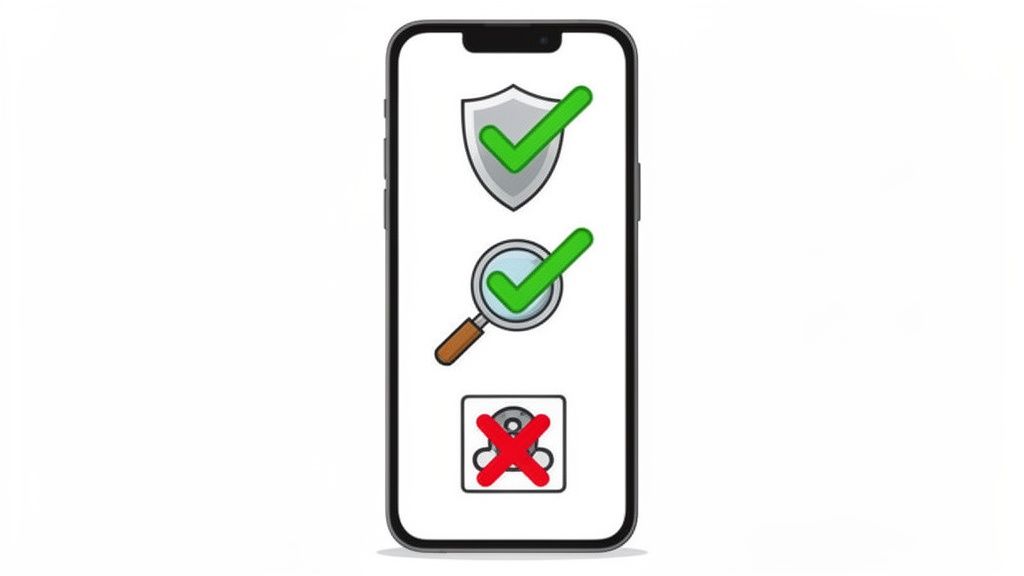
This whole process has become much more common, but many of us are still used to the old, less secure ways of doing things. It's a bigger shift than you might think. Before robust laws like the Online Safety Act came into force, the verification landscape was very different, as a 2023 Statista survey revealed.
UK Age Verification User Preferences (Pre-Online Safety Act)
The data below from a 2023 Statista survey shows how UK users most often encountered age verification before the new laws, highlighting the massive shift away from simple self-declaration.
| Verification Method Encountered | Percentage of Users (%) |
|---|---|
| Ticking a box (self-declaration) | 75% |
| Providing date of birth | 60% |
| Credit/debit card check | 24% |
| Submitting a photo of ID | 12% |
| Using a digital ID app (e.g., Yoti) | 10% |
| Facial age estimation (biometric scan) | 6-7% |
As you can see, a staggering 75% of users were most familiar with simply ticking a box. In stark contrast, advanced methods like facial age recognition were only seen by 6-7% of people. You can discover more insights about UK verification habits on techgdpr.com to see just how much things have changed.
Checklist for Creators Getting Verified
For creators, verification is often the final hurdle before you can monetise your content. Getting it wrong can mean payment delays or, worse, putting your real identity at risk.
- Confirm the Request is Legit: Before you upload anything, triple-check that the request is genuine. It should come directly from the platform’s official dashboard or a clearly named, reputable partner they’ve announced they're working with.
- Protect Your Document: When you're asked for an ID, use your phone to take a clear, well-lit photo. Never, ever send scans of your passport or driving licence over unsecured channels like email or DMs.
- Use Biometrics if Possible: If the platform offers facial age estimation, it’s often the best choice for privacy. This method confirms you're over a certain age without needing to store sensitive details like your name, address, or ID number.
- Secure Your Account Post-Verification: Once you're verified, keep a close eye on your account for any strange activity. Make sure you have two-factor authentication (2FA) enabled – it’s an absolute must.
Checklist for Users and Viewers
As a user, you’re in control. If a verification process feels sketchy, it probably is. Your priority is to access the content while exposing the absolute minimum amount of personal data.
- Check the URL: Is the verification page secure (does it start with
https?) Does the domain name look right, or is it a slightly misspelled version of the site you were on? Phishing scams love to use lookalike domains to trick you. - Deny Excessive Permissions: If an age verification app or browser extension suddenly asks for access to your contacts, location, or microphone, say no. There is no legitimate reason it would need that information.
- Skim the Privacy Policy: You don't need to read the entire novel. Just check the first couple of paragraphs to see who is collecting the data and if they mention deleting it right after verification. If it’s vague or confusing, that's a big red flag.
- Never, Ever Pay: Legitimate age verification for accessing content is a cost the platform covers, not you. Any site demanding a fee to prove your age is almost certainly a scam.
The bottom line is simple: a trustworthy verification process should feel professional, transparent, and focused. It should ask for one thing—proof of your age—and nothing more. Any service that tries to upsell you, harvest extra data, or create a false sense of urgency is not working in your best interests.
By approaching every verification request with a healthy dose of scepticism and following these practical steps, you can meet the new requirements while keeping your personal information exactly where it belongs: with you.
Got Questions About Age Verification? We’ve Got Answers.
Alright, let's tackle the big questions. The move to mandatory age checks has understandably kicked up a lot of dust, and if you’ve scrolled through any creator forums lately, you’ll have seen plenty of confusion and a fair bit of bad advice.
This section is here to cut through that noise. We’re going to walk through the practical, "what-if" scenarios you're most likely to face, giving you straight answers from people who understand how this technology works in the real world, not just in a policy document.
Can I Just Use a VPN to Get Around It?
This is easily the most common question we see, and the short answer is: no, not a chance. A VPN is a brilliant tool for masking your IP address and making it look like you’re browsing from another country, but its powers end there when it comes to this.
Modern age verification systems couldn’t care less about your location; they’re focused on your identity. When you’re scanning your driving licence or taking a biometric selfie, the system is cross-referencing a real-world credential. Your IP address is completely irrelevant to that process.
Thinking a VPN will bypass a proper age check is like trying to use a fake postcode to get into a pub that’s asking for your ID. The bouncer doesn't care where you say you live; they just want to see your face and your date of birth.
In fact, using a VPN can sometimes backfire. Some platforms might automatically flag an account that’s constantly hopping between different countries. That kind of activity can look suspicious, potentially triggering extra security checks or even a temporary account suspension. A VPN is a tool for privacy, not for pretending you’re older than you are.
What Happens If My Verification Fails?
It's a frustrating moment, but failing a verification check rarely means you’re instantly banned. It usually just means the automated system couldn't get a confident result on its first pass. This happens all the time for a few simple reasons.
Here’s what typically goes wrong and what you can expect to happen next:
- Poor Quality Submission: The number one culprit. A blurry photo of your ID, bad lighting casting a glare over the text, or a thumb covering your date of birth will almost always cause a failure. The software needs a crystal-clear image to work its magic.
- Document Problems: An expired ID is a guaranteed rejection. The system might also get confused if your selfie doesn't look much like the photo on your ID (we all change, but a drastic difference might require a human to step in).
- Technical Gremlins: Sometimes, it’s just technology being technology. Your internet connection might have dropped mid-upload, or the verification service itself had a momentary wobble.
If you fail, the platform will almost always let you try again. You'll usually be taken back to the start, often with some helpful tips on how to get a better result this time. If you fail a few times in a row, the case typically gets escalated to a human for a manual review, which might take 24-48 hours. It's a bit of a pain, but it’s definitely not the end of the line.
Do I Really Have to Do This on Every Single Site?
This is a massive headache for everyone. The thought of uploading your passport or driving licence to dozens of different websites, each using its own third-party verification partner, is a privacy nightmare waiting to happen. Thankfully, the industry knows this isn't sustainable and is starting to move towards a much smarter solution.
The concept gaining real momentum is the ‘reusable digital identity’. Imagine a secure wallet app on your phone that holds a verified proof of your age. Instead of going through the full ID scan process every single time, you'd simply authorise that app to send a "Yes, this person is over 18" confirmation to the site requesting it.
This approach is a huge leap forward for privacy. Your actual ID document is only processed once by a single, trusted provider. After that, you're just sharing a secure, cryptographic confirmation of your age, not your name, address, or document number.
While this isn't the standard everywhere just yet, it’s where things are heading. Big tech players are investing heavily in this kind of technology because it makes the whole process faster, safer, and far less repetitive for all of us.
Is My Data Actually Deleted After I'm Verified?
This is the multi-million-pound question, and the answer hinges entirely on the provider you’re dealing with. Any reputable age verification app or service operates on a strict principle of data minimisation. Their entire business model should be built around touching your sensitive data for the shortest time possible.
Here's how a trustworthy provider handles your information:
- Temporary Processing: Your ID and selfie data are held in a secure, encrypted state only for the few seconds it takes to run the checks.
- Immediate Deletion: As soon as the result—"verified" or "not verified"—is sent back to the platform, your personal data should be permanently wiped from their active servers.
- Transparent Policies: They will have a clear, easy-to-find privacy policy that explicitly states their data retention and deletion practices in plain English.
The danger comes from less scrupulous outfits that might hang onto your data for longer than necessary, massively increasing the risk of it being exposed in a breach. This is why it’s absolutely vital to read the privacy policy before you upload a single thing. If a company is vague about how and when they delete your data, don't trust them with it. Simple as that.
2 thoughts on “A Creator’s Guide to Any Age Verification App in the UK”