

It’s a creator’s worst nightmare. You’re all set to log in for your stream, but instead of your dashboard, you’re hit with a cold, impersonal message: “Account Suspended.” Just like that, your profile, your community, and your income have vanished into thin air.
The panic that sets in is completely understandable, but it's crucial to realise this is almost always a business decision, not a personal attack. Understanding why platforms act so decisively is the first step toward safeguarding your career.
Think of these platforms less as creative partners and more as giant corporations managing enormous financial risk. Their most critical relationship isn't with you, the creator; it's with their payment processors—the big names like Visa and Mastercard. Anything that could possibly jeopardise that relationship, whether it's a whisper of illegal activity or a sudden spike in customer chargebacks, gets shut down instantly.
A ban isn't malice. It's the platform’s immune system kicking in to neutralise what it perceives as a threat to its financial stability.
The Four Main Triggers for an Account Ban
So, what are these threats? While every platform has its own detailed rulebook, nearly every sudden account ban boils down to one of four core problems. It's often not about breaking an obvious rule, but about tripping an automated system that's been designed to spot trouble before it starts costing the company money.
Here’s a quick breakdown of the main reasons a creator might find their account suddenly locked.
| Violation Category | What It Means in Plain English | Common Examples |
|---|---|---|
| 1. Policy Violations | Breaking the platform's published rules, often accidentally. | Copyrighted music in the background, visible brand logos, using a misleading stream tag, mentioning off-platform payment methods. |
| 2. Financial & Fraud Flags | Anything that makes you look like a financial risk. | A user paying with a stolen card, a spike in chargebacks from your viewers, mismatched bank and profile details. |
| 3. Safety & Legal Issues | Actions that could expose the platform to legal trouble. | Underage appearance (even if you're over 18), unverified third parties in your stream, content that strays into illegal categories. |
| 4. Technical & Verification Problems | Outdated or incorrect account information that triggers an automated hold. | Expired ID on file, failing an age or identity re-verification check, using a VPN that flags a security alert. |
These categories cover the vast majority of cases. The key takeaway is that an algorithm, not a person, likely made the initial decision.
A common myth is that a human moderator watched your stream and decided they didn't like what they saw. The reality is that your ban was probably triggered by an automated system flagging a potential risk, long before a person ever got involved.
This distinction is vital. It means your account wasn't shut down because of a subjective opinion, but because a specific data point—a keyword, a payment flag, a piece of music—tripped an alarm. Knowing this is the first step to figuring out how to fix it.
Navigating the Unwritten Rules of Camming
Most creators have a good handle on the big no-nos. The obvious, illegal stuff is usually clear-cut and easy to avoid. But here’s the thing: most account bans don't happen because of those major violations. They happen in the murky grey areas of a platform's Terms of Service (ToS) – those massive legal documents that, let's be honest, almost nobody reads from start to finish.
The ban hammer rarely falls for something you knew was wrong. It’s far more likely to come down for a subtle, unwritten rule or a platform’s unique take on its own policies. The most successful creators have learned to read between the lines and think like a corporate moderator.
The Devil Is Always in the Details
It’s a common mistake to think, "If it's legal in the UK, it must be fine to stream." That assumption can get you into a world of trouble. Cam sites are private companies, not public squares. Their rules are often much stricter than the law because they're protecting their brand, their payment processors, and their advertisers.
This is where you find those tricky grey areas. Certain themes, props, or even conversations that are perfectly legal might be flagged as "commercially undesirable" by the platform. They see it as a potential risk, and in their world, risk is bad for business.
Here are a few common tripwires I’ve seen time and time again:
- Unverified Locations: Decided to stream from a hotel for a change of scenery? Or maybe a friend's place? If you haven't officially notified and verified that new location with the platform, you could be heading for an immediate suspension. To them, an unrecognised location is a huge security and compliance red flag.
- Surprise Guests: Bringing another person onto your stream, even for a second, is a major violation if they haven't gone through the platform's full ID and age verification process. This applies to everyone – your partner, a friend popping in to say hi, or even the delivery driver who accidentally walks into the background.
- Misleading Tags: It can be tempting to use popular but slightly inaccurate tags to get more eyes on your stream. Platforms are really cracking down on this. If you’ve tagged your stream with #asmr but your content is something else entirely, you can be flagged for "tag misuse," which is a clear policy breach.
The Violations You Don't See Coming
It gets even trickier. Many account bans have nothing to do with what you're doing on camera. These are often the most frustrating bans because they feel completely out of the blue.
Think about an inside joke you have with your regular viewers. It might involve a word that, unbeknownst to you, is on the platform's secret internal list of forbidden terms. You're using it innocently, but the automated bot scanning your chat logs doesn't get the joke. It just sees a keyword, flags your account, and moves on.
Your stream isn't just being watched by fans; it's being constantly scanned by algorithms. These bots are programmed to hunt for patterns—copyrighted music, brand logos on your t-shirt, specific words in your chat—and they are the first line of moderation that often gets things wrong.
A perfect real-world example is simply playing your favourite playlist in the background. If one of those songs is owned by a major record label, their automated copyright systems will likely ping the platform, which then passes that problem down to you as a warning or even a ban. To get a better handle on this, you can learn more about how cam platforms moderate content and what their systems look for.
Your Off-Platform Life Matters, Too
Here’s a big one that’s catching more people out: platforms are now enforcing "off-platform conduct" clauses. In simple terms, this means what you do on your personal Twitter, Instagram, or TikTok can be used as a reason to ban your cam account.
If you're caught up in public drama, posting hateful content, or doing anything that might attract negative press, the platform can decide you've become a liability to their brand and simply cut you loose. They don't want their name dragged into any controversy.
They view your public social media as an extension of your presence on their site. It’s a sobering thought, but when you're a professional creator, you are always representing your brand—and by extension, the platforms you work on. Staying in the clear isn't just about what you do on stream anymore; it's about managing your entire digital footprint.
How Money and Paperwork Can Get You Banned
It’s natural to think that what you do on stream is everything. But from a platform's point of view, the real business isn't just content – it's the smooth, uninterrupted flow of money. Your stream is the vehicle, but finance is the engine.
That’s why some of the most abrupt and permanent account bans have nothing to do with what happens on camera. They’re all about the money, the paperwork, and the risk you represent.
To a big streaming site, a creator with a messy financial trail or questionable paperwork is a much bigger threat than someone who occasionally pushes the content rules. Why? Because dodgy money puts the platform’s relationship with its banks and payment processors on the line. If those partners get spooked, the entire business is in jeopardy.
The Payment Processor Is King
Every single time a viewer buys tokens or sends a tip, that money travels through a complex web of financial systems. Platforms don't handle cash directly; they rely on payment processors like Visa and Mastercard, along with other third-party gateways, to do the heavy lifting. These companies have their own very strict rules and are famously cautious, especially when adult content is involved.
A sudden jump in chargebacks is one of the biggest red flags. A chargeback happens when a user disputes a payment with their bank, which then yanks the money back. This costs the platform directly in fees and damages its standing with the processor.
If your account gets linked to a high number of chargebacks, the platform might ban you just to stop the bleeding. It doesn't even matter if it's not your fault, like if a user paid with a stolen credit card. You've become a financial liability.
This financial pressure is enormous and shapes a huge amount of platform policy. For UK creators, this is even more serious, thanks to the Financial Conduct Authority's strict regulations. Platforms have to follow tough anti-money laundering (AML) rules, so any account even hinted at being involved in suspicious transactions will be shut down fast.
The flowchart below gives you a clear picture of how quickly a simple payment problem can spiral into a major account risk.
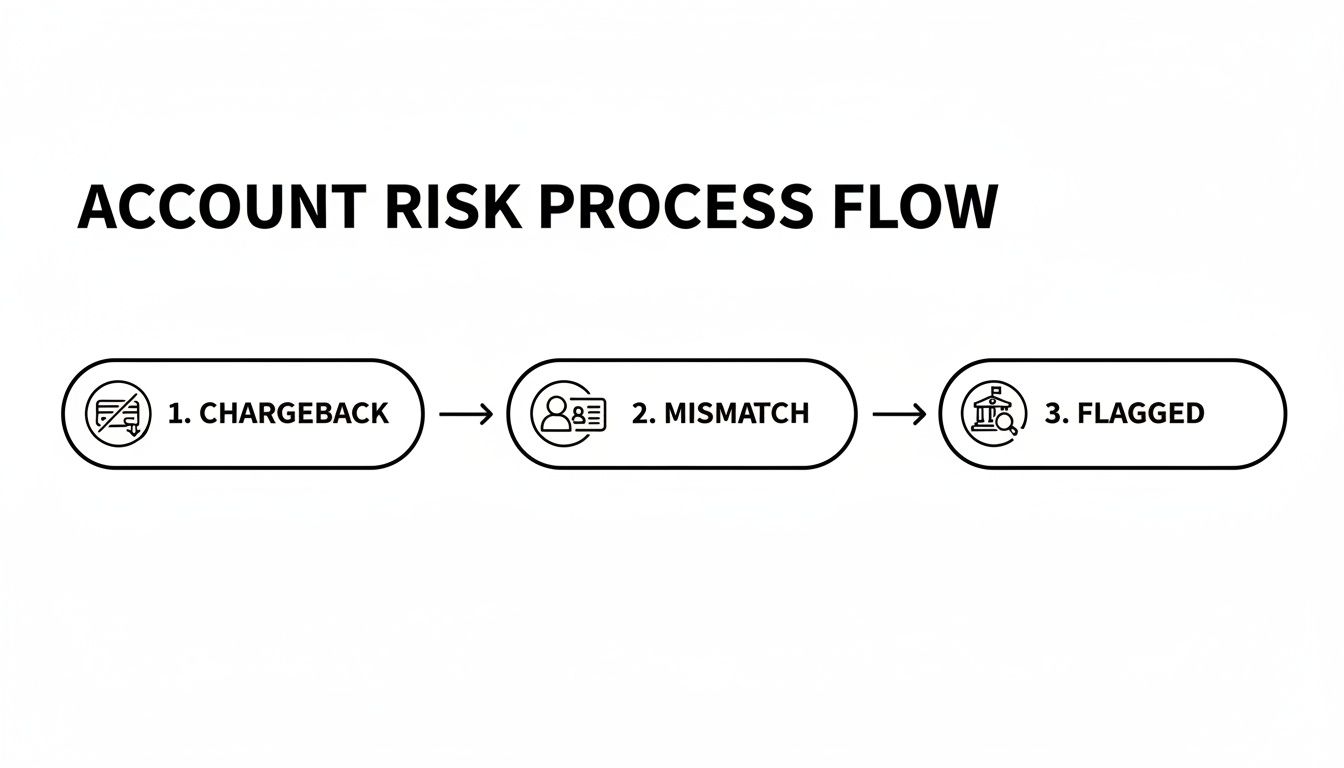
As you can see, a payment dispute can kick off a chain reaction, leading to a closer look at your verification documents and, before you know it, a flagged account.
When Your Paperwork Fails You
Before you can earn your first pound, you have to prove you are who you say you are. This isn't just a box-ticking exercise for the site; it's a legal requirement. It’s how they protect themselves from accusations of hosting underage models or facilitating fraud. Any little mistake or discrepancy in your paperwork can trigger an instant ban.
Here are some of the most common ways verification goes wrong:
- Expired ID: Sending in a passport or driving licence that's out of date is an automatic fail. No exceptions.
- Name Mismatches: The name on your government-issued ID must be an exact match for the name on your bank account and platform profile. No nicknames, no shortened versions.
- Poor Quality Scans: If the documents you upload are blurry, have glare, or are cut off, the system—and any person reviewing it—will reject them immediately.
- Failing Re-verification: From time to time, platforms will ask you to prove your identity again. Ignoring this request or failing the check will get your account suspended.
These aren't small administrative bumps in the road; they are fundamental checks that keep the platform compliant. To get a really good handle on this vital first step, take a look at our detailed guide on the UK cam site verification process. Getting this part right from the very beginning is absolutely essential if you want a stable, long-term career.
Understanding Your Biggest Threats: Bots and Reports
If you’re imagining a team of moderators glued to your stream, meticulously watching every second, you need a quick reality check. The first line of defence for any major platform isn't a person at all; it's an army of tireless, context-blind automated bots. These systems are the unseen force behind an enormous number of sudden account bans.
Think of these bots as digital bouncers with a very strict, very literal checklist. They aren't there to appreciate the nuance of your performance or understand your sense of humour. They are constantly scanning for specific triggers that violate the platform's Terms of Service (ToS)—everything from forbidden keywords typed in your chat to copyrighted music playing faintly in the background.
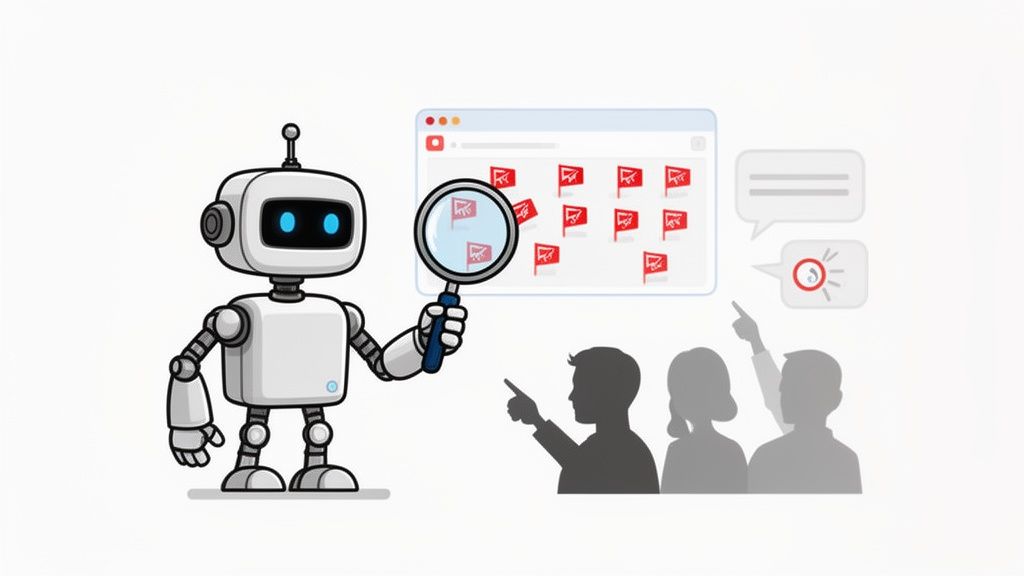
These systems are remarkably efficient but also incredibly clumsy. A bot can’t tell the difference between a brand logo on your t-shirt and an undeclared paid sponsorship, or a prop gun in a cosplay outfit and a real weapon. This complete lack of context is why so many creators get slapped with bewildering 'false positive' bans that need a human to step in and clean up the mess.
The Problem of Automated Moderation
Automated systems are responsible for a truly staggering volume of enforcement actions. Take a platform like OnlyFans, for instance, where over 35,865 creator accounts were removed in February 2025 alone through a mix of automated flags and manual reviews. With only 41% of new creator applications being approved each month, the scale of this digital gatekeeping is immense. For UK creators, this makes it absolutely crucial to stay compliant from day one. You can get a clearer sense of the scale by exploring the full platform statistics at ofstats.net.
So, what are these bots actually looking for? They're programmed to find very specific things:
- Visual Triggers: Brand logos, certain props, on-screen text, or even hand gestures that match patterns in their database of forbidden content.
- Audio Patterns: The system can identify copyrighted music clips, flag specific keywords spoken aloud, or recognise sounds associated with prohibited activities.
- Keyword Flags: Automated chat moderators scan for a long list of words and phrases related to illegal acts, taking payments off-platform, and other rule violations.
The bot doesn't care about your intent. It only cares about the data. If you use a forbidden word as part of an inside joke, the system flags it just the same as if you'd meant it maliciously. This is why you have to learn to create for two audiences at once: your fans and the algorithm.
When Users Weaponise the System
While bots are a constant, passive threat, the other major danger is far more active and malicious: user reports. Every platform has a reporting function that allows viewers to flag content they believe violates the rules. In theory, it’s a tool for community safety. In practice, it’s easily weaponised.
A 'report brigade' is when a group of users coordinate to mass-report a creator's stream, often for entirely fabricated reasons. They know that a sudden spike in reports for the same issue—like "underage user" or "hate speech"—will often trigger an automatic temporary suspension, even if the claims are completely baseless.
The platform’s system sees the sheer volume of flags and assumes there must be a serious problem, locking the account first and asking questions later. This tactic is often used by trolls, disgruntled viewers, or even rival creators simply to disrupt your business and get you offline.
To defend yourself, documenting everything is your best move. Keep records of your streams, save chat logs if you can, and take screenshots of any harassment. If you fall victim to a report brigade, this evidence will be your most powerful weapon in the appeals process. Learning to spot users who are trying to bait you into breaking a rule or who threaten to report you is the first step in proactively protecting your account from this kind of targeted attack.
How to Actually Win a Ban Appeal
So, the worst has happened. You’ve been banned. That initial gut-punch of panic and fury is completely normal, but letting it drive your next move is the fastest way to turn a temporary suspension into a permanent one. Forget the angry, all-caps emails. Winning a ban appeal isn’t about venting your frustration; it’s about treating the situation like a formal business dispute.
Your goal here is to make it as easy as possible for a real person in a support department to understand your case, look at the evidence, and reverse the decision. Think less like a spurned lover and more like a lawyer calmly building a case.
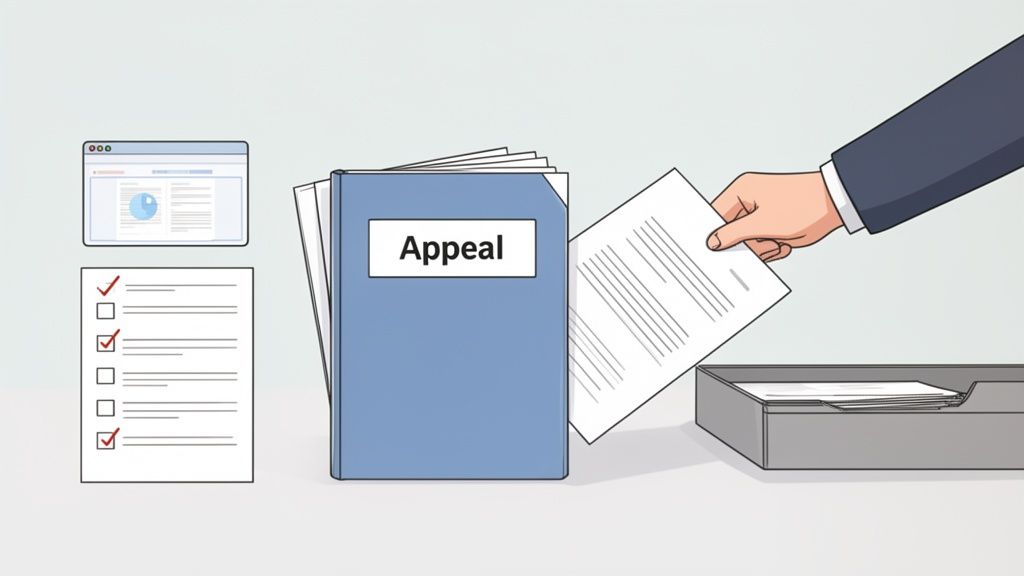
Step 1: Assemble Your Evidence
Before you even think about typing a single word, you need to gather your proof. Support agents deal with hundreds of emotional pleas a day; a clear, evidence-backed case will immediately make you stand out. Your memory of what happened simply isn't enough.
Here’s what you should be looking for:
- The Ban Notification: Take a clear screenshot of the email or on-site message that told you about the ban. Pay very close attention to the specific violation they mention.
- Chat Logs and Screenshots: If the ban was about a user interaction, screenshots of the chat are absolutely vital. This can prove you were being harassed or show that you were trying to de-escalate a tricky situation.
- Stream Recordings: If you record your streams (and you really should), find the recording from the time of the alleged violation. A video clip proving your innocence is the most powerful tool you have in your arsenal.
This evidence is the backbone of your appeal. Without it, you’re just another angry voice in their inbox.
Step 2: Write a Professional Appeal
Right, now it’s time to draft your message. The key is to be concise, polite, and completely factual. Remember, the person reading this probably wasn't responsible for the ban and is actually your best chance of getting it overturned.
Your appeal should follow a simple, clear structure:
- Identify Yourself: Start with your username and the email address linked to your account.
- State the Issue Clearly: "My account was suspended on [Date] for [Stated Reason from Ban Notification]."
- Politely Disagree: Briefly and calmly explain why you believe the ban was a mistake. If you think it was a bot error, say so.
- Present Your Evidence: Refer to the proof you’ve gathered. For example: "As you can see in the attached screenshot of my chat log, I was in the process of removing a problematic user who was violating the ToS."
- State Your Desired Outcome: "I am requesting a review of this suspension and the reinstatement of my account."
Crucial Tip: Never, ever threaten legal action, insult the support staff, or lie. Keep your appeal focused and professional. Emotion is your enemy here; clarity is your best friend.
Step 3: Understand What Not to Do
Your actions right after being banned are just as important as the appeal itself. One wrong move can get you permanently blacklisted, no matter how strong your case is.
The cardinal sin of a banned creator is ban evasion. Do not, under any circumstances, try to create a new account. Platforms track everything: your IP address, your device ID, your payment information, and even your digital fingerprint. A new account will be instantly linked to your banned one, and your temporary suspension will become a permanent, unappealable IP ban.
Patience is also critical. Support departments are often swamped and understaffed. Bombarding them with multiple angry follow-up emails every day will only get you flagged as a nuisance. Submit your appeal once, then wait. If you don't hear back within the timeframe they specify (often a week or more), a single, polite follow-up is acceptable.
Ultimately, winning an appeal requires strategy, not emotion. By providing clear evidence and communicating like a professional, you give yourself the best possible shot at getting back online where you belong.
Your Proactive Account Protection Checklist
Let's be honest, prevention is always better than cure. After going through all the reasons an account can get shut down, it’s easy to feel a bit on edge. But protecting your business isn't about paranoia; it's about being professional and putting a solid system in place.
Think of this checklist as a routine health check for your camming career. It turns all the advice we’ve covered into simple, actionable steps, helping you spot potential trouble long before it becomes a crisis.
Your Essential Security and Paperwork Audit
First things first, let's get the foundations sorted. If you get these basics wrong, even the most incredible content won't protect you. It might feel like boring admin, but this is the stuff that keeps your business afloat.
- Enable Two-Factor Authentication Everywhere: This is non-negotiable. Seriously. Switch it on for your streaming accounts, your email, and any payment platforms you use. No excuses.
- Keep Offline Backups: Get an encrypted USB stick or secure drive and store digital copies of your current, valid ID and any other verification documents. If a site suddenly asks you to re-verify, you'll have everything you need in seconds.
- Schedule a Bi-Annual ToS Review: Pop a reminder in your calendar for every six months to quickly scan the Terms of Service on your main platforms. Policies evolve, and ignorance is never an excuse a site will accept.
Proactive Content and Streaming Habits
This next bit is all about weaving good habits into your daily routine. Making a few small tweaks to how you stream can massively lower your risk of triggering an automated bot or dealing with malicious user reports.
Key Takeaway: Your best defence is treating your stream like a professional workspace. Document everything, control your environment, and never let anyone else dictate the terms of your broadcast.
- Use a Separate, Clean Device: If you can, dedicate a laptop or phone solely for streaming and handling your finances. This walls off your business from potential malware or software conflicts on your personal devices.
- Master Your Moderation Tools: Before you even think about going live, check that your keyword filters are up to date. If you expect a busy room, make sure you have at least one trusted human moderator ready to help out. Don't hesitate to block users who are giving you bad vibes from the get-go.
- Manage Difficult Users Professionally: When a user gets hostile or starts making threats, don't rise to it. Just block, report, and move on. Arguing is exactly the reaction they’re looking for and it just creates a messy chat log that could be twisted and used against you.
Staying on top of your admin and being mindful during your streams are the two most powerful things you can do to keep your account safe and sound. For a deeper dive into the financial side of things, check out our guide on how to avoid payout delays on cam sites.
Frequently Asked Questions About Webcam Account Bans
We’ve walked through the main reasons accounts get shut down, from automated flags to issues with your paperwork. But let's be honest, the real stress comes from the specific "what if" scenarios that keep you up at night. This final section is all about tackling those common questions and anxieties head-on.
Can I Get Banned for What Someone Else Says in My Chat?
Yes, you absolutely can. This is a massive stumbling block for many new creators. The platforms hold you, the broadcaster, 100% responsible for what happens in your channel. If your chat room turns into a cesspool of spam, hate speech, or talk about illegal activities and you just let it happen, the platform sees your silence as an endorsement.
This is exactly why having good keyword filters and a couple of trusted human moderators isn't just a nice-to-have – it's a core part of running your business. You have to be ready to mute, block, or kick out disruptive users the second they start causing trouble. Letting a toxic chat go unchecked is one of the fastest ways to get your account flagged for a violation you didn’t even commit yourself.
If I'm Banned on One Site, Will Other Sites Know?
For the most part, no. Competing platforms don't have a shared universal blacklist of banned creators. There's no secret database where they all compare notes on who they’ve removed. A ban for a content violation on one site won’t automatically stop you from signing up for another.
However, the reason for the ban might follow you. If you were banned for financial fraud or a high number of chargebacks, it's the payment processors (like Visa, Mastercard, or third-party payment gateways) that will flag you. Since every platform uses these same financial networks, a red flag from a payment company can make it incredibly difficult to get your accounts approved anywhere else.
Think of it this way: the webcam sites don't talk to each other, but the banks and payment systems they all rely on definitely do. A bad financial reputation is sticky.
How Can I Avoid Getting Flagged by Moderation Bots?
You can’t make yourself invisible to bots, but you can learn to stay off their radar. The trick is to start thinking like a machine that takes everything literally and has zero sense of context.
First, go and actually read the platform's list of forbidden words, topics, and images. Then, be meticulous about applying what you've learned:
- Cover Up Big Brand Logos: That cool top with a giant logo might get flagged by a bot as undeclared advertising.
- Kill Copyrighted Music: Even music playing faintly in the background can trigger an automatic copyright strike.
- Be Careful with Your Words: Use accurate stream tags and make sure any text on your screen doesn't include words from the platform's restricted list.
It's a bit like creating your show for two different audiences at the same time: your human fans who get the nuance, and the platform’s robot moderators who absolutely do not.
Is It True That Making a New Account After a Ban Gets You Blacklisted?
Yes, this is almost always true, and it’s the worst mistake you can possibly make. It's called ban evasion, and platforms treat it as a major offence. When they issue a ban, they aren't just blocking your username. They often log your IP address, the ID of the device you use, and your payment details.
The moment you try to create a new profile, their systems will almost certainly connect it back to your banned one, proving you're intentionally trying to get around their decision. This usually turns what might have been a temporary suspension into a permanent, non-negotiable IP ban. The only real way forward after a ban is to go through the official appeals process, no matter how slow or frustrating it feels.