
If you want to avoid payout delays on cam sites, remember this one golden rule: get your verification perfect on the first try. The second rule? Double-check every single digit and letter of your payment details. Most hold-ups aren't because the platform is being shady; they're the result of tiny, avoidable mistakes like a blurry ID photo, a typo in your bank details, or mismatched addresses.
The Real Reason Your Cam Payout Is Delayed
Let's get real about why your money gets stuck. It’s almost never some big, dramatic conspiracy. A delayed payout is usually the final domino to fall in a quiet chain reaction involving international banking laws, twitchy fraud detection bots, and the platform’s own rulebook. What you see as a simple transfer is actually a surprisingly complex journey.
Your earnings don’t just teleport from a fan’s wallet into your bank. They start on a viewer's credit card—often in a completely different country—then pass through payment processors, get held by the cam platform for a set time, and finally have to clear a gauntlet of security checks before they’re even sent your way. Each one of these steps is a potential tripwire.
From Viewer Tip to Your Bank Account
The path your money travels is littered with hurdles, all designed to stop fraud and meet strict financial regulations. This often means your payment is scrutinised by algorithms long before a human ever lays eyes on it. Something as simple as a typo in your payment info or an ID photo that’s just a little bit out of focus can be enough to trigger an automatic hold.
This flowchart shows the basic journey, highlighting the key stages where things can get gummed up.
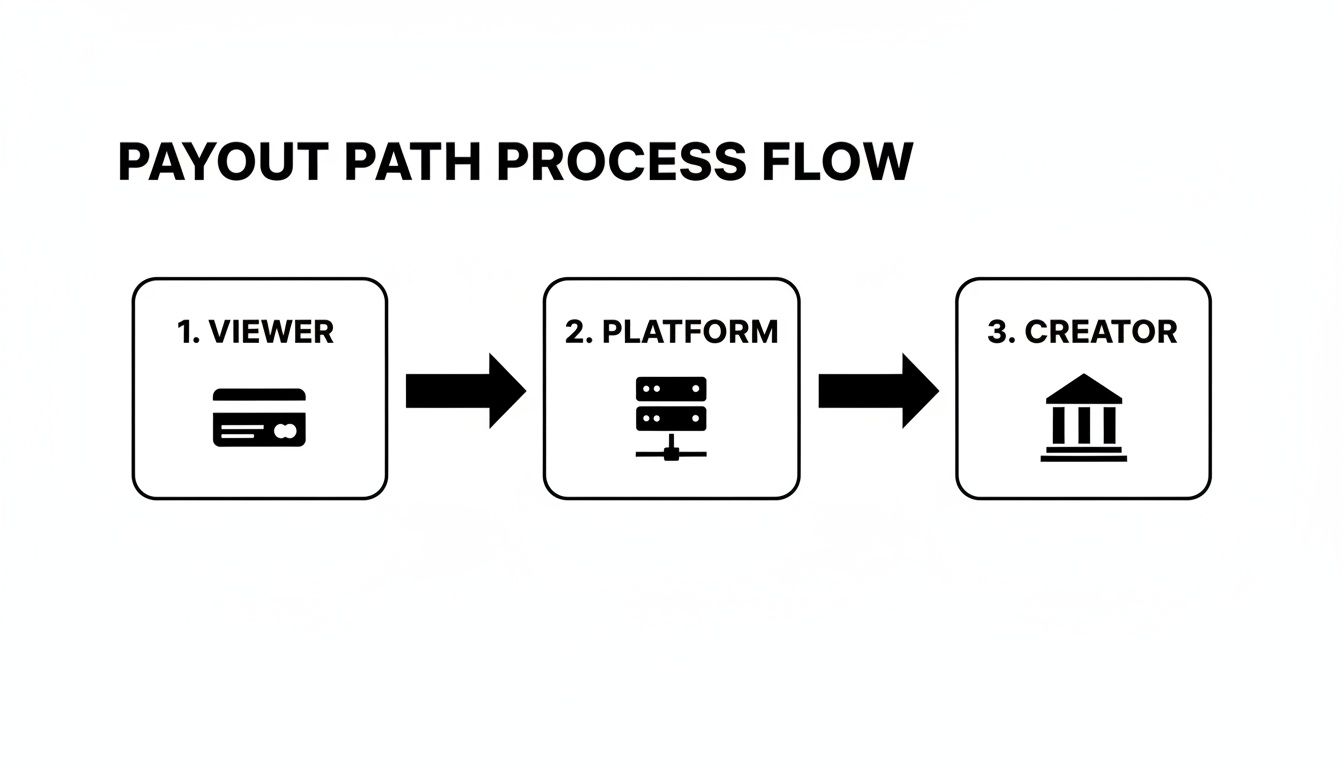
As you can see, the platform is the critical middleman, and its automated systems are where most of the friction happens.
Think of it like an international flight. Your money needs a valid passport (your verification documents), a correctly-named ticket (your payment details), and to pass through security (fraud checks). A problem at any checkpoint can ground the entire trip, turning what should be a two-day transfer into a week-long migraine.
Common Tripwires and Minor Oversights
The most frustrating thing? The biggest delays often come from the smallest mistakes. It’s completely understandable to focus on performing and earning, but that often means the admin side of things gets neglected until a problem pops up.
Here are a few classic scenarios I’ve seen time and time again:
- The Address Mismatch: Your driver's licence shows your old address, but the utility bill you uploaded has your new one. The system automatically flags this discrepancy, and your payout is frozen until someone can manually review it.
- The "Slightly" Expired ID: You uploaded your passport for verification six months ago, but it expired last week. The platform’s automated compliance sweep catches it and slaps an immediate hold on all your funds.
- The E-Wallet Typo: You mistype one single letter in your e-wallet email address. The payment gets sent into the digital ether, and it can take days—sometimes weeks—of back-and-forth with support to track it down and get it reissued.
The core takeaway is this: Platforms have no incentive to hold your money, but they are legally and financially on the hook to prevent fraud. Their systems are built to be overly cautious, so any tiny inconsistency can bring the whole process to a grinding halt.
Understanding this financial maze is the first, and most important, step to beating it. If you treat your account verification and payment setup with the same care and attention you put into a broadcast, you’ll sidestep the vast majority of these infuriating delays.
Master Your Verification on the First Try
Let's get straight to it: almost every single initial payout delay I've seen starts right here, at the verification stage. This isn't just a bit of admin; it's the platform’s way of navigating a massive pile of legal requirements, from age verification to anti-money laundering laws. Getting this right the first time is, without a doubt, the most powerful thing you can do to avoid payout delays on cam sites.
Think of it like getting past the bouncer at an exclusive club. If your ID looks even slightly off, you're not getting in. It’s the same deal here, but the bouncer is an automated system scanning for any reason to reject your application.
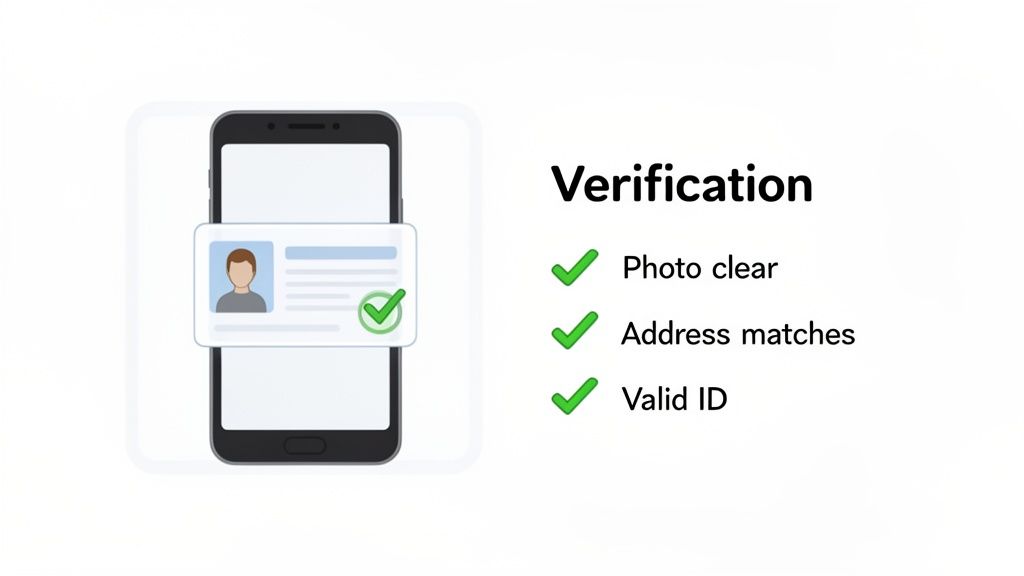
Why Are Platforms So Strict About This?
Honestly, it’s not personal. These platforms are under huge pressure from banks, payment processors, and governments to prove that every creator is a real, legally-adult person who is exactly who they claim to be. This process, often called KYC (Know Your Customer), is non-negotiable for any legitimate business handling money online.
This verification wall is also your first line of defence. It helps filter out fraudsters and ensures the platform can legally and securely pay you. In the UK, failing this step is a primary reason for payment freezes. Financial regulators have repeatedly shown that verification issues are a culprit in a significant percentage of payment holds for online creators.
It's a serious problem. A 2024 Action Fraud analysis revealed that a staggering 65% of reported creator payout complaints were tied to unverified accounts, compared to just 12% for fully compliant ones. This highlights how crucial a smooth verification is. You can read more about how fraud targets digital platforms to understand the risks involved.
Your Pre-Submission Checklist: Get It Right First Time
Before you even think about hitting that 'submit' button, you need to get your documents in order. Treat it like revising for an important exam—passing means getting paid on time.
Gathering the correct documents and ensuring they meet the platform's specific standards is half the battle. This simple checklist will help you prepare everything you need for a quick and painless verification.
Essential Verification Document Checklist
| Document Type | Key Requirements | Common Mistake to Avoid |
|---|---|---|
| Photo ID | Must be a government-issued ID like a passport or driver's licence. The photo must be clear, and all text must be legible. | Submitting an expired ID. Always check the expiry date before you upload. |
| Selfie with ID | Hold your ID next to your face in a well-lit photo. Your face and the ID must be fully visible and in focus. No filters allowed. | Your fingers covering any part of the ID, especially your date of birth or photo. |
| Proof of Address | A recent utility bill or bank statement (usually less than 3 months old) showing your full name and current physical address. | Using a PO Box address. These are almost never accepted for KYC purposes. |
| Release Form | A signed form (often called a Model Release or 2257 form in the US) confirming you consent to create and distribute adult content. | A digital signature that doesn't match your legal name or leaving sections blank. |
By ticking off every item on this list, you give the platform's verification system absolutely no reason to flag your account for a manual review, which is where those long, frustrating delays really begin.
Common Rejection Reasons and How to Sidestep Them
I’ve seen countless creators get stuck in verification limbo for weeks, all because of small, completely avoidable mistakes. Learn from their experiences so you don’t have to make the same ones.
-
Bad Photo Quality: Your passport or driver's licence needs to be crystal clear. Lay it on a flat, dark surface in a brightly lit room. And please, turn off your camera's flash – the glare it creates can hide crucial details and trigger an automatic rejection.
-
Cutting Off the Edges: The system needs to see all four corners of your document. Don’t hold it in your hand where your thumb might cover a date, and don't crop the image too tightly. Frame the entire document in the shot.
-
Mismatched Names: This is a classic. The name on your ID must exactly match the name you used to register on the platform and the name on your bank account. No nicknames, no middle initial if it's not on the ID, no shortcuts.
-
Screenshotting Bills: Never submit a screenshot of a digital bill. They are easily edited and instantly raise red flags. Instead, download the official PDF directly from your bank or utility provider’s website.
It’s also worth knowing that platforms are using increasingly sophisticated tech to verify you. To get a better handle on this, you can learn about the role of a modern age verification app in our detailed guide.
By preparing your documents meticulously and anticipating what the platform needs, you can sail through verification and set yourself up for stress-free payouts from day one.
Choosing a Payout Method That Actually Works for You
Once your account is verified, the next big question is how you'll actually get your hands on your money. This isn’t just some minor admin task; your choice of payout method directly affects how quickly your earnings hit your account, how much you keep after fees, and how it all looks on your financial records. Nailing this part is essential to avoiding those frustrating payout delays.
There’s no one-size-fits-all answer here. What’s perfect for one creator could be a complete headache for another. You’re essentially balancing three things: speed, cost, and privacy.
Direct Bank Transfers: The Safe but Slow Option
On the face of it, a direct bank transfer seems like the easiest path. In the UK, you’ll see this listed as BACS or Faster Payments, while it’s often called a wire transfer or ACH in the US. It's your money, sent straight to your bank account. Simple, right?
Well, the reality can be a bit more complicated. While UK Faster Payments can be almost instant, many platforms process payments as international wires. These can get stuck in financial limbo for 3-5 business days, and sometimes even longer if a bank holiday gets in the way. You might also get hit with fees from both the sending and receiving banks, which eats into what you’ve earned.
There's also the paper trail to consider. The transaction will show up on your bank statement, often listing the name of the platform’s parent company. For any creator wanting to keep their cam work separate from their main finances, this lack of discretion can be a major issue.
E-Wallets: The Speedy Middle Ground
This is where third-party payment processors, or e-wallets, really shine. You’ll hear names like Paxum thrown around a lot in the adult industry, and for good reason. They act as an intermediary, giving you a digital wallet where your funds land before you decide to move them to your personal bank account.
Many creators swear by them, and here’s why:
- Speed: Payments from a cam site to an e-wallet are usually much quicker than bank wires. Sometimes, the money is there within 24 hours.
- Privacy: When you transfer the money to your bank, the statement will show the e-wallet's name, not the cam platform's. This adds a crucial layer of discretion.
- Separation: It lets you create a financial buffer, keeping your cam income neatly ring-fenced until you need it.
The trade-off, of course, is fees. E-wallets charge for their services. Expect a small fee to receive the money, another to withdraw it to your bank, and maybe a currency conversion fee if you’re paid in USD but bank in GBP. These little cuts can add up, so always read the fee schedule carefully. You can see how different adult streaming platforms handle these payout options to get a feel for what's standard.
Cryptocurrency: The Fast but Volatile Frontier
For creators who are a bit more tech-savvy and don't mind a bit of risk, cryptocurrency is becoming a more common payout choice. Payments in Bitcoin, Ethereum, or stablecoins like USDT can land in your wallet in minutes, completely bypassing weekends and bank holidays. The transaction fees are often lower than international wires, too.
The biggest selling point for crypto is its raw speed and borderless nature. But its value can be incredibly volatile. The £500 of Bitcoin you cash out on Monday could easily be worth £450 by the time you convert it to pounds on Tuesday.
This volatility is precisely why many creators stick to the tried-and-tested methods. Using crypto also means you need a solid grasp of how digital wallets, exchanges, and security work. If you’re not confident managing your own digital assets, the risk of a simple mistake costing you real money might outweigh the promise of a faster payout.
Ultimately, the best choice boils down to your personal priorities. If you just want simplicity and can handle a short wait, a direct bank transfer might be fine. If you value speed and privacy above all, an e-wallet is probably your best bet. And if you’re comfortable with the risks, crypto offers the fastest route of all.
Getting to Grips with Payout Schedules and Minimums
Ever had that moment where you’ve earned a solid amount, you’re ready to cash out, and the platform basically says, “Not so fast”? This is where payout schedules and minimum thresholds come into play, and mastering them is the difference between a predictable income and a frustrating waiting game. They're not designed to annoy you, but they can certainly feel that way if you don't understand how to work with them.
Platforms don’t just let you withdraw money whenever you feel like it. They operate on a strict financial calendar, often with weekly or bi-weekly pay periods. Miss the cut-off time by even an hour, and you could be waiting another week or two for your money. Honestly, it’s all about logistics and cost-saving on their end—processing thousands of tiny payments is far more expensive than handling them in organised batches.
Understanding the Platform's Money Clock
The first step to getting paid on time is learning the platform's rhythm. Most sites will have a clear schedule outlined in their terms of service or a dedicated payout section. Don't just skim this—internalise it. You need to find out two crucial pieces of information:
- The Pay Period: Does it run Monday to Sunday? Wednesday to Tuesday? Knowing the exact start and end days is vital.
- The Payout Day: This is the day they actually process the payments for the previous period. It’s often a few days after the period closes, giving them time for all their internal checks.
For instance, a site might have a pay period from Monday to Sunday, but the actual payments aren't processed until the following Friday. If you need that money for the weekend, you have to plan your streams to make sure your earnings from the previous week are ready to go.
Why That Minimum Payout Threshold Matters
Alongside the schedule, every platform has a minimum payout threshold. This is the smallest amount you can have in your account before you're even allowed to request a withdrawal. It can be anything from £20 to £200 or more, depending on where you work.
This isn't just an arbitrary number. Platforms set these limits to keep their own transaction fees down. Sending a single £100 payment costs them the same as sending five £20 payments, so they’d much rather you let your earnings build up. If your balance is £99.50 on a site with a £100 minimum, you simply won't get paid until you earn that last 50p.
The real trick is to treat the minimum threshold not as a barrier, but as your baseline target for each pay period. If the minimum is £100 and the pay period ends on Sunday, your goal should be to hit at least £100 by Saturday night, giving you a buffer.
Strategies for Consistent Payouts
To truly master the system and make sure you're consistently getting paid without delays, you need a plan. Don’t just leave it to chance.
Here’s a practical approach I’ve seen work time and time again:
- Mark Your Calendar: Add the pay period end date and the official payout day to your personal calendar as recurring events. This simple visual reminder keeps you focused.
- Work Backwards: If the payout minimum is £150 and you typically stream three times a week, your goal is to average £50 in earnings per stream. This turns a vague goal into a concrete, session-by-session target.
- Account for Fees: Always remember that the platform takes a cut. If you need to withdraw £100, you might need to earn closer to £150-£200, depending on the site's commission rate. Always aim to clear the threshold after their fees have been deducted.
By understanding and planning around these simple financial rules, you take control. You stop waiting for your money and start telling it when to arrive.
How to Avoid Account Holds and Security Freezes
Sometimes, a payout delay isn’t a simple admin hiccup; it's a deliberate security freeze. Platforms can be notoriously quick to lock down funds at the slightest hint of suspicious activity, and their automated systems are often designed to be a bit twitchy. This isn’t just about one payment; it's about making sure your entire online business isn't mistakenly flagged as a risk.
An account hold can feel personal, but it’s usually triggered by an impersonal algorithm. These systems are constantly scanning for patterns that look like fraud, account takeovers, or even money laundering. A sudden, massive spike in your earnings, a login from an unusual location, or rapid-fire changes to your payment details can all set off red alerts. From the platform's perspective, it's better to freeze your account first and ask questions later than risk a fraudulent payout.
The Non-Negotiables of Account Security
Before we dive into the more nuanced stuff, let’s cover the absolute basics. Skipping these is like leaving your front door wide open and then being surprised when you find your TV missing. These aren't just suggestions; they are the bedrock of protecting your earnings and your identity online.
- Enable Two-Factor Authentication (2FA): If a platform offers 2FA, turn it on. Right now. It adds an extra layer of security, usually a code sent to your phone, that stops unauthorised access even if someone manages to steal your password. It’s the single most effective defence against account takeovers.
- Use a Password Manager: Creating a unique, complex password for every single site you use is non-negotiable. A password manager like Bitwarden or 1Password generates and stores these for you, so you only have to remember one master password. Reusing passwords across different sites is a massive security risk.
Nailing just these two steps will prevent the vast majority of common security issues that can lead to a frozen account and a massive headache.
Staying Off the Fraud Detection Radar
Beyond the basics, your own behaviour on the platform can sometimes inadvertently trigger a hold. The key is to act like a legitimate, consistent business owner—because that’s exactly what you are. Erratic actions just look suspicious to automated systems.
For example, try to avoid changing your payout details too frequently. If you switch from a UK bank account to a Paxum e-wallet and then to a crypto address all within the same pay period, you look exactly like someone who has just hijacked an account and is trying to siphon off the money. If you absolutely must change your details, the best time to do it is right after a successful payout, not just before one is due.
Another major red flag is dealing with chargebacks. A chargeback happens when a viewer disputes a transaction with their credit card company. A high rate of chargebacks tied to your account makes you look like a high-risk creator in the eyes of the platform's payment processors. While you can't control every single viewer, you can certainly minimise the risk.
The best defence against chargebacks is clear communication and delivering on what you promise during a show. If a viewer feels they got exactly what they paid for in a private session or via a tip, they have no reason to dispute the charge.
If you do get a notification about a chargeback, handle it professionally. Cooperate fully with the platform's investigation and provide any evidence you have, like chat logs or recordings (if permitted). This shows you’re a responsible partner, not part of the problem. You can get a better sense of these backend processes by understanding how cam platforms moderate content and enforce their rules.
Ultimately, preventing security freezes comes down to demonstrating consistency and reliability. Use strong, unique passwords, enable 2FA, keep your personal and financial details stable, and conduct yourself professionally. By doing this, you give the platform's security bots no reason to put a pause on your well-earned payments.
What to Do When a Payout Is Already Late
Right, it’s happened. The date you had circled on your calendar has come and gone, and your money is officially missing in action. It's easy to jump straight to panic or fire off an angry email, but honestly, a calm, methodical approach will get you paid much faster.
Before you even think about hitting that ‘contact support’ button, it's time to do a little detective work yourself. More often than not, a late payment isn't some big platform conspiracy; it's usually a simple oversight that's surprisingly easy to fix.
Your Pre-Support Checklist
Run through these common culprits first. It might feel like you're going over the basics, but trust me, the solution is often hiding in plain sight.
- Double-Check the Schedule: Are you absolutely sure it’s late? Go back and look at the platform’s official payout calendar. Don't forget to account for weekends and bank holidays, especially if the platform operates in a different country to you. A Monday bank holiday in the US can easily push a payment to Tuesday or Wednesday.
- Inspect Your Payment Details: Scrutinise every single letter and number. Is your bank account info 100% correct? Is there a tiny typo in your e-wallet email address? One wrong digit is all it takes to send your earnings into the digital ether.
- Review Your Account Status: Log into your dashboard and have a proper look around. Is there a big red banner demanding you re-verify your ID? Has your account been placed on a temporary security hold for some reason? These alerts are easy to miss when you're in a hurry.
If you’ve checked all of these and everything genuinely seems perfect on your end, then it’s time to get in touch with the support team.
How to Contact Support and Actually Get Answers
Your first message to support really sets the tone. If you're professional, clear, and give them all the info they need upfront, you make it incredibly easy for them to help you. It also makes it much harder for them to send back a generic, unhelpful reply.
Think of it this way: your goal is to make resolving your ticket the easiest task on their to-do list. Give them everything they need to investigate without having to play email tennis asking for more details.
Start with a clear and direct subject line. Something like "Query Regarding Payout for Period [Start Date] – [End Date]" works perfectly. In the body of your message, just state the facts calmly and politely.
Here’s a simple template you can adapt:
"Hi Team,
I'm writing to enquire about my payout for the period ending on [Date]. The expected payment date was [Date], but it hasn't arrived yet.
My username is [Your Username], and the payout was for £[Amount] to my [Your Payout Method, e.g., Paxum account or UK Bank Account].
I have already double-checked that my payment details are correct on my profile, and I can't see any holds or notifications on my account. Could you please provide an update on the status of this transaction?
The payout transaction ID, if one was generated, is [Transaction ID].
Thanks for your help,
[Your Name]"
This approach is professional and gives them all the key information straight away. And a final tip: always keep a record of your communication. Screenshot your support tickets and save the email chain. That documentation is your best friend if the delay drags on.
Common Questions About Cam Site Payouts
Let's dive into some of the most frequent questions I see creators asking about getting paid. These are the nitty-gritty queries that pop up when you're managing your finances, and getting clear answers can save you a lot of stress. Think of this as your go-to reference for navigating the money side of things.
Can a Platform Legally Withhold My Money Indefinitely?
In short, no—not without a very compelling reason. A platform can’t just decide to keep your earnings without cause. What they can do, however, is legally hold your funds if they suspect something is wrong. This usually involves a breach of their terms of service, a fraud investigation, or dealing with chargebacks linked to your account.
In the UK, this all comes down to contract law. The terms and conditions you agree to when you sign up will almost certainly have clauses that allow them to freeze payments under these specific circumstances. The crucial point is that they have to have a legitimate basis for their actions; they can't just keep your money on a whim.
What Happens If I Close My Account with Money Still in It?
This is one of those classic "read the small print" scenarios. Most platforms have a policy that you need to meet their minimum payout threshold before closing your account if you want that final payment. If your balance is under that minimum, you could end up forfeiting what's left.
My advice: Always double-check the platform's policy before you decide to leave. If you’re just a few pounds shy of the threshold, it's often worth doing one last quick stream to get your balance over the line. That way, you can cash out every penny you've earned.
Do Payout Delays Affect My Credit Score?
A delayed payout from a cam site will not directly impact your credit score. These platforms aren't reporting your payment status to credit agencies like Experian or Equifax. Your earnings are a private matter between you and the site.
The knock-on effect is where the danger lies. If you're counting on that cam income to pay your credit card bill or a loan, and a delay makes you miss a payment, that's what will harm your credit history. It’s another powerful reason to try and build a small financial buffer, so you aren't left in a bind if a payment doesn't land on the exact day you expect it.
Is It Safer to Get Paid More Frequently in Smaller Amounts?
This is a really smart strategy, and it’s one I see a lot of experienced creators adopting. If your platform allows for it and you're earning enough, switching to weekly payouts instead of waiting for a monthly one is a great way to lower your risk.
Think about it: if a security hold or a technical glitch happens, it only affects one week of your earnings, not a whole month's worth. It also means you’ll notice if something is wrong much, much faster.