
Age verification on cam sites isn't just a checkbox anymore; it's a serious, legally required hurdle in many parts of the world, especially here in the UK. Platforms now rely on proper tech like ID scans and facial recognition to make sure everyone—both creators and viewers—is over 18. The goal is twofold: protect minors and drag the industry into a new level of legitimacy, kicking and screaming if necessary.
Why Age Verification Suddenly Got So Serious
Let’s be honest, for years, "age verification" on most adult websites was a running joke. A quick click to say you were over 18 was usually all it took. Those days are well and truly over, and the reason is simple: intense legal and regulatory pressure.
Things really changed with the arrival of heavy-hitting laws like the UK's Online Safety Act. This wasn't some dusty policy document; it placed the legal responsibility squarely on the shoulders of the platforms. Regulators like Ofcom were given teeth, with the power to hand out massive fines or even block sites that fail to use "highly-effective age assurance."
The End of the Honour System
This new legal reality completely upended how cam sites do business. The old "yeah, I'm 18" self-declaration model became a huge financial and legal risk. Platforms were left with a stark choice: adopt robust, tech-based verification systems or face the consequences. This isn’t just about ticking boxes for bureaucrats; it's a fundamental shift towards building a more responsible and legally sound industry.
This shift means that platforms can no longer play dumb. They are now legally on the hook for taking concrete steps to prevent minors from accessing adult content and to verify that all creators are of legal age.
Of course, this transition hasn't been without its headaches. For creators, it adds another layer of admin that can feel invasive and could even threaten their income if the system bugs out. Many are understandably concerned about where their sensitive personal info is going and how securely their ID documents are being stored. You can learn more about how a modern age verification app handles this data securely.
For viewers, being asked for an ID just to watch a stream can feel like a major invasion of privacy, clashing with the anonymity that brought them to these platforms in the first place. The central conflict is clear: how do you balance legal compliance and safety with the privacy expectations of performers and their audiences? This guide will break down exactly how these new systems work, what they mean for you, and how to navigate them safely.
How Age Verification Technology Actually Works
So, you've hit that "Verify Age" button. It's no longer a simple pinky promise; you're being asked for your government-issued ID and maybe a selfie. What's actually happening behind the curtain? Let’s pull it back and see what makes this tech tick.
Most reputable platforms don't handle this sensitive process themselves. They bring in specialist third-party companies known as KYC (Know Your Customer) providers. These are the digital bouncers of the internet, firms whose entire business is securely checking identities for banks, crypto exchanges, and now, adult content sites.
Think of it this way: the cam site is the club owner. They don't personally check every ID at the door; they hire professional security to do it properly and legally. This separation is crucial. It means your passport or driving licence isn't just sitting in a random folder on the cam site's server. Instead, it’s whisked away through an encrypted channel to a company that's built from the ground up to handle this kind of data securely.
The Main Ways Your Age Gets Checked
There isn’t just one way to do this, and platforms often mix and match a few methods. Each one comes with its own trade-offs between speed, accuracy, and how much personal information you have to hand over.
Document Scanning and Data Extraction: This is the one you’ll see most often. You upload a picture of your ID, and an automated system gets to work. It uses Optical Character Recognition (OCR) to read your name and date of birth, but it’s also looking for subtle signs of forgery, like incorrect fonts or dodgy hologram patterns.
Facial Biometrics and Liveness Checks: This step usually follows the ID scan. You'll be asked to take a live selfie or a short video. The system's AI then compares the face in that video to the photo on your ID. To stop people from just holding up a picture of someone else, it will often ask you to perform a "liveness" check—like smiling, turning your head, or blinking—proving you're a real person, right there in that moment.
AI Age Estimation: This is a newer, more privacy-friendly approach. Instead of figuring out who you are, it just tries to estimate how old you are. The system analyses the geometry of your face from a selfie, crunches it against millions of data points, and spits out an age estimate (e.g., "likely over 18"). The best part? Your photo is usually deleted immediately after, meaning no personal data is stored.
This technology is a massive leap from the old ways. A 2023 UK survey found that a staggering 75% of users had only ever ticked a box to access adult sites. With regulations like the Online Safety Act now in full swing, these robust, tech-driven methods are becoming the new normal.
A Quick Look at the Pros and Cons
To make sense of it all, here's a simple breakdown of the most common technologies you'll encounter.
Common Age Verification Methods Compared
| Method | How It Works | Privacy Impact | Typical Use Case |
|---|---|---|---|
| ID Scan & OCR | You upload a photo of your ID. An AI reads the data (name, DOB) and checks security features. | High. Your ID data is processed, though usually by a secure third party. | Standard verification for creators and often for viewers in strictly regulated regions. |
| Facial Biometrics | You take a selfie or video. An AI matches your face to your ID photo and confirms you're real. | High. Your biometric data (a facial map) is created and compared. | Paired with ID scans to prevent fraud and impersonation. Essential for creator onboarding. |
| AI Age Estimation | You take a selfie. An AI analyses your facial features to estimate an age range without identifying you. | Low. The photo is typically deleted instantly. No personal data is stored. | A quick, privacy-focused check for viewers to confirm they are over 18. |
| Third-Party KYC | An all-in-one service that bundles ID scans, biometrics, and database checks into one smooth process. | Medium to High. Managed by a specialist firm, which adds a layer of security and trust. | The "gold standard" used by most major cam platforms for both creators and viewers. |
As you can see, there’s no single "perfect" system. Each method has its place.
The Reality of It All
A full ID and selfie check is incredibly accurate but can feel more invasive. On the other hand, AI age estimation is brilliant for privacy but might occasionally get it wrong and lock out a legitimate user (a "false positive"). The method a platform chooses often comes down to its specific legal obligations and what kind of experience it wants to offer its users.
For a deeper look into the day-to-day operations these systems support, you can explore our guide on how webcam sites work.
Ultimately, understanding this technology is key. Knowing that a specialist KYC provider is handling your data, and that clever features like liveness checks are there to stop fraud, can make the whole process feel less like an intrusion and more like a modern security measure—one designed to keep everyone in the space safe.
What Verification Means for Your Business as a Creator
For any webcam creator, that age verification step isn't just another box to tick—it's the absolute key to unlocking your earnings. Think of it as the final, essential step in setting up your shop. Without it, your token balance is just a number on a screen. Once you're verified, that number turns into real money in your bank account.
This isn't just some arbitrary platform rule; it's a legal and financial requirement. When you start earning, the platform isn't just paying a random username. They're entering into a financial agreement with a real person, and that comes with serious obligations like anti-money laundering (AML) checks and tax compliance. They need your legal ID to prove to banks and regulators that they're paying a legitimate, adult individual and not funding illegal activities.
This separation of identities is actually great for your privacy. By linking your legal self to the platform’s secure payment system, you can keep your on-screen persona completely separate. Your real name and details stay safely behind the scenes with the payment and compliance teams, while your audience only ever knows you by your chosen stage name.
The following diagram breaks down the main types of technology platforms use to handle this critical process.
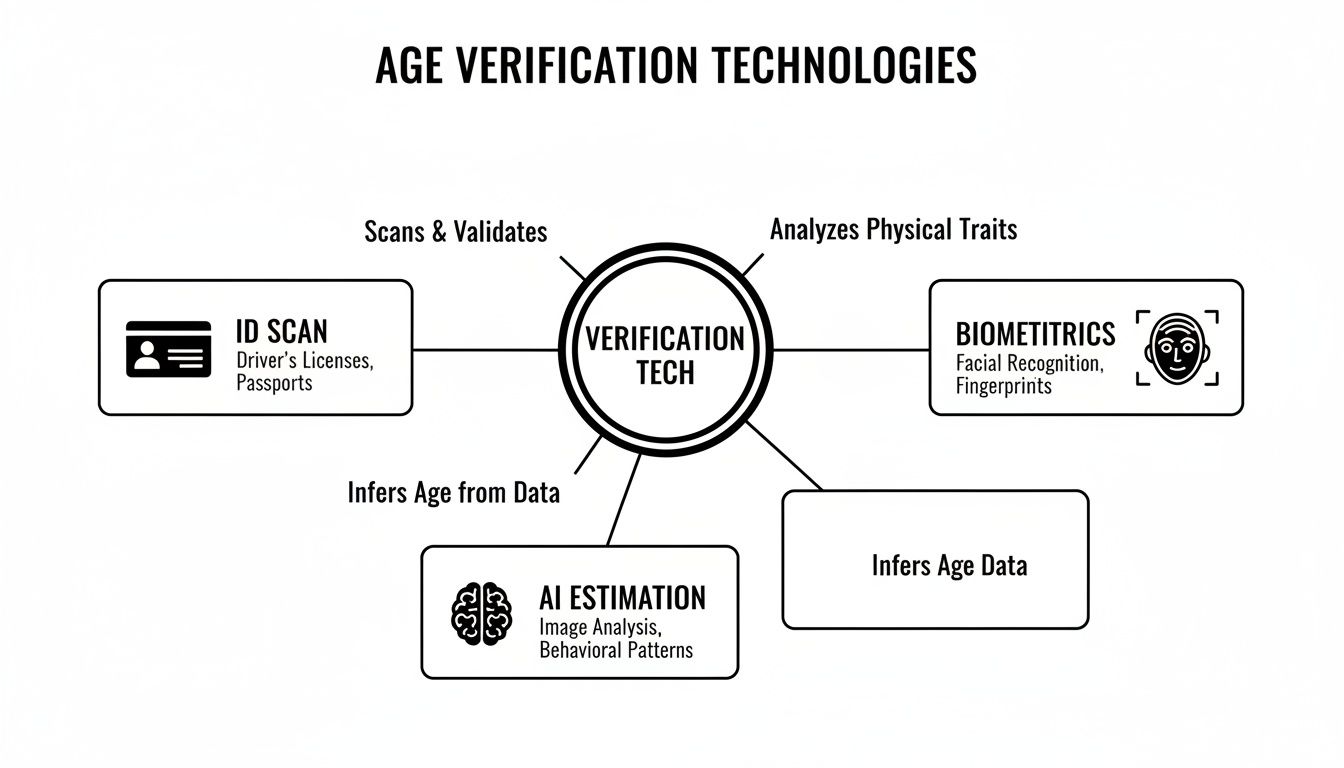
As you can see, the methods range from direct ID scans to biometric checks and AI-powered estimation, with each platform striking its own balance between security and user privacy.
Your Essential Verification Checklist
To get verified smoothly, have your documents ready before you even begin. Any hold-ups at this stage mean a delay in your first payout, which is something nobody wants.
Here’s a breakdown of what you'll almost certainly need:
- A Valid, Government-Issued Photo ID: This is non-negotiable. A passport or driving licence is your best bet. Double-check the expiry date—an out-of-date ID will get you an instant rejection.
- A Clear, Recent "Liveness" Photo or Video: You'll be asked to take a selfie, often holding your ID or a piece of paper with the current date and the site's name on it. This proves you are the same person on the ID and that you're applying right now.
- Proof of Address (Sometimes): Some platforms may ask for a recent utility bill or bank statement to confirm where you live, usually for tax reasons. The name and address on this document must perfectly match what's on your ID.
The single biggest reason for verification delays is mismatched information. The name on your application, your ID, your proof of address, and your bank account must all be identical. No nicknames, no abbreviations—no exceptions.
Common Mistakes That Will Stall Your Payout
Countless creators get stuck in verification limbo because of small, avoidable slip-ups. Getting it right the first time is the quickest way to get your earnings flowing.
Make sure you avoid these common pitfalls:
- Using a Stage Name on Your Application: The verification form is for your legal details only. Your performer name belongs on your public profile, not in the back-end compliance system.
- Submitting Blurry or Glare-Filled Photos: Lay your ID on a flat, well-lit surface and take the photo from directly above. Turn off your camera's flash, as it almost always creates a glare that makes the ID unreadable for automated systems.
- Cropping or Editing Your ID Photo: Send the full, unedited picture of your document. Any hint of digital alteration will be flagged as potential fraud.
- Information Not Matching: If you've recently moved or changed your name, ensure all your documents are updated and consistent before you apply. An old address on your driving licence but a new one on your utility bill is a guaranteed rejection.
At the end of the day, getting your age verification on cam sites sorted is the first professional step you take. It's the administrative price of admission to a legitimate, regulated online business where you can earn safely and securely. Treat it with the same seriousness you would when opening a new bank account, and you'll sail through the process without a problem.
Navigating Checks Without Sacrificing Your Privacy
So, you’re ready to support a creator or check out a stream, and suddenly you're met with a request for your ID. For many viewers, this feels like a massive overreach. It clashes directly with the anonymity that’s always been part of the appeal of these platforms. It's a fair question: why should you have to hand over personal documents just to watch?
This new reality is a direct consequence of the legal clampdown we’ve been talking about. Laws like the UK’s Online Safety Act are pushing platforms to verify viewers, not just performers. The idea is to create a closed-loop system where everyone on the site—on both sides of the camera—is confirmed to be an adult. While the intention is good, the execution can feel pretty invasive if you're left in the dark about what’s happening with your data.
Despite the hesitation many people feel at first, the numbers show a surprising level of acceptance. A 2023 survey found that an overwhelming 84% of UK users actually completed the age check to get access, with only a tiny fraction giving up and going elsewhere. This high completion rate suggests that when the systems are clear and feel secure, most people accept them as a necessary hurdle. You can find more details on this in the full Statista report.
Keeping Your Digital Footprint to a Minimum
Just because you have to verify doesn't mean you have to surrender your privacy completely. The key is being smart about how and where you share your details. Any reputable platform will take your privacy seriously, but it’s always wise to take your own precautions.
Here are a few practical steps you can take to protect yourself:
- Know Who You're Dealing With: It helps to understand the difference between the cam site itself and its third-party verification partner. Good platforms use specialist KYC (Know Your Customer) services like Yoti or Persona, which are built from the ground up to handle sensitive data securely. Your ID isn't just being sent to a random support inbox; it’s processed in a highly secure, encrypted environment.
- Check for a Secure Connection: This one’s non-negotiable. Never, ever upload documents on a page that doesn't have "HTTPS" and a padlock icon in your browser's address bar. This is the most basic sign that your connection to their server is encrypted and private.
- Use Privacy-Focused Payment Methods: When buying tokens, think about using payment options that create a layer of separation between the site and your main bank account. Things like prepaid cards or certain e-wallets can be a great choice. This also often helps ensure the transaction appears under a discreet billing name on your statement.
Spotting the Signs of a Secure System
Not all verification processes are created equal. A secure, professional system has tell-tale signs that should give you confidence, while a sloppy one should set off immediate alarm bells. Look for a clean, professional interface that clearly explains what you need to do and why.
A legitimate age verification system will never ask you to send your ID over email or through a social media message. The entire process should happen inside a secure, dedicated portal on the website itself. If you're redirected to a strange-looking site or asked to use an insecure method, stop what you’re doing.
Ultimately, your age verification on cam sites is a transaction based on trust. You are trusting the platform to handle your data responsibly, and they are trusting that you are who you say you are. By understanding how the process works and taking a few simple precautions, you can navigate these checks with confidence, support the creators you enjoy, and keep your personal information exactly where it belongs—under your control.
For a closer look at what this process involves from the other side, check out our guide on the UK cam site verification process for streamers.
The Unintended Consequences of Verification
For all their good intentions, age verification systems are far from a perfect solution. In the rush to comply with new laws, platforms can end up with processes that are clunky, frustrating, and sometimes create entirely new problems—problems just as serious as the ones they were meant to solve.
The hard truth is that a poorly implemented system doesn't just stop minors; it can alienate and drive away legitimate adult users. When someone is faced with a verification process that feels too invasive, overly complicated, or just plain slow, many will simply give up and look for an easier option elsewhere. This creates a predictable and dangerous knock-on effect.
The Migration to Unregulated Spaces
Think about it: if a mainstream platform makes it too difficult to get in, a huge chunk of its audience won't just throw their hands up and walk away. Instead, they'll migrate to the darker corners of the internet—to completely unregulated sites that often operate outside the law and have zero interest in moderation, security, or ethical conduct.
This isn't just a theory. Recent data from the Lucy Faithfull Foundation paints a stark picture of this exact problem happening in the UK. Since stricter age verification rules came into force, an alarming 45% of users have reportedly moved to unregulated sites that have no checks at all. Critically, of those who made the switch, nearly 40% encountered uncomfortable or illegal material. It’s clear proof that pushing users away from compliant platforms can inadvertently expose them to far greater risks. You can read more on how verification rules can backfire from this research.
When the Algorithm Says No
Another major headache is the problem of "false positives." This is where a perfectly legitimate adult gets incorrectly flagged and locked out by a flawed automated system. It’s incredibly frustrating for viewers and can be financially devastating for creators who rely on their accounts for their livelihood.
It happens more than you’d think:
- An AI age estimation tool might misjudge someone's age simply due to poor lighting or an unusual camera angle.
- An automated document scanner could fail to read a valid ID because of a slight glare or a worn-out hologram.
- A "liveness check" might fail if a user has a disability that prevents them from performing a required action, like turning their head or smiling on command.
Getting stuck in a loop of automated rejections with no clear way to speak to an actual person for a manual review is a common and infuriating experience. It really highlights the need for robust customer support to handle the inevitable errors that technology will always make.
The Ever-Present Risk of Data Breaches
And finally, let's talk about the elephant in the room: data security. Asking millions of users to upload copies of their passports and driving licences creates a massive, honey-pot target for hackers. While any reputable platform will use specialist third-party services to handle this data securely, the risk can never be completely eliminated.
A data breach involving this kind of sensitive information is a nightmare scenario. We’re not just talking about leaked email addresses; this is about connecting someone’s legal identity directly to their use of an adult platform. This is precisely why the security and track record of a platform’s verification partner are just as important as the site itself. Ultimately, a balanced approach is crucial—one that makes age verification on cam sites effective without being so difficult that it drives people into the shadows.
Common Questions About Age Verification
Navigating age verification can feel a bit like trying to read the small print in a dimly lit room. To cut through the confusion, we’ve put together direct answers to some of the most common questions we hear from both creators and viewers. This is the essential need-to-know, without the corporate jargon.
Is It Safe to Give My ID to a Cam Site?
This is the big one, and the honest answer is: it depends entirely on the platform's professionalism.
Reputable cam sites don’t just save a picture of your passport on their main server. Instead, they use secure, encrypted third-party KYC (Know Your Customer) services that specialise in handling exactly this kind of sensitive information.
Before you upload anything, do a quick safety check. Look for "HTTPS" in the URL, skim the site’s privacy policy, and see if they name their verification partner. While no system is ever completely foolproof, sticking to established platforms that invest in professional security is massively safer than using obscure sites with questionable practices.
Can I Use a Cam Site Without Verifying My Age?
In strictly regulated regions like the UK, you really shouldn't be able to. Any platform that lets you access adult content without performing a robust age check is likely operating outside the law. This should be a major red flag for its overall security, moderation standards, and payment safety.
Trying to sidestep these checks with a VPN might seem clever, but it often violates the site’s terms of service. This can get your account banned, potentially locking up any funds you have on the platform. For your own safety and to support creators on compliant platforms, it’s always best to stick with sites that follow the rules.
What Happens if My Verification Gets Rejected?
A rejection is frustrating, but it’s rarely a dead end. The most common culprits are easily fixable issues like blurry photos, mismatched information (for example, the name on your ID doesn’t exactly match the name on your account), or submitting an expired document.
First, check the rejection email or notification the site provides; it usually gives a specific reason. Then, re-submit your documents carefully. Place them on a flat surface with good, even lighting and make absolutely sure there's no glare.
If you’re still getting rejected after a second try, it’s time to contact the platform’s support team. They can often trigger a manual review by a human, which can resolve complex issues that automated systems might flag by mistake. Don’t just give up; a bit of persistence usually gets the job done.
Will Age Verification Show Up on My Bank Statement?
No, the age verification process itself will not appear on your bank statement. It's a data check, not a financial transaction, so there's nothing for your bank to record.
However, any actual purchases you make for tokens, subscriptions, or private shows obviously will. These transactions are typically billed under a discreet company name used by the site's third-party payment processor. This is done specifically to protect your privacy, so the charge won't explicitly mention the cam site's brand name. This separation helps keep your viewing habits private from anyone who might see your bank records.