
Cam site scams are cons designed to rip off creators or viewers on adult streaming sites. They're all about stealing money, personal information, or both, and they work by exploiting the unique mix of anonymity, financial transactions, and trust that these platforms run on. For viewers, this might look like a bot profile feeding you a pre-recorded loop or a dodgy phishing link. For creators, it’s often more about payment fraud, stolen content, and even blackmail.
Why Cam Site Scams Are So Common
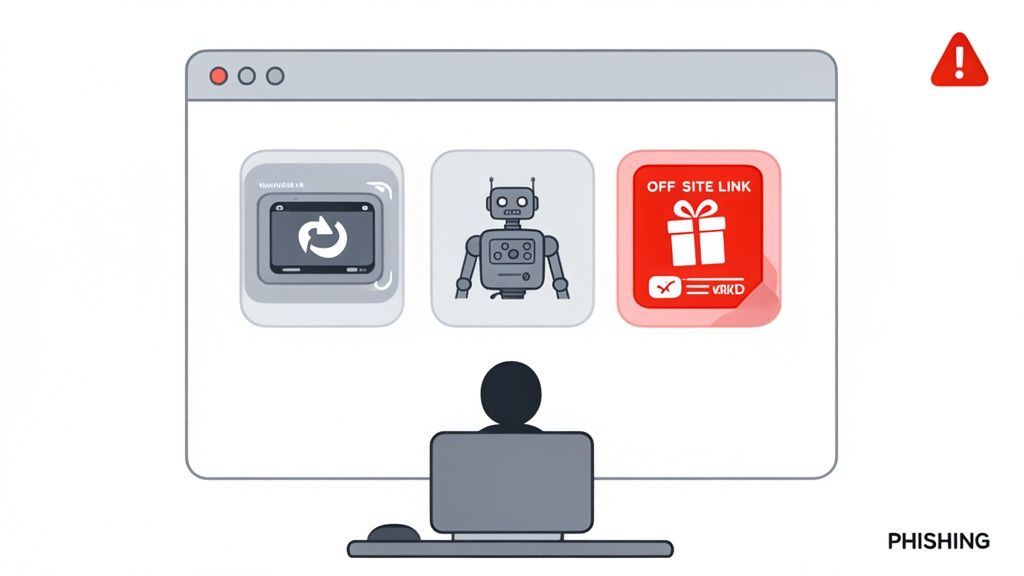
Let's be real: spending time on cam sites can sometimes feel like navigating a minefield. This isn't some boring lecture on cybersecurity; it's a practical look at the schemes that pop up where anonymity, money, and desire collide online. This environment is fertile ground for fraudsters, who target both the audience and the performers.
The goal here is to change how you see the risks. Instead of just hoping you don't get unlucky, you'll start to recognise the predictable patterns behind the most common cons. You don't need to be a tech genius to stay safe—you just need a solid grasp of the human psychology and financial loopholes that scammers love to exploit.
The Perfect Storm for Fraud
So, what makes these platforms such a hotspot for scams? It boils down to a few key ingredients that create the ideal conditions for deception. Getting your head around these is the first step towards protecting yourself. If you're new to camming, it's worth checking out a guide on how webcam sites work to get the lay of the land.
Here’s what makes the ecosystem so vulnerable:
- Anonymity Meets Aspiration: Viewers usually want to remain anonymous, while creators are busy building a very public persona. Scammers play both sides, hiding their own identity while exploiting the trust that performers have worked so hard to build with their audience.
- Direct Financial Transactions: The whole business model is built on direct and often instant payments—from token tips to private show fees. That speed is fantastic for creators, but it also leaves the door wide open for payment scams like chargebacks.
- Emotional Connection: Great streaming is all about building a genuine connection. Scammers are masters at faking these bonds to manipulate both viewers and creators into making bad decisions, like sending money off-platform or revealing personal details.
This guide isn’t here to judge why you’re on these sites. It’s here to arm you with knowledge. The best way to avoid getting played is to understand the game.
The Most Common Scams Targeting Viewers
Right, let’s get into the scams aimed squarely at the audience. It’s incredibly easy to get swept up in the moment on these sites, but a healthy dose of scepticism can save you a world of financial pain and a massive headache down the line.
The most common cam site scams aren't sophisticated hacks; they're clever social engineering tricks that play on your trust and horniness. Scammers count on you wanting to believe what you’re seeing, creating situations that feel urgent or too good to be true. Knowing their playbook is your best defence.
The Bot Profile and Pre-Recorded Loop
This is one of the oldest tricks in the book, yet it still catches people out. You find a stream, the performer looks amazing, but something just feels… off. The chat feels scripted, their replies are generic, and they seem to completely ignore specific questions or requests.
You’re probably looking at a bot profile. This is where a scammer has nicked someone's photos and videos to create a fake account. They set a pre-recorded video to play on a loop while a simple script (or a person barely paying attention) spams the chat with lines like "tip me for a surprise!"
The goal is painfully simple: to trick you into spending your tokens on a performer who doesn't actually exist. You’re essentially tipping a GIF.
- Red Flag: The performer never says your username or directly answers a unique question you ask.
- Red Flag: Their movements look repetitive, almost like a short clip playing over and over again.
- Red Flag: The chat room is filled with other generic-looking accounts all hyping up the "performer."
The Off-Platform Private Show Promise
This one should set alarm bells ringing immediately. You’re chatting with a performer, and they start trying to get you to leave the site for a "cheaper" or "more exclusive" private show, asking you to pay them directly through an untraceable method like PayPal, gift cards or crypto.
It's a classic bait-and-switch. Once you send that money, it’s gone. You have absolutely no recourse because you’ve stepped outside the platform’s secure environment.
Crucial Takeaway: Legitimate cam sites have built-in payment systems for a reason—they offer security and a way to handle disputes. Anyone pushing you hard to sidestep that system is almost certainly trying to rip you off. You can get a better handle on the financial side by understanding how cam platforms make money.
The interplay between anonymity, desire, and money creates a perfect storm for scams, as this image shows.
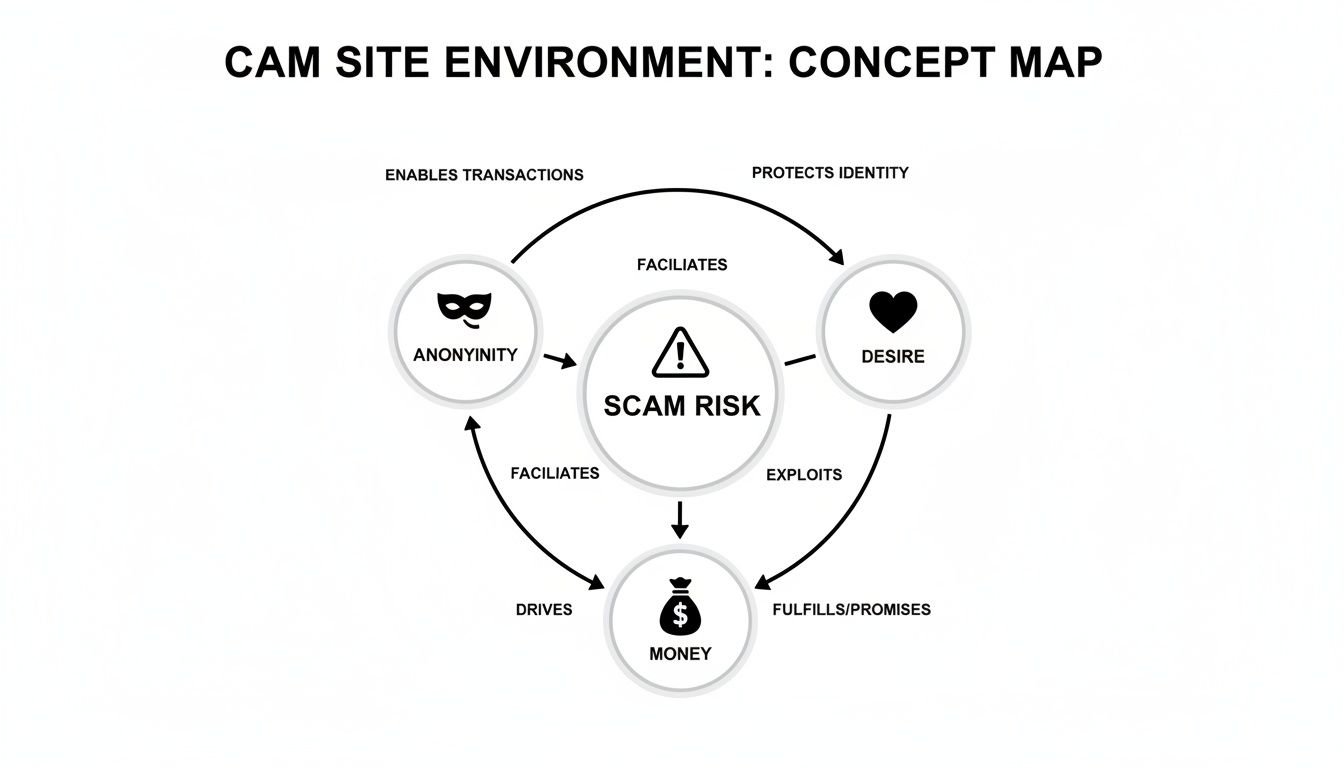
The very things that make these platforms so appealing are the same elements scammers know how to exploit.
Phishing for Your Credentials and Cash
Phishing is a massive threat across the entire internet, but it's particularly effective in the cam world. These scams use fake login pages and dodgy links to steal your account details and, ultimately, your payment information.
For instance, a scammer might pop up in your DMs with a message like, "Check out my secret gallery!" and a link. You click it, and it takes you to a page that looks identical to the cam site's real login screen. You type in your username and password, and that's it—they've got you.
Another common trick is the "special offer" link. You might get an email promising free tokens or a big discount on a private show. The link leads to a shady website that asks for your credit card details to "verify your age" when, in reality, it's just harvesting your financial data. These tactics are very close to romance scams, where emotional manipulation is used to get money. In fact, research shows over half of UK online daters are vulnerable, with losses over five years topping an eye-watering £400 million—a stark reminder of the financial incentive for fraudsters. You can read the full research from UK Finance to learn more.
Spotting these scams boils down to being vigilant. Always double-check the URL of any login page to make sure it’s the official domain. If an offer seems too good to be true, it is. And never, ever enter your password or payment details on a site you got to from an unsolicited link.
How Scammers Go After Creators and Their Income
While viewers often face scams designed to swipe their login details or payment info, the schemes targeting creators are far more personal and financially devastating. If you’re a creator, you need to understand that your income, your privacy, and even your personal safety are the main targets for a whole different class of cam site scams.
These aren't just about tricking someone out of a few tokens. They’re designed to claw back your hard-earned cash, exploit your work, and in the worst cases, shatter the boundary between your online persona and your real-world identity. Protecting your earnings starts with knowing exactly what you're up against.
The Chargeback Scam: The Ultimate Gut Punch
Of all the financial threats you'll face, the chargeback scam is probably the most infuriating. It usually starts out looking like a fantastic session, only for it all to unravel weeks down the line.
Here’s how it works: a user, often a "whale" who seems to be spending big, will drop into your room and tip generously. They might book a long, expensive private show, pay for everything, and then vanish once it’s over. You see the earnings pop up in your account, feel great about a successful day, and get on with your work.
Then, weeks later, the payment is suddenly reversed. The user has called their bank or credit card company and falsely claimed the charges were fraudulent. Just like that, the platform yanks the money from your earnings. Because it was a formal payment dispute, you're left with nothing to show for your time.
The cruel reality of chargebacks is that you've already put in the time and the performance, and the platform often sides with the payment processor, not you. This makes it absolutely critical to document everything and be wary of unusually large, out-of-the-blue tips from brand-new accounts.
Doxxing and Extortion: Weaponising Your Identity
This is where scams cross a dangerous line from financial fraud into serious personal threats. Doxxing is the act of digging up and blasting someone’s private information all over the internet without their consent. For any creator who relies on a degree of anonymity, it's a living nightmare.
A malicious user might spend weeks, even months, patiently gathering tiny clues you might accidentally drop on stream. It could be a glimpse of a street sign out your window, a casual mention of a local café, or details scraped from your loosely connected social media accounts. Before you know it, they've pieced together your real name, where you live, or even information about your family.
Once they have that leverage, the extortion begins. The scammer will threaten to expose your personal information to your family, your day job, or the wider public unless you give them what they want—free shows, money, or performing specific acts on command.
This tactic is all about power and control. Defending against it requires a militant approach to your operational security (OpSec). You have to treat your streaming persona and your private life as two completely separate entities with absolutely no crossover. Your knowledge of a platform's rules can also be a key defence; understanding how cam platforms moderate content will help you spot and report users exhibiting stalking behaviours before they can escalate.
Fake Agencies and Shady Affiliate Schemes
As you start to build a following, you'll inevitably get DMs from people promising to take your career to the next level. While there are legitimate agencies out there, the industry is unfortunately littered with scams.
These fake agencies often promise you the world: top-tier promotion, a massive influx of new followers, and guaranteed high earnings. The catch? You have to pay a hefty upfront "management" or "marketing" fee. As soon as you pay, they either vanish completely or just feed you useless, generic advice you could have found online for free.
Here are a few red flags to watch for:
- Upfront Fees: Real agencies typically take a percentage of what you earn. They don't ask you to pay them to get started.
- Vague Promises: Be suspicious of anyone promising "guaranteed success" without laying out a clear, detailed strategy.
- Unprofessional Communication: Emails riddled with typos or messages from generic Gmail accounts are a massive warning sign.
These schemes prey directly on a creator's ambition. Some of these scams even mirror the emotional manipulation found in romance fraud, where victims are lured in with promises of a better future. The financial fallout can be devastating—UK romance scam losses averaged £8,000 per victim by 2024, a pattern that echoes when creators are tricked into sending money for non-existent "cam equipment" or "promotional packages." You can discover more insights about these alarming trends to grasp the full financial risk.
The core lesson is simple: if an offer sounds too good to be true, it almost certainly is. The best way to protect your income is to be deeply sceptical of anyone who asks you for money in exchange for a promise.
When the Platform Itself Is the Problem
Not every con artist is a lone wolf hiding behind a fake profile. Sometimes, the most damaging scams are built right into the architecture of the platform you're using. These are the bigger, more structural traps where the house itself is rigged against you. To spot them, you have to look past individual users and start questioning the very systems you're operating on.
What makes these system-level scams so dangerous is that they play on your trust. You assume the platform is a safe, regulated marketplace, but that's not always the case. While a typical scammer needs to trick you with a clever story, these cons just need you to sign up and start spending, assuming the owners have your back.
Ghost Sites and Data Harvesters
The most brazen example of this is the ‘ghost site’. These are slick, professional-looking websites created for one reason only: to steal your credit card details. They pop up out of nowhere, run aggressive ad campaigns across adult networks, and often feature profiles of well-known models lifted from legitimate sites to build instant credibility.
So you sign up, grab a token package, and… crickets. The models you try to chat with are completely unresponsive (because they aren't actually there), the site is riddled with bugs, and the customer support email bounces back. A few weeks later, the entire site vanishes without a trace. The only thing left is your payment information, now being sold on the dark web or used to make fraudulent purchases.
The real threat of a ghost site is how legitimate it can feel right up until it disappears with your data. That's why you absolutely have to check a platform's age and reputation before you even think about entering your card details.
Dodgy Affiliate Schemes
Another murky area is the world of dodgy affiliate marketing. This is where third-party promoters or "agents" push a legitimate cam site but twist the facts to get you to sign up through their link, earning them a commission.
For instance, an affiliate might blast out ads claiming a certain platform offers a fantastic 80% commission rate for creators. What they conveniently leave out is that the real take-home pay is closer to 50% after the platform deducts its various hidden fees. Or for viewers, they might promise "50% off tokens for new members," but their link just applies their affiliate code without giving you any actual discount. The platform is real, but you've been lured in under false pretences, and the affiliate gets a piece of every pound you spend or earn.
Legally Sketchy Terms of Service
Perhaps the most common system-level trap is a platform with terms of service (ToS) that are, strictly speaking, legal but are designed to be incredibly exploitative. These aren't illegal scams in the traditional sense; they're just awful business models built to trap creators and squeeze every penny out of users.
You have to read the small print. Here’s what to watch out for:
- Baffling Payout Systems: Some sites use deliberately confusing payout structures with multiple token values, shifting conversion rates, and a mountain of hidden fees. This makes it almost impossible for a creator to figure out what they’re actually making per minute.
- Sky-High Payout Thresholds: A platform might set a ridiculously high minimum payout (say, £500) before a creator can withdraw their earnings. This is a deliberate strategy to ensure that newer or part-time models work for months, racking up money that they can never actually access.
- Content Ownership Grabs: Buried deep in the legal jargon, some platforms sneak in clauses that give them a sweeping, permanent licence to use any content you stream. This could mean they can resell your recorded shows forever without ever paying you another penny for them.
These aren't cam site scams like phishing or chargebacks, but they are deeply unethical systems designed to profit from confusion and your assumption that things are fair. Reading the ToS isn't just a boring legal formality—it's your first and best defence against a platform built to take advantage of you from day one.
Your Practical Checklist for Staying Safe
Knowing the theory behind cam site scams is one thing, but actually dodging them in the wild is what really counts. This section is your practical, no-nonsense checklist for keeping yourself and your finances safe, whether you're a viewer enjoying the content or a creator building a business. Think of it as your quick-reference guide for proactive self-defence.
Scammers thrive on impulse and misplaced trust. By turning these safety habits into second nature, you make yourself a much harder target. This isn't about being paranoid; it's about being prepared.
Essential Safety Habits for Viewers
As a viewer, your main goals are to protect your identity, your payment details, and your peace of mind. Scammers targeting you are usually after quick, untraceable payments or account credentials they can exploit later. Sticking to these rules will shut down the vast majority of their attempts.
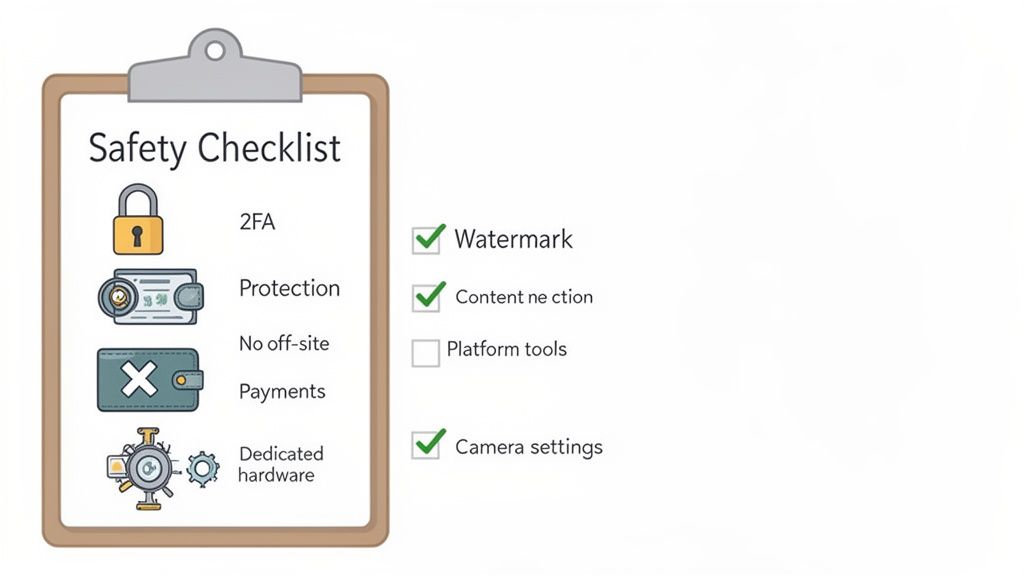
- Never Leave the Platform for Payments: This is the golden rule. Any creator pushing you to pay via PayPal, crypto, or gift cards is almost certainly running a scam. Legitimate platforms have secure, built-in payment systems for a reason—they protect you.
- Use Strong, Unique Passwords and 2FA: Don't be tempted to reuse the same password from your email or banking app. Create something unique for the site and enable Two-Factor Authentication (2FA) on your account. It’s a tiny bit of hassle for a massive security boost.
- Be Sceptical of Sob Stories: A sudden, desperate plea for money to fix a broken webcam, pay a medical bill, or handle some other "emergency" is a classic manipulation tactic. These stories are engineered to create a false sense of intimacy and urgency, tricking you into sending money off-platform.
- Verify Before You Trust: Take a moment to check a creator's profile for signs of authenticity. Do they have a verified badge? Do they link to active, legitimate social media accounts? Do they interact with chat in a specific and personal way? Bots and fakes simply can't fake genuine interaction for long.
The emotional manipulation used in these scams is strikingly similar to romance fraud. In the UK, scams using these exact tactics have cost victims over £409.7 million between January 2020 and December 2024, with scammers building fake trust before asking for cash. This really highlights why staying on verified platforms with secure payment systems is so crucial. You can learn more about these romance scam statistics from Action Fraud to see the parallels for yourself.
Critical Protections for Creators
For creators, the stakes are even higher. Scams don't just threaten your income; they can compromise your real-world identity and safety. Your checklist is about building a firewall between your performance persona and your private life, while also shielding your earnings from fraud.
Your safety and your business depend on treating your streaming operation with professional-level security. A casual approach to your privacy or finances is an open invitation to scammers.
- Watermark Your Content: Always apply a visible, hard-to-remove watermark with your platform username to your stream. This simple step makes it much harder for content thieves to steal your videos and use them to create fake bot profiles on other sites.
- Use a Dedicated Streaming Setup: If you can, use a separate computer or device solely for streaming. This isolates your work from your personal life, preventing any potential malware or spyware from accessing your personal files, banking information, or private photos.
- Never Share Personal Financial Details: This includes your PayPal email, bank account details, or anything that could be linked back to you personally. Stick exclusively to the platform's official payout system. No exceptions.
- Understand Chargeback Policies: Get familiar with your platform's terms of service regarding chargebacks. Be wary of brand-new users making unusually large tips right off the bat, as this is a common red flag for chargeback fraud. Always document everything.
- Enforce Strict Persona Separation: Make sure there is absolutely no link between your creator persona and your personal identity. Use a different name, avoid showing identifying features in your background, and keep your personal social media accounts completely separate and private.
What to Do If You Get Scammed
Right, you’ve realised you’ve been scammed. It’s a sickening feeling – that horrible mix of anger, betrayal, and maybe even a little embarrassment. Before you do anything else, take a breath and remember this: it’s not your fault. These scammers are pros. They do this for a living, and their tactics are designed to trick even the most savvy people.
The initial shock is rough, but what you do in the next few hours can make a huge difference. Don’t panic. Just focus on a few clear, deliberate steps to lock things down and start picking up the pieces.
Your Immediate Action Plan
The first priority is damage control. You need to cut the scammer off and start the ball rolling to get your money back or secure your information.
- Call Your Bank or Card Provider: This is step one, no exceptions. Ring the fraud department number on the back of your card and tell them exactly what happened. Explain that your details were stolen or you were deceived into a payment. They’ll immediately freeze the card to stop any more money from going out and kick off the chargeback process.
- Change Your Passwords: Log in to the cam site and change your password right away. Now for the crucial part: if you’ve used that same password anywhere else (and let's be honest, many of us do), you need to change those too. Start with the most important ones, like your main email account and online banking. This is a great time to finally start using a password manager to generate unique, strong passwords for every single login.
- Gather All the Evidence: Whatever you do, don't delete the conversation. Screenshot everything – the chat logs, the scammer's profile page, any transaction receipts or IDs, and especially any chats that happened on other apps. Every little detail is a piece of the puzzle.
Reporting the Scam
With your accounts secured, it's time to report the incident. This isn’t just about getting justice for yourself; it’s about making sure this person can’t do the same thing to someone else.
I know the temptation is to just shut the laptop and try to forget it ever happened. But reporting is the only way these scammers get stopped. It gets their accounts banned and helps authorities connect the dots on larger operations.
First, get in touch with the cam site’s support team. They usually have a dedicated "trust and safety" or "report abuse" section. Send them all the screenshots you collected. Any platform worth its salt will take this seriously, investigate, and hopefully ban the user for good.
Next, you need to report it as a crime. Here in the UK, the official channel for this is Action Fraud. It's the central reporting body for all fraud and cybercrime. You can file a report on their website or call them. They’ll ask for details like:
- The scammer's username and which website it was on.
- A step-by-step account of how the scam played out.
- The exact amount of any money you lost.
- All the evidence you’ve gathered.
Lastly, give yourself a break. Being scammed is incredibly stressful and can really shake your confidence. It's okay to feel upset or angry. Let yourself feel it, but don't let some faceless crook make you feel ashamed. You’ve taken back control, and that's what counts.
Got Questions About Cam Site Scams? We’ve Got Answers.
Let's tackle some of the most common questions people have. Think of this as a quick reference guide to reinforce what we've already covered, getting you straight to the answers you need.
How Can I Spot a Fake Cam Profile?
A real creator is present and engaged. They'll react to the chat in real-time, respond to specific things you say, and usually have a "verified" badge from the platform. Check their profile for social media links – a genuine creator will have accounts with a real history of posts and interaction.
On the flip side, fake profiles often just play a looped video, so you'll notice repetitive movements. Their chat responses feel generic and canned, ignoring your specific questions, and they're almost always trying to herd you towards shady links or off-site payment options.
Are the "Free" Cam Sites Riskier for Scams?
Not inherently, but the risk profile is different. Scams happen everywhere, whether the site is premium or free. The big difference with "freemium" sites is the huge number of users, which naturally attracts more scammers trying their luck with phishing links and other basic tricks.
The best way to protect yourself is the same everywhere: never, ever share personal details or send money outside the platform's official channels. Always stick to the site’s built-in tipping and payment systems. They’re designed to protect you, but that protection disappears the second you go off-site.
I've Been Scammed. Can I Get My Money Back?
It's tough, but not always a lost cause. If you paid with a credit card through the platform’s secure system, your best bet is to request a chargeback. You need to contact your bank or credit card company immediately and report the fraudulent transaction. The sooner you act, the better your chances.
This is exactly why paying off-platform with things like gift cards, crypto, or direct bank transfers is so dangerous—those transactions are pretty much irreversible. The very first call you should make is to your bank to freeze your card and start the dispute process. They are your main line of defence for getting stolen money back.