

The UK's Online Safety Act 2023 is a massive piece of legislation, and if you’re in the webcam or creator world, it’s about to change your entire working reality. At its heart, the Act forces online platforms to finally take real responsibility for the content on their sites. It’s a huge digital regulation shift from simply reacting to problems to actively preventing them.
This isn't just another minor policy update. It's a fundamental change that will reshape creative freedom, online safety, and ultimately, how you earn a living.
What Is the Online Safety Act and Why Does It Matter?
Let's cut through the legalese. The Online Safety Act 2023 is the UK government's attempt to finally bring some order to the internet, particularly for sites that host content made by users—like yours. For years, the unwritten rule was simple: platforms provided the stage, but what happened on it was largely someone else's problem. This new law completely tears up that old script.
The core idea is something called a ‘duty of care’. In plain English, this means platforms can no longer just play whack-a-mole with harmful content after it's reported. They now have a legal obligation to proactively find, manage, and minimise risks to everyone using their service. For those of us in the adult streaming world, the consequences are immediate and significant.
The End of the Wild West
Think of it as the internet's 'wild west' era finally getting a sheriff. This law, which officially passed on 26 October 2023, requires platforms to conduct serious risk assessments and build systems to get illegal content down fast. We're not talking weeks or days, but often within hours for the most harmful stuff.
The new framework introduces several key changes that will directly affect your experience, whether you're a creator or a fan:
- Robust Age Checks: The flimsy "Are you 18?" tick-box is gone for good. Platforms with adult content must now use genuinely effective age verification methods.
- Proactive Moderation: Sites need systems to find and remove illegal content before it gets widely shared, not just wait for someone to flag it.
- Clearer Rules: Platforms have to be upfront and transparent about their policies and how they enforce them. No more vague terms of service that seem to change on a whim.
- Real Consequences: For the first time, this law has teeth. Platforms face enormous fines—and even potential jail time for senior managers—if they don't comply.
This isn't just about protecting children, though that's a huge part of it. It’s also about pushing the industry to professionalise and forcing platforms to actually invest in the safety of the communities they profit from.
To give you a clearer picture, here’s a quick summary of the biggest changes the Online Safety Act introduces for creators and platforms in the UK adult content space.
Online Safety Act At a Glance: What Is Changing?
| Key Change | What It Means for You |
|---|---|
| Mandatory Age Verification | The simple "Are you 18?" box is no longer enough. Expect platforms to require more robust checks, like providing ID or using third-party age estimation tools. |
| A 'Duty of Care' | Platforms are now legally responsible for user safety. This means they must proactively look for and remove illegal content, not just react to reports. |
| New Illegal Content Offences | The Act criminalises things like cyberflashing and encouraging self-harm. Platforms must have systems in place to prevent and remove this content quickly. |
| Stricter Content Moderation | To avoid massive fines, platforms will likely enforce their terms of service more strictly. This could lead to more content takedowns and account suspensions. |
| Enhanced User Controls | Viewers must be given tools to control the types of content they see, such as filtering out material they find harmful but that isn't illegal. |
These changes signal a major overhaul. While the aim is to make the internet safer, the practical effects will be felt in your day-to-day work and online interactions.
A New Reality for Creators and Viewers
The legal responsibility falls squarely on the platforms, but you're the one who will feel the day-to-day impact. Getting set up on a new site will likely involve more intensive verification steps. You might find that platform content guidelines become stricter and less flexible. The tools you use for privacy and safety will almost certainly change.
For creators, this could mean more hoops to jump through, but there's a flip side: it could also bring stronger protections against things like content theft and targeted harassment. For viewers, accessing content might involve a bit more friction, but it also promises more control over what appears in your feed.
The Online Safety Act 2023 isn’t some abstract law to ignore; it’s the new rulebook that is set to redefine the entire UK creator economy.
How Platforms Must Adapt to the New Rules
So we know the Online Safety Act 2023 is here, but what does it actually mean for the platforms we use every day? In short, it hands a brand new, non-negotiable rulebook to every webcam site and creator platform that has users in the UK.
The first duty is pretty straightforward: tackle illegal content. The message is simple – find it and remove it, fast. This isn’t just about adult content; it covers everything from terrorist material to content promoting self-harm. For any platform, getting this wrong could mean facing regulator fines big enough to put them out of business.
But for those of us in the adult streaming world, the other two duties are where the real, day-to-day changes are going to hit hardest.
Protecting Children and Empowering Adults
These next two obligations are the big ones for our industry. Platforms are now legally required to actively protect children and empower adult users. These aren’t just gentle suggestions; they're legally binding duties with serious teeth.
Child Protection: This is the most significant and disruptive change. Any site hosting adult content must now have "highly effective age assurance" in place to stop anyone under 18 from seeing it. The old "click here to confirm you're 18" disclaimer? It's officially dead and buried.
Adult Empowerment: This part is about giving you, the adult user, proper control over what you see. Platforms must provide tools that let you filter out legal content you’d rather not encounter and be completely transparent about their own rules and what is and isn't allowed.
In essence, the law is telling platforms: "It's your house, so you are now responsible for who gets through the front door and for giving your guests the tools to manage their own stay."
This dual focus demands a level of investment and maturity that many platforms have dodged for years. The era of vague rules and lax enforcement is over, which will have a massive knock-on effect on how creators stream and how viewers interact. To get a better handle on the systems platforms have been using, check out our guide on how cam platforms moderate content. It offers a deeper look into the processes now being overhauled by these new laws.
The New Playbook for Platforms
So, what does following these rules look like on the ground? It means platforms have to operate within a much more structured and accountable system.
Conduct Rigorous Risk Assessments: Sites can't just sit back and wait for trouble. They must proactively map out the risks on their platform—from illegal material popping up in live chats to the potential for children to access streams—and have a solid plan to deal with them.
Implement 'Safety by Design': This philosophy means building safety features directly into the platform's DNA, not just tacking them on as an afterthought. It influences everything from the algorithms that suggest content to the reporting tools available to every user.
Publish Transparency Reports: Platforms will have to regularly publish reports detailing the steps they’re taking to comply with the Online Safety Act 2023. This creates public accountability and shines a light on whether they’re truly playing by the rules.
Appoint a UK Representative: Even if a platform's headquarters are overseas, having UK users means it must appoint a legal representative in the UK. There’s no more hiding offshore to avoid responsibility.
This new reality forces platforms to fundamentally change how they operate. Profit can no longer be the sole guiding star; user safety is now a non-negotiable legal requirement. For both creators and viewers, this should hopefully translate into a more regulated and ultimately safer environment.
The End of Anonymity and the Rise of Age Checks
For years, the internet’s favourite little white lie was the humble ‘Are you over 18?’ button. We all clicked it, the sites displayed it, and everyone just sort of went along with the honour system. Well, those days are officially over. The Online Safety Act 2023 hasn't just discouraged that button; it has effectively made it obsolete.
The UK's digital regulator, Ofcom, now mandates what it calls 'highly effective age assurance' for any platform that hosts pornographic content. This isn't a friendly suggestion – it's a legal command. For both creators and viewers on webcam platforms, this is easily the most immediate and game-changing part of the new law.
To see how this new duty fits into the grand scheme of things, it helps to look at the three core responsibilities platforms now have.
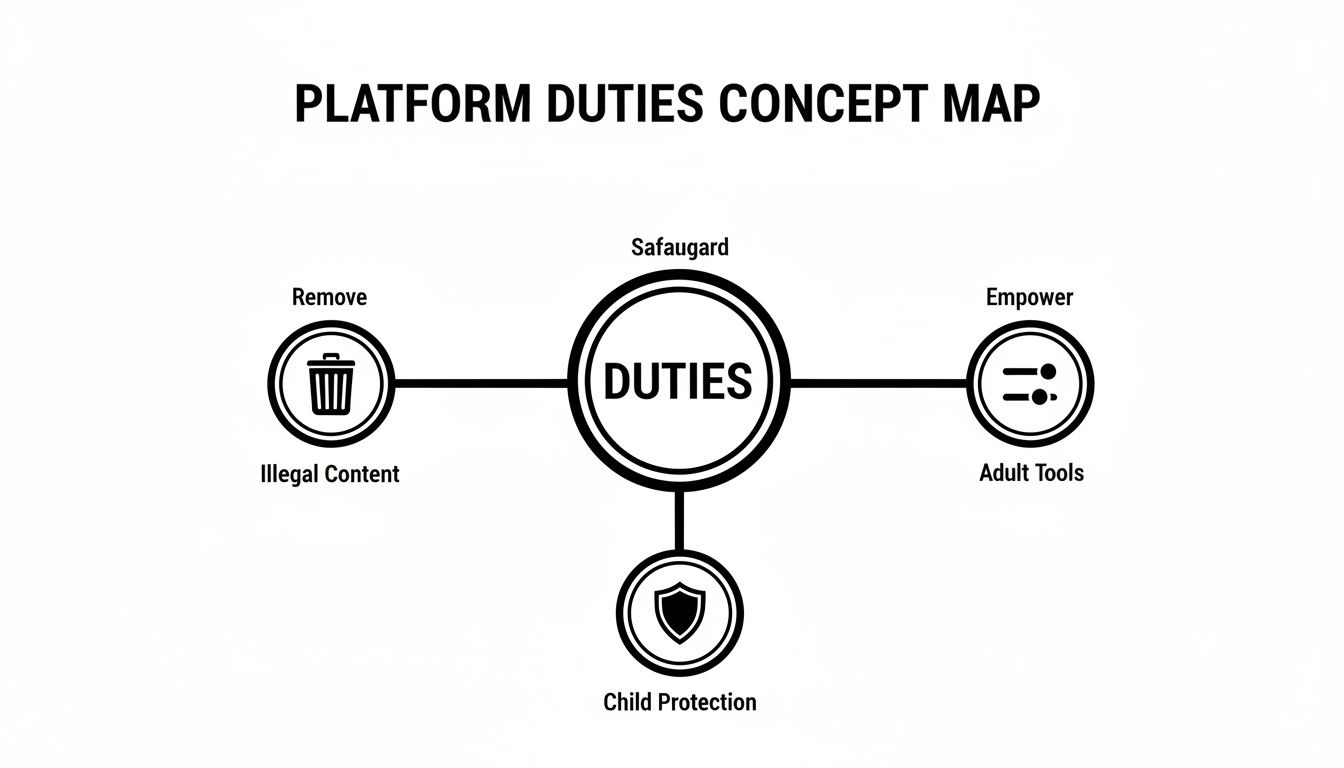
As you can see, robust age checks are no longer a footnote. They are a central pillar of a platform’s legal obligations, sitting right alongside removing illegal material and giving adults more control over what they see.
What Does ‘Highly Effective’ Actually Mean?
Let’s be clear: this isn't about just ticking a box or promising you're old enough. Ofcom expects platforms to use real, solid methods to verify a user's age. This is perhaps the single biggest operational hurdle the adult streaming world has ever faced, and it completely rewires the user experience.
The government isn't doing this on a whim. The push for these measures came after Ofcom’s own research revealed a shocking statistic: an estimated 60% of 13-17-year-olds had encountered potentially harmful content online. That finding put a huge amount of pressure on lawmakers to act decisively.
So, in practice, what kinds of checks should you expect to see popping up?
- Facial Age Estimation: This tech is pretty clever. It uses your device’s camera to analyse your facial structure and estimate your age without ever saving the photo. It’s quick, and because no image is stored, it’s one of the more privacy-focused options.
- Photo-ID Matching: This is the digital version of getting carded at a pub. You’ll be prompted to upload a photo of your government-issued ID, like a driving licence or passport, which is then verified by a specialised third-party service.
- Digital ID Apps: Think of this like a digital passport you keep on your phone. You go through a one-time verification process with a dedicated app. Afterwards, that app can simply confirm to websites that you're over 18 without handing over any of your other personal details.
The Trade-Off: Safety vs. Anonymity
There’s no way to sugar-coat this: for UK users, this is the end of true anonymity when accessing adult content. This new reality forces a tough but necessary conversation about the balance between online safety and personal privacy.
Naturally, the first question on everyone's mind is, "What happens to my data?" The system is specifically designed so that the adult websites themselves never see or store your personal ID. The entire verification is handled by a separate, regulated company whose only job is to send a simple "yes, this person is an adult" or "no, they are not" back to the website.
The crucial distinction here is verifying your age, not your identity. The law’s goal is to confirm you are an adult, not to know which adult you are. For creators, this means you can—and absolutely should—continue using a stage name and keeping your professional persona completely separate from your real-world identity.
This new system is a compromise, plain and simple. While it does add a new step to the process, it's also designed to create a more professional and verifiably adult-only space. To get a better feel for the specific technologies involved, it's worth learning more about how a modern age verification app works. Understanding the mechanics can make the whole process feel a lot less intimidating.
How the Act Impacts Your Content and Your Income
So, what does all this legal talk actually mean for your streams and, more importantly, your bank balance? Frankly, with platforms now facing eye-watering fines for getting it wrong, they’re going to get cautious. Really cautious. Expect them to enforce their terms of service far more strictly and be much quicker to act on any content they see as a risk.
The bottom line is that your creative freedom and your income are now tied to your platform's appetite for risk. A performance that was once considered edgy or catered to a specific niche might now get flagged by an overzealous algorithm. For creators who like to push the envelope, this could mean more content takedowns, frustrating shadowbans, or even account suspensions while platforms scramble to figure out their new obligations.
The Double-Edged Sword of Moderation
On the one hand, this pressure to clean house means platforms will almost certainly rely more heavily on automated moderation. These AI systems can be great for catching obvious violations, but they are notoriously clumsy when it comes to understanding context, satire, or the specific nuances of kink.
Imagine this: you’re performing a scene that involves intricate rope work or a particular fetish. The algorithm, trained on a narrow set of data, could easily misinterpret it as something non-consensual. Your stream could be shut down mid-performance and your account flagged instantly, leaving you to fight a long battle with an overwhelmed support team.
The real danger here isn't just losing out on a single stream's income; it's the risk of having your entire account penalised because a machine misunderstood your work. This makes it more critical than ever to know your platform's rules inside and out and to keep your own records.
On the other hand, there is a silver lining. The Act's tough stance on illegal content brings a much-needed crackdown on things like non-consensual material and content theft. This is a huge win for creators. For years, fighting piracy has felt like a hopeless game of whack-a-mole. Now, platforms have a powerful legal and financial reason to give you better tools to protect your content and act swiftly against people who steal it.
‘Legal but Harmful’ and Your Creative Freedom
Things get even more complicated for the biggest players in the game. By 2026, these ‘Category 1’ services will also have to tackle what the Act calls ‘legal but harmful’ content for adults. This covers sensitive topics like the promotion of self-harm or eating disorders.
This part of the law is really about giving adult users more direct control. Platforms will be required to provide robust filtering tools, letting viewers simply opt out of seeing certain types of legal content they would rather not encounter.
For you, as a creator, this introduces a new balancing act:
- More Viewer Control: A user who isn’t interested in seeing content related to a specific fetish can now easily filter it out. This means your potential audience for that niche might shrink.
- Potential for ‘Soft’ Censorship: Even if your content is perfectly legal, if enough users filter it out or the platform decides it’s too “risky,” it could be demoted by algorithms. This directly impacts your visibility and, as a result, your income. Our guide on how cam platforms make money explains just how much visibility affects your earnings from things like tips and private shows.
Ultimately, the online safety act 2023 is pushing the entire industry to become more professional. While it certainly introduces new hurdles for creativity and your finances, it also holds the promise of a safer, more accountable space where your work—and your safety—are better protected.
The Real Consequences for Non-Compliant Platforms
For years, platforms could get away with a digital shrug when things went wrong on their watch. The Online Safety Act 2023 brings that era to an abrupt and expensive end. This law isn't a set of polite recommendations; it's a rulebook backed by some of the toughest penalties in the world. The old mantra of "move fast and break things" is dead and buried. Now, it's "comply or pay."
The financial penalties alone are enough to make boardrooms in Silicon Valley sit up and listen. This isn't a slap on the wrist. A platform that fails to comply faces fines of up to £18 million or 10% of its global annual turnover—whichever figure is higher. For the big players, that could easily run into the billions, a powerful incentive to finally get their house in order. You can get a sense of the staggering scale of these potential fines and the new duties they enforce in more detail.
It’s Personal: Risk for the People in Charge
But here’s where the Act gets really interesting. For the first time, it introduces a level of personal accountability that is completely new to the tech industry. Senior managers can no longer hide behind the corporate veil. If they deliberately ignore their responsibilities or fail to protect users, they can now face criminal charges.
We’re not talking about a theoretical threat. This could mean up to two years in prison for executives found to have wilfully failed in their legal duties.
This changes everything. It’s a deliberate strategy to force a profound cultural shift right from the top. When an executive's personal freedom is on the line, user safety suddenly becomes a top-tier priority, not just a line item for the legal department.
This creates a powerful reason for platforms to embrace the spirit of the law, not just tick the boxes. The goal is to weave safety into the very fabric of their business model.
What This Accountability Means for You
This new era of accountability isn't just about punishing platforms; it's about rebalancing the power dynamic in your favour. The scales are finally tipping away from the tech giants and back towards the creators and users who make their sites valuable in the first place.
So what does this mean in practice?
- Your Complaints Have Teeth: When you report a serious issue, like content theft or a safety threat, platforms are under immense legal pressure to act. Ignoring legitimate reports is now a very risky and expensive game for them to play.
- A Fairer Appeals Process: If a platform wrongly takes down your content or suspends your account, you have a much stronger position. The Act demands clear and accessible appeals processes, so you’re no longer just shouting into a void.
- A Cleaner, Safer Environment: The crackdown on illegal content, driven by the threat of massive fines, will inevitably push bad actors off major platforms. This helps clean up the ecosystem for legitimate creators who are playing by the rules.
Ultimately, the Online Safety Act 2023 means platforms can no longer treat your safety as an optional extra. It is now a core, legally-mandated part of doing business in the UK. For creators, this should mean a more professional, accountable, and, hopefully, much safer place to build a career.
Your Creator Safety Checklist for the New Era
The Online Safety Act 2023 is here, and it’s forcing big changes on the platforms we use every day. As they scramble to comply, their rules and automated systems are going to get a lot more aggressive. This isn't just a bit of legal paperwork; it's a fundamental shift that directly affects your content, your account, and your income.
Getting ahead of these changes is about being smart and proactive. Here’s a practical guide to protecting your career in this new, heavily regulated environment.
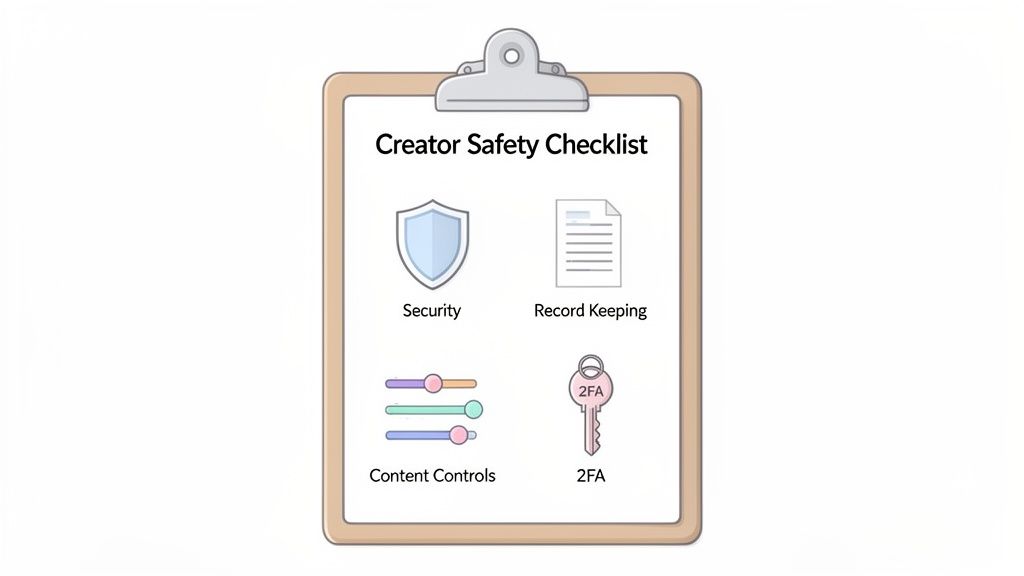
Audit Your Digital Security
Let's start with the basics: locking down your accounts. If a platform offers two-factor authentication (2FA), you need to turn it on. Right now. It is the single best defence against someone hijacking your profile and, with it, your entire business.
Think of your password as the key to your house. 2FA is the security alarm and deadbolt. Even if someone steals your key, they still can't get in without the separate code from your phone.
- Activate 2FA Everywhere: Don't just stop at your streaming platform. Enable it on your payment accounts (like Paxum or PayPal) and, most importantly, the email address that everything is tied to.
- Use Strong, Unique Passwords: Never reuse passwords. It’s a pain, but a good password manager can create and store complex passwords for you, making this much easier.
- Keep Work and Personal Separate: Use a dedicated email for your creator brand. Never link your professional accounts back to your personal Facebook or private email address. This creates a firewall between your public persona and your private life.
Master Your Platform’s New Tools
Platforms are now legally required to give you more control over your experience. This means new privacy settings, better filtering options, and clearer ways to report issues. It’s your job to find these tools and learn how to use them. They are your first line of defence.
Because of the Online Safety Act 2023, you should see better reporting mechanisms and clearer appeal processes, which help hold platforms accountable to their own rules. You can find more detail on how the Act empowers users on Ondato.com.
Think of your platform's new privacy dashboard as the control panel for your career. You need to learn where the emergency stop button is before you need to use it. Find out how to block entire regions, filter your chat, and manage who can even send you a message.
Document Everything Meticulously
In a world run by algorithms, you have to be your own best advocate. Automated moderation makes mistakes—a lot of them. AI flags are notoriously clumsy and lack context. Your own meticulous records are the only insurance you have when you need to fight a wrongful suspension or content takedown.
Your Dispute-Ready Toolkit should include:
- Read and Save the Terms of Service: Every time you log in, download a PDF of the platform's current Terms of Service and content guidelines. When they update them (and they will), save the new version too. This gives you dated proof of what the rules were at any given time.
- Keep Records of Your Content: Maintain a private archive of your streams, especially if your content is niche or pushes boundaries. A short, out-of-context clip might get you flagged, but having the full VOD can prove your innocence.
- Screenshot All Communications: Save every single email, support ticket, and official message you have with your platform. If a support agent tells you something is okay and you get banned for it later, that screenshot is your golden ticket.
This isn’t about paranoia; it’s about professionalism. By taking these concrete steps, you’re doing more than just navigating a new law—you’re taking firm control of your business and building a career that can weather any storm.
Common Questions About the Online Safety Act
Still have questions? You're not alone. The Online Safety Act 2023 is a complex beast, and there's a lot of confusion and dodgy information flying around. To clear things up, let's tackle some of the most common queries we see from UK creators and viewers.
Does This Law Ban Pornography in the UK?
No, absolutely not. This is probably the biggest misconception out there, so let's be crystal clear: the Act is not designed to ban legal adult content. Its two main goals are simply to stop children from seeing it and to get genuinely illegal material off the internet for good.
For consenting adults, the law is actually about giving you more control, not less. It forces platforms to provide tools that let you filter out the kinds of content you’d rather not see. They also have to be transparent about what is and isn't allowed on their site. Legal adult content, made by and for consenting adults, remains completely legal.
What Do I Need to Do as a Creator to Comply?
From a legal standpoint? Nothing. The duty to comply with the Online Safety Act 2023 falls squarely on the shoulders of the platforms, not individual creators. You are not going to get a knock on the door from the regulator.
However, you will be directly affected by the changes platforms make to stay on the right side of the law. This means you will almost certainly have to go through more robust age and identity verification, both when signing up and to keep your existing account. You'll also need to adapt to their new content rules, which are likely to be stricter.
Your main responsibility is simple: stay informed. Read your platform's updated terms, learn their new rules, and master the safety and privacy tools they now have to provide. It’s about protecting your business by playing by the new rules of the game.
When Does This Actually Take Effect?
The Act officially became law back in October 2023, but it’s not a big-bang change. The regulator, Ofcom, is rolling out the rules in phases, so think of it as a slow and steady process.
The first phase, which focuses on tackling illegal content, is already being put into action. The bit that gets the most attention, though—the requirement for mandatory age verification on sites with pornographic content—isn't expected to be fully enforced until around 2026. So, while the law is in place, its biggest impacts will arrive gradually.
What if a Platform Is Based Outside the UK?
It makes no difference where the company’s head office is. The Online Safety Act 2023 applies to any service that is accessible to people in the United Kingdom. If a webcam platform has a UK audience, it must comply with UK law.
And Ofcom has some serious power to enforce this. It can issue those massive fines we talked about (up to 10% of global turnover). For platforms that still refuse to cooperate, it can even work with internet service providers to have them blocked entirely for UK users. The days of hiding offshore are over.