Let's get straight to it: if you're making money as an online adult creator in the UK, that cash is taxable. Simple as that. Every subscription, tip, token purchase, or PPV sale is viewed by HMRC as income from self-employment, and you’re legally required to declare it.
Your No-Nonsense Guide to UK Creator Tax
So, you’ve started to see some income from Fansly, OnlyFans, or another platform. Fantastic. Now it’s time to tackle the bit no one enjoys: His Majesty's Revenue and Customs (HMRC). It’s tempting to see the money hitting your bank account after the platform’s 20% cut as just a bit of 'side cash', but that's a fast-track to getting into hot water.
In the UK, the system for this is called Self Assessment. It’s the standard process for all self-employed people—which, congratulations, now includes you—to report their earnings and figure out how much tax they owe. It might sound daunting, but you're not alone; millions of freelancers and small business owners navigate this every single year.
The Magic Number You Need to Know
The most critical figure to burn into your memory is £1,000. This is your annual trading allowance.
Here's what it means for you:
- If your earnings are less than £1,000 in a single tax year (which runs from 6th April to 5th April), you don’t need to do a thing. No need to register with HMRC or file a tax return for this income.
- If your earnings are more than £1,000, you legally must register as self-employed with HMRC and file a tax return. It doesn't matter if you earn £1,001 or you're pulling in figures like the average OnlyFans income; once you cross that threshold, you're on HMRC's radar.
To give you a clearer picture, here’s a quick summary of what you need to do at different earning levels.
UK Creator Tax Obligations At a Glance
| Earnings in a Tax Year (6 April – 5 April) | What You Need to Do |
|---|---|
| £0 – £1,000 | You can use your trading allowance. No need to register or file a Self Assessment tax return. |
| £1,001 – £12,570 | You must register as self-employed and file a Self Assessment tax return. You won't pay Income Tax, but you will need to pay Class 2 National Insurance contributions. |
| £12,571+ | You must register as self-employed and file a Self Assessment tax return. You will pay Income Tax and both Class 2 and Class 4 National Insurance contributions on your profits. |
This isn't just friendly advice; it's a legal requirement. HMRC is actively looking at income from digital platforms, so trying to fly under the radar simply isn't a long-term strategy. You can read more about how HMRC is tackling the creator economy on taxadvisermagazine.com.
This guide is here to walk you through exactly what counts as income, how to get registered, what you can claim as expenses to lower your bill, and how to get your tax return filed without any drama. We're skipping the fluff and focusing on the practical steps you need to take to stay compliant and stress-free.
Decoding What Counts as Taxable Income
Right, let’s get into the nitty-gritty of what HMRC actually wants to see. One of the most common—and costly—mistakes creators make is thinking their taxable income is the cash that finally hits their bank account.
Unfortunately, it’s not that simple. HMRC is interested in your gross earnings. This is the total amount your fans paid you before any platform took its slice.
Thinking you only need to declare the net figure is a fast track to a tax headache. For example, if a fan subscribes for £10, you have to record £10 as income. It doesn't matter if you only see £8 of it after fees. That missing £2 is a business expense, which we’ll cover later, but you can’t just pretend the initial £10 never existed.
This rule applies to every single penny you earn online.
From Tokens to Tips: What to Track
Your income isn't just one big payment. It’s a mix of dozens, or even hundreds, of different transactions that all add up. Your job is to keep a clear record of every single one.
Here’s a breakdown of the typical income streams you absolutely must declare:
- Monthly Subscriptions: The recurring payments from fans for access to your main content feed.
- Pay-Per-View (PPV) Content: Any money made from selling individual photosets, videos, or private messages.
- Live Stream Earnings: This covers tokens, tips, or whatever currency fans use during a cam show.
- Private Session Fees: The direct earnings from one-on-one shows, calls, or custom video chats.
- One-Off Tips: Any direct "tips" or payments sent by fans that aren't tied to a specific piece of content.
For cam models, there’s an extra step: converting platform currency. If a fan tips you 100 tokens during a stream, you can't just jot down "100 tokens" in your spreadsheet. You need to find the exact value of those tokens in pounds sterling at that moment and record that figure. Platforms provide detailed statements breaking this down, so make it a habit to download and save them every month. For a deeper dive into this, check out our guide on how cam models get paid.
The Golden Rule: If a fan or customer paid money for it, it’s almost certainly taxable income. Your responsibility is to record the full amount they paid, not just what you pocketed after fees.
What About Gifts and Wishlists?
This is where the lines can get a bit blurry, but HMRC’s position is actually quite clear. If you receive something from an Amazon Wishlist (or a similar service) as a direct part of a transaction—say, "buy me this lingerie set and I'll wear it in a private show"—then it’s not really a gift.
It's what the tax office calls 'payment in kind'. This means its cash value is treated as taxable income. You have to declare the price of that item just as if you'd been paid the money directly. Genuine, unsolicited gifts sent with no strings attached are a grey area, but the second it becomes part of a deal, it’s income.
The earnings spectrum for creators is massive. While top performers pull in millions, the tax rules apply just the same to those with smaller followings. In 2023, creators on just one platform earned a collective $5.32 billion, with the average creator grossing around $1,800 annually before the platform's 20% cut. You can find more details in this OnlyFans revenue and creator data report on upmarket.co. Every single pound of that, once you're over the £1,000 trading allowance, needs to be accounted for.
How to Register as Self-Employed with HMRC
Right, let’s tackle the first piece of admin that makes most creators feel a little nervous: officially telling HMRC you’re in business. Registering as self-employed sounds daunting, but honestly, it’s just an online form. Think of it less like a courtroom summons and more like applying for a library card—just with slightly bigger consequences if you forget.
For almost every online adult creator out there, the most direct and common path is registering as a sole trader. This is the standard setup for any one-person business in the UK. In simple terms, it means you and your business are one and the same in the eyes of the law, which keeps things nice and straightforward.
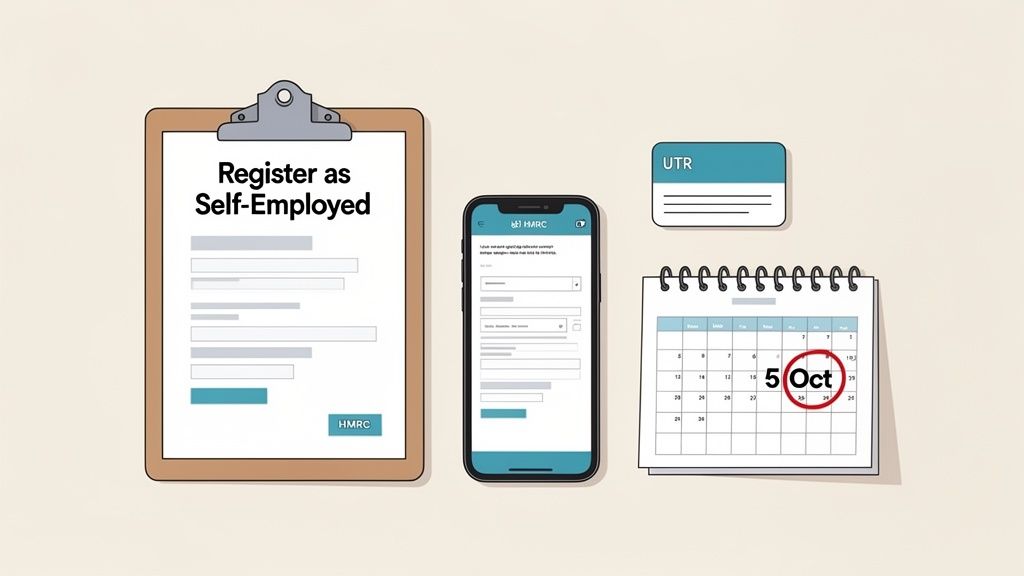
The most crucial thing to burn into your memory is the deadline. You have to register with HMRC by 5th October following the end of the tax year you started trading and earned over that initial £1,000. So, if you started making money in January 2024 (which falls in the 2023-2024 tax year ending 5th April 2024), your deadline to register is 5th October 2024. Don't let it slip by.
Getting Yourself Registered, Step by Step
You can do the whole thing online through the GOV.UK website. Before you dive in, it’s smart to get a few key bits of information ready. It'll make the process much smoother and less of a headache.
Here’s what you’ll need to hand:
- Your National Insurance Number: You'll have this. It’s on any old payslips, P60s, or letters about tax or benefits.
- Your Personal Details: Just the basics—full name, date of birth, address, phone number, and email.
- Your 'Business' Start Date: This is just the day you first started earning from your content. Be honest, but don’t stress over it; an approximate date is absolutely fine.
- The Nature of Your Business: They’ll ask what you do. You don't need to write a detailed essay about your niche. Something simple and factual like "Internet Content Creator" or "Online Performer" works perfectly.
Once you’ve submitted the form, HMRC will do its thing. In a few weeks, a very important letter will arrive through your door containing your Unique Taxpayer Reference (UTR) number.
Your UTR Number is Your Golden Ticket
Think of this 10-digit UTR number as your personal account number with HMRC. You’ll need it for everything tax-related, from filing your return to talking to an accountant. Guard it with your life.
What About Setting Up a Limited Company?
You’ll probably hear people talking about setting up a limited company. While it's true this can offer some tax efficiencies for very high earners and creates a legal wall between your personal and business finances, it’s also a whole different level of complexity. It brings a lot more admin, stricter reporting rules, and pretty much means you’ll need an accountant from day one.
For most creators, especially when you're just starting, sticking to the sole trader route is by far the most practical and sensible choice. You can always make the switch to a limited company later on if your income skyrockets and the benefits start to outweigh the extra hassle. For now, keep it simple.
Claiming Every Allowable Business Expense
This is where you get to be smart with your money. Claiming business expenses is how you legally lower your profit figure, which, in turn, cuts down the amount of tax you owe. Think of it as your reward for being organised and running a tight ship.
But be warned: this is also the area where honest mistakes can lead to serious headaches with HMRC.
The golden rule you need to live by is the ‘wholly and exclusively’ principle. It’s a bit of HMRC jargon, but it simply means you can only claim for costs that were generated purely for your business. It sounds strict, but for an online creator, the list of legitimate costs you can and should be claiming is actually pretty long.
What about things you use for both work and personal life? That’s completely fine. You just need to figure out a fair and reasonable split. Say your laptop is used 80% of the time for streaming, editing, and admin, and 20% for watching Netflix. Simple – you can claim 80% of its cost against your tax. Just be honest and realistic with your numbers.
Your Essential Creator Expense Checklist
Let's get into the nitty-gritty. Here are the common expenses that apply directly to your work as an online adult creator. Keeping receipts and records for these is an absolute must.
- Equipment and Tech: This is a big one. It covers your camera, studio lighting, microphones, laptop or PC, and even the phone you use for creating content and managing your social media.
- Props and Wardrobe: Lingerie, costumes, toys, and any other specific items you buy solely for your content are allowable. This is a classic example where the 'wholly and exclusively' rule really matters.
- Platform Fees: You know that 20% (or whatever your platform charges) slice taken from every sub and tip? That’s a 100% allowable business expense. You have to declare your gross income first, and then you deduct this fee as a cost of sale.
- Software and Subscriptions: This includes your video editing software, photo apps like Facetune or Lightroom, VPN services for security, or any other digital tool you pay for to keep your business running.
- Marketing and Promotion: Paid for a shoutout from a bigger creator? Run ads on social media to find new fans? These are marketing costs and are perfectly claimable.
- Professional Fees: The fee you pay an accountant to handle your tax return or a solicitor for advice is an allowable business expense. Honestly, a good accountant often saves you more than they cost.
Working From Home Expenses
Let’s be real, most creators work from a home studio—which is often just a corner of the bedroom. The good news is this means you can claim a portion of your household running costs. You can’t just write off your entire rent, but you can calculate the business percentage of your key bills.
This includes a portion of:
- Your rent or mortgage interest (important: not the capital repayment part of a mortgage)
- Council Tax
- Gas and electricity bills
- Your broadband bill
To figure this out, you need a sensible method. A common approach is to work out what percentage of your home is your dedicated workspace. For instance, if your studio setup takes up 15% of your home's floor space, you can apply that percentage to your utility bills.
HMRC's Simplified Option: If that sounds like too much number-crunching, HMRC offers 'simplified expenses'. This is just a flat monthly rate you can claim based on the hours you work from home. It saves you from dissecting every bill and is much, much easier, though often a little less generous.
What You Absolutely Cannot Claim
Getting this wrong is one of the fastest ways to get your tax return flagged for a closer look, so pay attention here. The 'wholly and exclusively' rule means many things that feel like they're for work are actually considered to have a 'dual purpose' and are therefore a no-go.
Common Allowable vs Non-Allowable Creator Expenses
This table gives you a quick and easy comparison to help you identify valid business expenses and steer clear of the common traps.
| Expense Category | Generally Allowable (If 'Wholly & Exclusively' for Business) | Generally Not Allowable |
|---|---|---|
| Clothing | Specific costumes, lingerie, or uniforms bought only for content creation. | Everyday clothing, even if you happen to wear it on stream. HMRC sees this as having personal use. |
| Personal Care | N/A | Gym memberships, haircuts, manicures, spray tans, cosmetic surgery, or general makeup. HMRC classes these as personal maintenance, not a business cost. |
| Food & Drink | N/A | Your daily coffee, lunch while working at home, or groceries. These are considered everyday living costs. |
| Travel | Journeys to a specific photoshoot location or an industry event. | Your daily commute (if you had one) or any personal travel. |
The logic here can feel a bit frustrating. Of course your appearance is part of your brand! But HMRC’s rules are very firm on this. Trying to claim a gym membership or your everyday foundation is a surefire way to attract the wrong kind of attention.
Stick to the clear-cut, legitimate expenses, and you’ll keep your tax affairs clean, simple, and stress-free.
Filing Your Self Assessment and Paying National Insurance
Right, this is where it all comes together: filing your tax return. After a year of carefully logging all your income and expenses, the Self Assessment is how you report your final figures to HMRC. It might sound intimidating, but think of it as just an online form where you declare your business's performance for the year.
The most important date for your diary is 31st January. This is the non-negotiable deadline to file your online return and pay what you owe for the previous tax year. Miss it, and you're looking at instant penalties, so circle it in red!
The form itself is relatively straightforward. It asks for the two main numbers we've been talking about: your total income (all that cash from subs, tips, and PPV before platform fees) and your total allowable business expenses. The system then does the maths for you, subtracting your costs from your income to arrive at your profit – the figure that tax is actually calculated on.
Understanding Your Tax and National Insurance Bill
Once you hit submit, HMRC works out your final bill. This isn't just one lump sum; it's made up of Income Tax and National Insurance contributions. As a self-employed creator, you'll usually be dealing with two types of National Insurance.
Let's break them down:
- Income Tax: This is the main tax on your profits. It's applied in bands, meaning you only pay higher rates on the slice of your profit that falls into those higher bands. For the 2024/25 tax year, the basic rate is 20% on profits between £12,571 and £50,270.
- Class 2 National Insurance: Think of this as a flat-rate weekly payment that gives you access to state benefits like the State Pension. For 2024/25, you only have to pay it if your profits are over £12,570, and it’s a fixed £3.45 per week.
- Class 4 National Insurance: This is an extra contribution based on a percentage of your profits. You'll pay 6% on profits that fall between £12,570 and £50,270.
This is why tracking your expenses is so vital – every legitimate cost you claim directly reduces your profit and, therefore, your final tax bill.
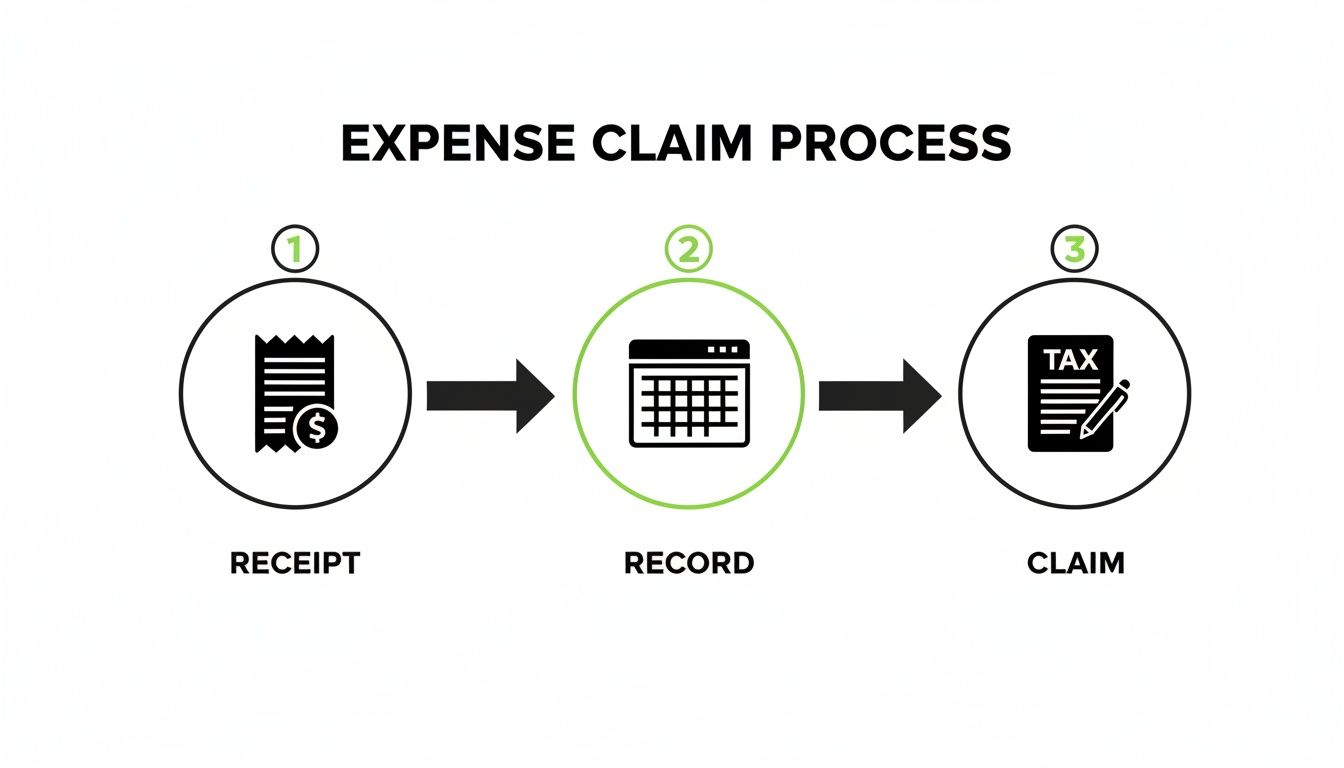
The flow is simple: get a receipt for a business cost, record it properly, and then claim it on your tax return. Simple, but powerful.
A Worked Example: The Tax Calculation in Action
Let's put some real numbers to this. Meet Alex, a UK-based creator who has had a decent year. Here’s a simplified look at their finances:
- Gross Income (all subs, tips, PPV): £35,000
- Total Allowable Expenses (platform fees, props, internet etc.): £9,000
- Taxable Profit (£35,000 – £9,000): £26,000
So, how would HMRC calculate Alex's tax bill for the 2024/25 tax year?
Income Tax Calculation:
- Alex's profit is £26,000.
- The first £12,570 is tax-free thanks to the Personal Allowance.
- This leaves a taxable amount of £13,430 (£26,000 – £12,570).
- Income Tax is 20% of £13,430 = £2,686.
National Insurance Calculation:
- Class 2: Alex’s profit is well over the £12,570 threshold, so they pay the full year's flat rate. That’s £3.45 x 52 weeks = £179.40.
- Class 4: Alex pays 6% on the same slice of profit that was subject to Income Tax. So, 6% of £13,430 = £805.80.
Total Tax Bill:
- £2,686 (Income Tax) + £179.40 (Class 2 NI) + £805.80 (Class 4 NI) = £3,671.20.
This example makes it crystal clear how important those expenses are. If Alex hadn't bothered to claim that £9,000 in costs, their profit would have been the full £35,000, and their tax bill would have been thousands of pounds higher. It really does pay to be organised.
A Quick Word on Payments on Account: Heads up! If your final tax bill is over £1,000, HMRC will probably ask you to make 'payments on account'. These are essentially advance payments towards your next year's tax bill, paid in two chunks. It catches a lot of newly self-employed people off guard, so don't be surprised if your first bill feels much bigger than you expected.
The sheer scale of the creator economy means the government can't afford to ignore it, which is why getting your personal tax affairs in order is so important. For a bit of perspective, UK-based OnlyFans paid a staggering £110 million in corporation tax in 2023 – a figure that absolutely dwarfed the £7.2 million paid by Starbucks. This shows just how seriously HMRC takes the revenue from these platforms, and you can read more about OnlyFans' UK tax contributions on spectator.com.
Keeping Good Records Without Losing Your Mind
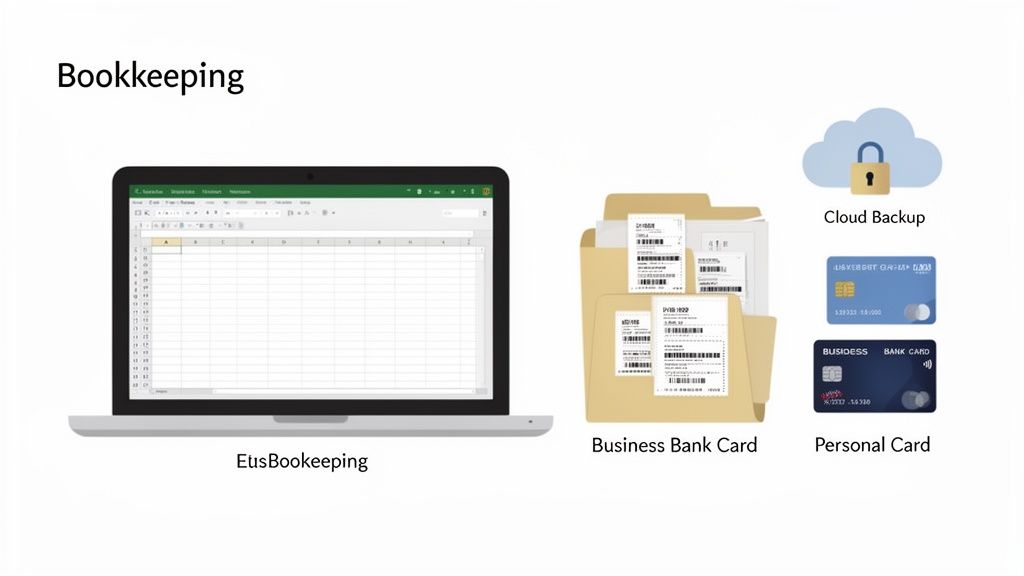
Let's be honest, bookkeeping is probably the last thing you want to think about. But getting it right is your best defence if HMRC ever decides to take a closer look at your business. Think of it as the necessary admin that keeps your creative career on solid, legal ground. Putting it off only leads to last-minute panic, forgotten expense claims, and the risk of some nasty penalties down the line.
The great news? You don’t need to be an accountant. For most creators, a simple spreadsheet is perfectly fine. Just create one tab for all your income (the gross figure, before any platform fees) and another for every single business expense. Get into the habit of updating it every time you receive a payout or buy something for work. It turns a potential nightmare task into a manageable five-minute routine.
If the very thought of a spreadsheet makes you want to run for the hills, there are some brilliant, easy-to-use accounting software options out there. Tools like QuickBooks or FreeAgent can connect directly to your bank account, making it so much simpler to track and categorise everything as it happens.
What to Keep and For How Long
HMRC’s rule on this is crystal clear: you have to keep your business records for at least five years after the 31st January submission deadline for that tax year. To be on the safe side, I always tell people to just hang onto everything for six years. It might seem like a long time, but it's one of those non-negotiable parts of being your own boss.
So, what exactly do you need to file away (digitally, of course)?
- All platform payout statements: These are your non-negotiable proof of income. Make a habit of downloading them every single month.
- Receipts for all expenses: This includes email receipts for things you buy online (like props, software, or lingerie) and clear photos of any paper receipts.
- Bank statements: These are vital for matching up the money coming in and going out with the records you've kept.
Your records are your evidence. If you don't have a receipt to prove an expense, you can't claim it. And if you can't prove your income, HMRC will estimate it for you – trust me, you won't like their number.
Protecting Your Privacy and Your Sanity
Juggling payments from multiple platforms while keeping your personal name separate from your creator persona is a massive headache. This is exactly why a separate business bank account is non-negotiable.
Opening a dedicated bank account for your creator earnings isn't just a smart move; it's essential for both anonymity and organisation. It builds a clean wall between your personal life and your business finances, which makes your bookkeeping infinitely easier. Having that one dedicated account means you can see all your income and outgoings in one place, which also helps you sidestep frustrating payout delays from the platforms. For more on that, take a look at our guide on how to avoid payout delays on cam sites.
Using a separate account (which will have to be in your legal name) is also a powerful way to protect your privacy. Your fans and the platforms only need to see your business details, while the link to your personal identity remains between you and your bank. It’s a simple, professional step that brings huge peace of mind and makes tax season feel a lot less like a crisis. Seriously, get this sorted from day one.
Your Top UK Creator Tax Questions Answered
We’ve worked through the essentials, but let's be honest, tax often throws up some weird and wonderful questions. This is where we tackle a few of the most common – and often most confusing – scenarios that creators find themselves in.
Do I Have to Pay Tax on Gifts from My Amazon Wishlist?
This is a classic for a reason, and it’s a bit of a grey area. HMRC’s view boils down to one simple question: was it a genuine gift, or was it a transaction?
Think of it like this: if a fan buys you something in direct exchange for a service ("buy me this lingerie set and I'll do a custom photoshoot in it"), then it’s not really a gift. It's what HMRC calls 'payment in kind'. You need to treat the item's cash value as taxable income and log it just like any other payment.
If, on the other hand, a gift arrives completely out of the blue with no strings attached, it's far less likely to be considered income. The line can be blurry, though. The safest approach? Keep a detailed record of everything. If you're ever unsure, it’s always best to chat with an accountant.
What Happens If I Haven't Declared My Income for Years?
First things first: don't panic. The absolute worst thing you can do is ignore it and hope HMRC doesn't notice. They have sophisticated systems, and sooner or later, they probably will.
Here’s the good news: HMRC is much more lenient with people who hold their hands up and come forward voluntarily. You can do this through a process known as a voluntary disclosure, which is basically a way of bringing your tax affairs up to date.
You will almost certainly have to pay the tax you owe, plus interest and some penalties. But these will be a fraction of the fines you'd face if HMRC has to launch an investigation to find you. Your best bet is to get a tax professional on your side. They can work out what you owe and handle the whole disclosure process for you, taking a huge weight off your shoulders.
Should I Register for VAT as an Adult Creator?
You are only legally required to register for VAT if your total taxable sales – that’s your gross income before any expenses, not your profit – tip over the VAT threshold in any rolling 12-month period. For the 2024/25 tax year, that threshold is £90,000.
However, there’s a vital detail here for most platform-based creators. Big players like OnlyFans are already UK VAT-registered. They effectively handle the VAT on the services provided to your fans, which often means you don't have to register personally, even if your own earnings sail past the threshold.
Don't just assume this is the case, though. You must read the terms and conditions for every single platform you use. If you also make money from your own website or other direct sales, you need to track that income separately. VAT is notoriously tricky, so if you see your income getting anywhere near that £90,000 mark, it's non-negotiable: you need to get professional advice.