Let’s cut to the chase: yes, your cam earnings are absolutely taxable in the UK. Every token, tip, subscription, or private show payment is considered income by HM Revenue and Customs (HMRC). Trying to pretend otherwise is a surefire way to invite a world of financial pain and late-night panic down the line.
Are UK Cam Earnings Really Taxable? The Short Answer
There’s a persistent myth that money earned through tokens or platform tips somehow flies under the radar. Many new models figure that because the payment systems feel a bit like Monopoly money or are based overseas, the income doesn't count. That's a dangerously expensive mistake to make.
As far as HMRC is concerned, it makes zero difference whether your money comes from a monthly salary or from viewers on a streaming site. Income is income, and it all gets thrown into the same tax pot. Your career as a cam model is seen as a form of self-employment, which, by default, makes you a sole trader in the eyes of the tax man.
The Magic Number: Understanding the £1,000 Trading Allowance
If there’s one number every UK-based creator needs to burn into their brain, it’s £1,000. This is your annual trading allowance—a handy tax exemption for people with smaller amounts of self-employed or casual income.
Here’s how it works in the real world:
- If you earn £1,000 or less from all your self-employed gigs (camming, OnlyFans, any other side hustles) in a tax year, you don't have to register with HMRC or declare that income.
- The moment you earn £1,000.01, you're legally required to register for Self Assessment and file a tax return.
Crucially, this allowance applies to your gross income. That’s the total amount of money your viewers spend before the platform skims its percentage and before you subtract any of your business expenses, like new lighting or outfits.
For instance, if your fans spend £1,200 on your content but the platform only pays out £840 after taking its 30% cut, your gross income for tax purposes is still £1,200. This means you’ve crossed the threshold and must register. It shows just how important it is to understand how cam models get paid to get your tax reporting right.
Here's a quick reference table to make it even clearer.
UK Webcam Earnings Tax At a Glance
| Earning Scenario | Is It Taxable? | Action Required |
|---|---|---|
| Gross cam earnings are £1,000 or less in a tax year. | No (covered by Trading Allowance) | None. You don't need to register or file a tax return for this income. |
| Gross cam earnings are £1,001 or more in a tax year. | Yes | You must register for Self Assessment with HMRC and file a tax return. |
| You have a PAYE job and earn over £1,000 from camming. | Yes | You must declare your cam income via a Self Assessment tax return. |
This table provides a simple overview, but remember that individual circumstances can vary. When in doubt, it's always best to get professional advice.
How HMRC Knows About Your Online Income
It’s easy to fall into the trap of thinking your online earnings are somehow invisible. The money flows from overseas platforms, through third-party payment apps, and sometimes even as digital tokens. It all feels very detached from a traditional payslip landing in your bank account each month.
But that’s a dangerous assumption to make. HMRC is far more clued-up than most people realise, especially when it comes to the digital world. The days of them relying on dusty paper trails are long gone. Today, they have a powerful digital toolkit designed specifically for the creator economy.
The belief that your income is hidden just because it passes through PayPal or a platform's own wallet is completely out of date. These are regulated financial companies, and HMRC has the power to demand data from them.
Meet Connect: HMRC's Digital Detective
HMRC's trump card is a powerful data-matching system called Connect. Imagine it as a giant digital spider's web, constantly pulling in and cross-referencing information from countless sources to spot anything that doesn’t add up. It’s not just peeking at your bank statements; it’s piecing together a comprehensive picture of your entire financial footprint.
Connect sifts through mountains of data from dozens of places, including:
- Payment Processors: Services like PayPal, Stripe, and other online payment gateways are all on HMRC’s radar.
- Bank Accounts: It scrutinises the flow of money in and out of both your personal and business accounts.
- Social Media: This one might surprise you. While your Instagram profile isn't a direct financial record, a public feed showing a lifestyle that clashes with your declared income can absolutely raise a red flag. Think lavish holidays and designer shopping sprees.
- Government Records: It compares what you tell them with data from other agencies, like the DVLA or the Land Registry.
This system is built to sniff out undeclared income from online work, which makes it incredibly risky to try and keep your earnings quiet.
HMRC's Connect system isn't just sitting there waiting for mistakes. It actively hunts for 'lifestyle mismatches'. If you're declaring £15,000 a year but your social media is a highlight reel of trips to Dubai and luxury purchases, the system is designed to flag that inconsistency for a human investigator to look into.
The Reality of Digital Tax Enforcement
This isn't just about clever software; it's backed by serious legal power. The Digital Economy Act of 2017 gives HMRC the legal authority to demand information from digital platforms specifically to clamp down on tax evasion. They don’t have to ask nicely; they can legally compel these companies to hand over data on who is earning what.
And it works. HMRC has become incredibly good at spotting undeclared income from content creators. For example, their advanced system can cross-reference data from over 30 different sources. In one real case, an influencer who declared an income of £18,200 was flagged by Connect. The system noticed a pattern of brand payments that were missing from her tax return, which eventually led to a £38,000 tax bill plus penalties. You can find more examples of how HMRC tracks online income on YouTube.
This isn't to scare you. It’s about being realistic. The digital trail you create is permanent and, for HMRC, it's accessible. In the creator economy, the only smart move is to be upfront, organised, and compliant from the very beginning.
Choosing How to Structure Your Business
Right, so you've accepted that HMRC will be taking a slice of your earnings. The next big question is how you'll actually set yourself up. This sounds far more formal and intimidating than it really is. For most creators in the UK, this choice boils down to two paths: operating as a sole trader or setting up a limited company.
Let's get one thing straight: this isn't about picking a cool name for your profile page. This is about the legal and financial structure you'll use to manage your money. Getting this sorted from the get-go will save you a world of stress down the line.
This flowchart maps out how visible your online earnings are to the tax authorities, which is a big factor when you're deciding how to set yourself up.
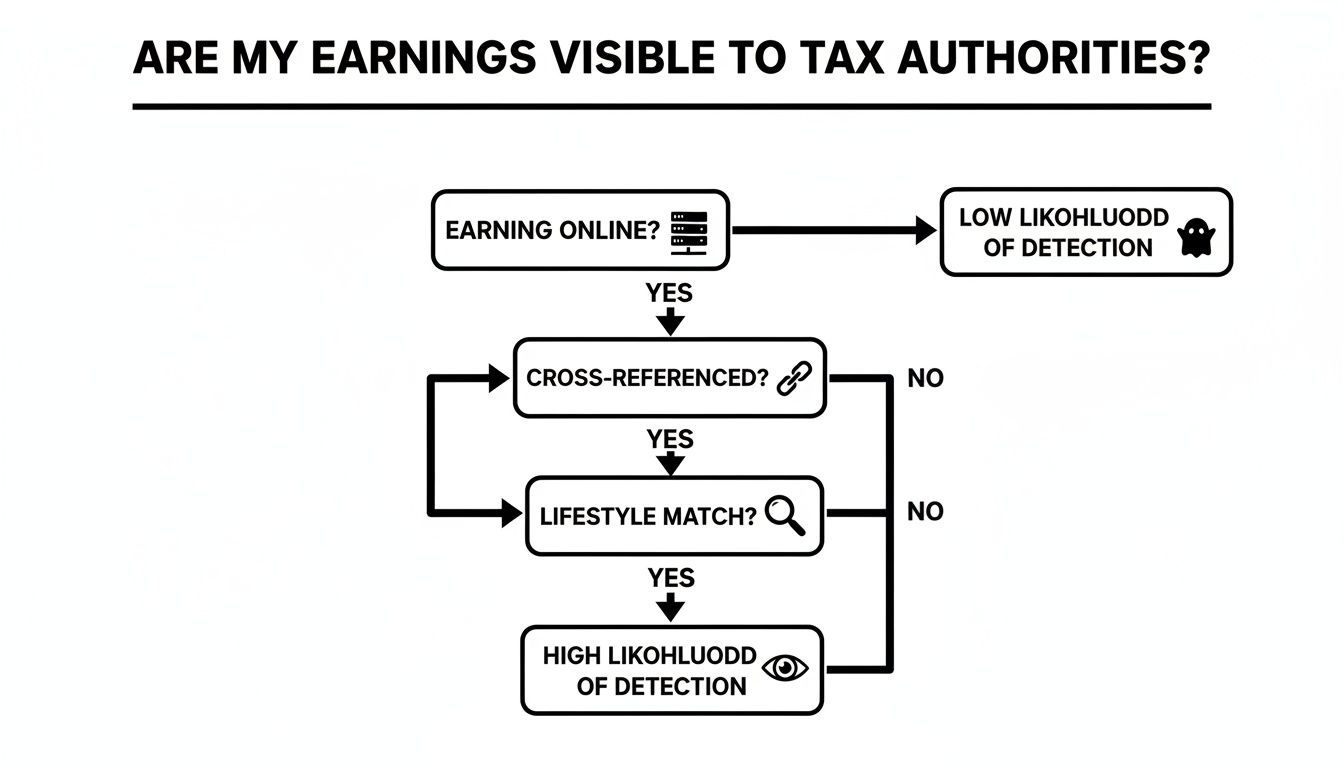
The main point here is that your financial footprint is rarely hidden. In our digital world, different bits of data are constantly being cross-referenced, and HMRC expects everything to match up.
The Sole Trader Path: The Go-To for Most Creators
Honestly, for about 99% of people starting out in the camming industry, becoming a sole trader is the perfect choice. It's by far the simplest, quickest, and cheapest way to get legitimate with HMRC. In fact, if you earn over £1,000 in a tax year and haven't set up a company, you are a sole trader by default.
Think of it this way: as a sole trader, you and your business are legally the same thing. There's no separation. The money you make is your personal income, and any business debts are your personal debts.
Here’s what that looks like in practice:
- Super Easy Setup: All you have to do is tell HMRC you’re self-employed. There are no registration fees with Companies House or anything complicated like that.
- Simple Bookkeeping: You just need to keep a record of your income (every payout from tokens, tips, etc.) and your expenses (that new ring light or your internet bill). Once a year, you report these figures on your Self Assessment tax return.
- You're in Full Control: After you've paid your tax, all the profits are yours to keep. You don't need to deal with the complexities of company accounts, corporation tax, or dividends.
The main drawback? It's something called unlimited liability. If your business were to get into debt, your personal assets—like your savings or even your home—could technically be at risk. For most cam creators, this risk is incredibly low, but it's something you should know about.
When to Think About a Limited Company
Setting up a limited company is definitely the next level. This involves creating a whole new legal entity that is completely separate from you. The company gets its own bank account, owns its own assets (like your equipment), and is responsible for its own debts. You'd usually be the director and main shareholder, paying yourself through a salary and dividends.
So, when does this actually make sense? It's generally a conversation to have when your income starts to get seriously high.
A limited company creates a 'corporate veil' between your personal finances and your business finances. This separation is the main draw, but it comes with a much bigger administrative burden.
Forming a company might be a smart move if:
- Your profits are consistently high (think £50,000+ a year): At this level, there can be tax advantages. Paying yourself with a small salary and taking the rest in dividends can sometimes lead to a lower overall tax bill than being a sole trader in a higher tax bracket.
- You want to protect your personal assets: Because the company is its own legal entity, its debts are its own. This is the limited liability we talked about.
- You're planning to build a bigger brand: If you see your camming work as the foundation for a larger adult entertainment business—maybe one that involves hiring other creators or selling merchandise—a company structure adds credibility and is much more flexible for growth.
But be warned, running a limited company means more paperwork, stricter deadlines, and almost certainly higher accountancy fees. It’s a big step up in complexity, which is why for the vast majority of creators, the sole trader route is the perfect fit to start with.
Juggling a Day Job and Your Cam Income? Here's How Tax Works
Working a 9-to-5 while building your career as a creator is a classic hustle. It’s incredibly common, and for good reason – it gives you a stable financial safety net. But, let's be honest, it does add a few extra wrinkles to your tax situation. The main thing to get your head around is that HMRC looks at all your income together, but it taxes each stream differently.
The biggest mistake people make? Assuming the tax paid on their main job through PAYE (Pay As You Earn) somehow covers their cam earnings. It absolutely doesn't. Your employer only deducts tax based on the salary they pay you, which means your self-employed income is entirely your responsibility to declare and pay tax on.
How Your Personal Allowance Works with Two Incomes
Every taxpayer in the UK gets a Personal Allowance – that's the amount you can earn each year before you start paying Income Tax. For the 2024/25 tax year, this figure is £12,570. This isn't a separate allowance for each job; you only get one, and it's applied to your total income.
In almost every case, your PAYE job will use up your Personal Allowance first. Say you earn £25,000 from your day job. That salary alone uses up the entire £12,570 allowance. This means every single pound you earn from camming, right from the very first one, is taxable.
This is a critical point that catches so many creators out. They think they can earn up to £12,570 from their streams tax-free, but if they have another job, that allowance is almost certainly already gone.
Think of your Personal Allowance like a single bucket. Your day job fills it up first. Any cam income you earn is like pouring water on top—it spills over immediately and becomes taxable.
National Insurance on Both Jobs
Then there's National Insurance (NI), which adds another layer. You'll probably end up paying two different types of NI, one for each income stream.
- On your Day Job (PAYE): You'll pay Class 1 National Insurance. Your employer sorts this for you, deducting it automatically from your payslip.
- On your Cam Earnings (Self-Employed): You are responsible for paying Class 4 National Insurance on your profits. You'll work this out and pay it as part of your Self Assessment tax return.
The rates and thresholds for each class are different, so you can't just lump them together. Paying NI on both employed and self-employed income is standard procedure. It’s interesting to see how this plays out when you consider the average OnlyFans income and what the tax bill might look like at various earning levels.
A Real-World Example
Let's make this practical. Picture a creator named Alex who works part-time in retail and also streams online.
- Retail Job Salary: £15,000 per year
- Cam Earnings (after expenses): £10,000 per year
Alex's total income is £25,000, which means they must file a Self Assessment tax return for the cam earnings. Their salary has already eaten up the £12,570 Personal Allowance, so the full £10,000 from streaming is subject to tax. This is a super common scenario, and it's vital to understand how these combined incomes affect your overall tax and NI bill.
This is exactly why you need to set aside money from your cam payouts specifically for tax. A good rule of thumb is to squirrel away at least 25-30% of every payment into a separate savings account. That way, when your tax bill lands, the money is already there waiting. No nasty surprises, no stressful financial hit. Juggling two income streams is totally manageable, as long as you plan for tax from day one.
Claiming Expenses and Keeping Good Records
When you’re self-employed, HMRC doesn’t tax you on your total earnings; they tax you on your profit. The simple formula is Profit = Income – Allowable Expenses. This is fantastic news because every legitimate business expense you claim directly reduces your profit, and therefore, reduces your tax bill.
Think of it this way: the money you spend to run your camming business isn’t really your money anymore. It’s a business investment. So, why should you pay tax on it? The government agrees, which is why they let you deduct these costs.
But there’s a catch. You have to be meticulous about it.
What Counts as a Business Expense?
The golden rule from HMRC is that an expense must be "wholly and exclusively" for your business. This means you can't claim for something that has a significant personal use, known as 'duality of purpose'.
For example, a specific costume you only wear on camera? That’s almost certainly an allowable expense. Your weekly food shop? Definitely not. The lines can get a bit blurry with things you use for both work and personal life, like your internet connection or your laptop. In those cases, you have to work out a reasonable business-use percentage.
Why Good Records Are Non-Negotiable
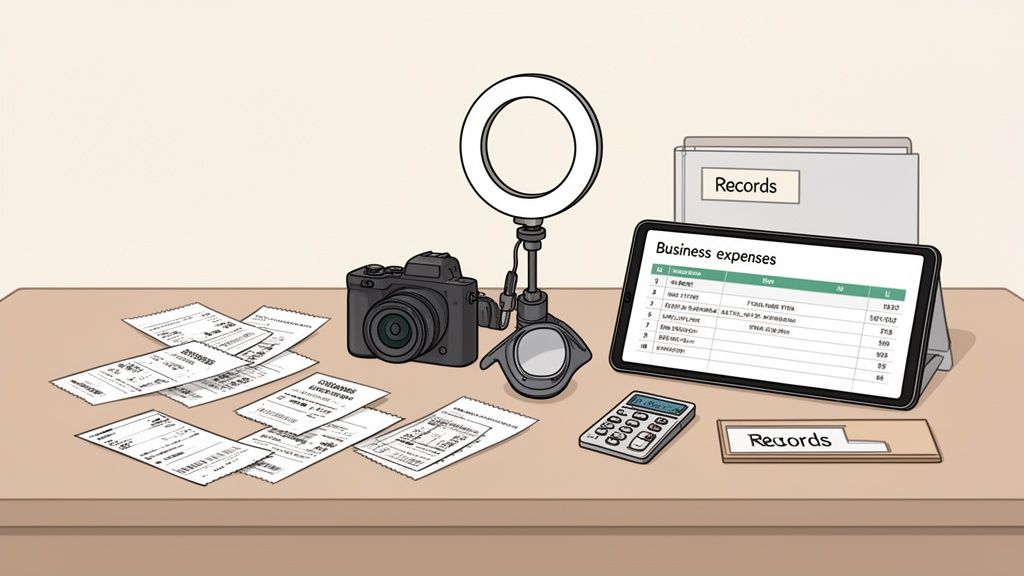
This isn't just about saving receipts in a shoebox (though that's a start!). Good record-keeping is your proof. If HMRC ever decides to take a closer look at your tax return, you’ll need to justify every single expense you've claimed.
Imagine you've bought a new high-end webcam. Without a receipt or bank statement showing the purchase, how can you prove you actually bought it for your business? You can't.
Keeping organised records from day one will save you a world of stress. It also gives you a clear picture of your business's financial health and helps you avoid payout delays by having your financial details in order.
Common Allowable Expenses for Webcam Creators
To get you started, here's a look at some common expenses that creators in this industry often claim. This isn't an exhaustive list, but it covers the main areas where you're likely spending money to generate your income.
| Expense Category | Examples | Key Consideration |
|---|---|---|
| Equipment | New webcam, microphone, lighting equipment, laptop, or computer. | If used for both business and personal use, you can only claim the business portion. Keep a log of usage. |
| Outfits & Props | Lingerie, costumes, toys, or other items used exclusively for your streams. | Must be wholly and exclusively for business. Everyday clothes, even if worn on stream, usually don't count. |
| Software & Subscriptions | Streaming software, video editing tools, VPN services, antivirus software. | If the subscription has a clear business purpose, it's generally allowable. |
| Home Office Costs | A portion of your rent/mortgage interest, council tax, gas, and electricity. | Calculated based on the space you use for work and how long you use it. HMRC has simplified flat rates for this. |
| Internet & Phone | A percentage of your monthly broadband and mobile phone bills. | Claim the business-use percentage. Be realistic – HMRC knows you use your phone for personal calls too. |
| Professional Fees | Accountant's fees, legal advice, membership fees for creator organisations. | These are fully deductible as they are directly related to managing your business and finances. |
This is about smart business management, not dodgy accounting. Claiming legitimate expenses is a standard part of being self-employed and a key way you legally reduce the amount of tax you owe. The golden rule is simple: if you bought something wholly and exclusively for your camming business, you can probably claim it. If you’re ever unsure, keep the receipt and ask an accountant.
Getting Registered with HMRC and Finding Help
Okay, we’ve worked through the theory of how UK tax applies to your cam earnings. Now it's time to tackle the practical side of things – the part that can feel a bit intimidating. But honestly, once you know the steps, it’s all perfectly manageable. Let's break down how to get registered, what deadlines you need to know, and when it might be smart to get a professional involved.
Your first official step is simple. As soon as your total earnings from camming and any other self-employed work top the £1,000 trading allowance in a tax year, you need to let HMRC know you're in business. This means registering for Self Assessment.
You can do this online through the GOV.UK website. It's a straightforward process that just requires your National Insurance number and a few personal details. Once that's done, HMRC will mail you a Unique Taxpayer Reference (UTR) number. This is your personal ID for everything tax-related, so keep it somewhere safe.
Deadlines You Absolutely Cannot Miss
HMRC runs on a strict schedule, and missing their deadlines means automatic fines, no excuses. There are two key dates you need to circle on your calendar:
- 5th October: This is your deadline to register for Self Assessment. You must do this by the 5th of October following the end of the tax year you started earning over the threshold. For instance, if your income crosses £1,000 between April 2024 and April 2025, you have until 5th October 2025 to register.
- 31st January: This is the main event. It’s the final deadline to submit your online tax return and pay whatever tax you owe for the previous tax year.
DIY vs. Calling in an Accountant
This is a big question for many new business owners: should you manage your own taxes or hire an expert? There's no one-size-fits-all answer; it really comes down to how complex your finances are and how confident you feel.
Going it alone is definitely an option, especially when you're starting out. If your income and expenses are straightforward, you can absolutely handle it yourself. Using accounting software like Xero, QuickBooks, or FreeAgent can be a massive help. These tools often link directly to your bank, making it much easier to track what’s coming in and what’s going out, which simplifies everything when it's time to file your return.
Hiring an accountant, on the other hand, can be a brilliant move as your business grows. They do far more than just fill in a form. A great accountant will actively look for ways to make your business more tax-efficient, ensuring you claim every single expense you're entitled to. They also take care of all the communication with HMRC, freeing you from that stress.
Think of an accountant not as a cost, but as an investment in your business. Their fees are a tax-deductible expense, and the money they save you often more than covers their bill. More importantly, they give you back your time and peace of mind.
The key is finding the right accountant. You need someone who has experience with sole traders and, ideally, understands the creator economy. Don't be shy about asking them directly if they've worked with clients in the online content or adult industries. A true professional won't be fazed in the slightest; they'll simply focus on giving you the best financial advice for your specific business. Getting expert, non-judgemental help is a powerful sign that you're taking your career seriously.
Answering Your Top Questions About Cam Earnings and Tax
Let's finish up by tackling some of the questions I hear most often from creators. Getting your head around UK tax can feel tricky, but understanding these key points will put you on the right track.
"What if I get paid in crypto or tokens instead of cash?"
This is a big one. HMRC is very clear on this: it doesn’t matter what form the payment takes. Whether it’s Bitcoin, a platform's own tokens, or a digital gift, it’s all treated as income.
You need to work out its value in Pound Sterling (£) on the day you received it and record that figure as part of your earnings. Think of it like being paid in a foreign currency – you just have to convert it.
But there’s a second layer to crypto. If you hold onto it and the value increases before you sell or spend it, that profit could be subject to Capital Gains Tax. So, you have the Income Tax on its value when you first earn it, and then potentially Capital Gains Tax on any profit you make from it later.
"Do I have to register for VAT?"
For most creators starting out, the answer is probably no, but you absolutely need to keep an eye on this. You are only legally required to register for VAT if your total turnover hits the VAT threshold, which is currently £90,000 in a rolling 12-month period.
Crucially, "turnover" means your gross earnings – the total amount fans pay before the platform takes its percentage. If you're getting close to that £90,000 mark, it's time to get professional advice, as VAT is a complex area with strict rules.
"I haven't declared my earnings from previous years. What should I do?"
First off, don't panic. But also, don't ignore it. Hoping HMRC won't notice isn't a viable strategy, and the longer you leave it, the worse it can get.
The best thing you can do is approach them first. HMRC has a formal process for people to voluntarily disclose unpaid tax. Coming clean proactively almost always leads to much lower penalties than if they start an investigation and find you themselves.
Speaking to an accountant who is experienced with online creators can be a massive help here. They can guide you through the disclosure process, help you calculate what you owe, and handle the communications with HMRC, letting you sort out the past and move forward without that constant worry.