

Let's cut to the chase: are cam sites safe? The honest, slightly unsatisfying answer is… it depends. It's not a simple yes or no. Think of it less as a guarantee and more as a partnership between the platform's tools and your own common sense.
For readers comparing the experience for themselves, you can browse UK live cams from our main page.
What Safety Really Looks Like on Cam Platforms
Imagine a cam site is like a nightclub. The owners built the venue, hired bouncers, and sell the drinks, but ultimately, how you act inside determines whether you have a great night or get into a mess. Whether you’re a viewer or a creator, your best defence is understanding the room you're in. Safety here isn't just about dodging obvious scams; it’s a careful balance of protecting your identity, your money, and your sanity.
This guide will slice through the hype and the scaremongering. We’ll look at how these platforms actually function, where the real tripwires are, and what practical steps you can take to stay in control.
The Three Pillars of Cam Site Safety
Nearly every risk you'll run into on a webcam platform falls into one of three buckets. Get your head around these, and you're already halfway to making smarter choices.
-
Privacy and Identity: This is all about keeping your real-world life separate from your online persona. It’s everything from picking a screen name to making sure your Amazon parcels aren't visible in your background. For creators, this is your frontline defence against doxxing. For viewers, it’s about ensuring your private browsing stays exactly that—private.
-
Financial Security: This covers anything with a pound sign attached. We’re talking about using secure payment methods, knowing what the charge will look like on your bank statement, and learning to sniff out a financial scam. For performers, it’s about making sure your earnings are paid out correctly and securely, without your personal bank details leaking.
-
Personal and Emotional Well-being: This is about boundaries, pure and simple. For creators, it means using the block and mute buttons with zero hesitation and managing the endless tide of weird DMs. For viewers, it's about remembering there's an actual human being on the other side of the camera and interacting with them accordingly.
Here's the key takeaway: no platform can promise you 100% safety. They offer a framework and a set of tools, but you're the one who has to use them. Managing your own safety is an active, not a passive, thing.
In the UK, the question of whether cam sites are safe is part of a much bigger conversation about online life. Ofcom's latest figures show that 79% of UK adults have seen pornography online, with around 26% coming across it every month. This proves there's a massive audience interacting with this content, often without a full grasp of the privacy trade-offs. This makes having practical safety knowledge more critical than ever. For a deeper dive, you can explore the official government statistics on UK online behaviours.
How Cam Platforms Actually Work Behind the Scenes
To get a real handle on whether cam sites are safe, you need to lift the bonnet and see how the engine runs. These platforms aren't just simple video chats; they're complex little economies with their own currencies, rules, and power dynamics. Understanding the machinery is the first step to using it safely.
At its core, a cam platform is a marketplace connecting two distinct groups: creators (the performers) and viewers (their audience and customers). The site acts as the middleman, providing the streaming tech, handling the money, and offering some level of moderation—all in exchange for a hefty slice of the pie. Nothing on these sites is truly "free."
Following the Money: The Token Economy
The lifeblood of any cam site is its internal currency, usually called tokens or credits. Viewers don't just hand over cash directly to the performers. Instead, it’s a multi-step process that insulates both parties:
- Viewers Buy Tokens: First, you buy a bundle of tokens from the platform using your credit card, PayPal, or another payment method. Crucially, this transaction is with the website, not the individual creator.
- Viewers Spend Tokens: You then "tip" these tokens to performers to show appreciation, make a request, or pay to unlock a private session.
- Creators Earn Tokens: Every token you spend lands in the creator's platform account.
- The Platform Takes Its Cut: This is the key part. The platform skims off a significant percentage of every token's value. This fee, which can be anywhere from 30% to 60%, covers their running costs, marketing, payment processing, and, of course, their profit.
- Creators Cash Out: After the site has taken its share, the creator can finally withdraw their earnings, which are then converted back into real money.
This system creates a financial buffer, meaning a viewer's credit card details are never exposed to a creator, and vice-versa. The flip side is that the platform itself holds a vast amount of sensitive financial data on everyone involved.
The mind map below shows the main areas where you need to be thinking about safety when using these sites.
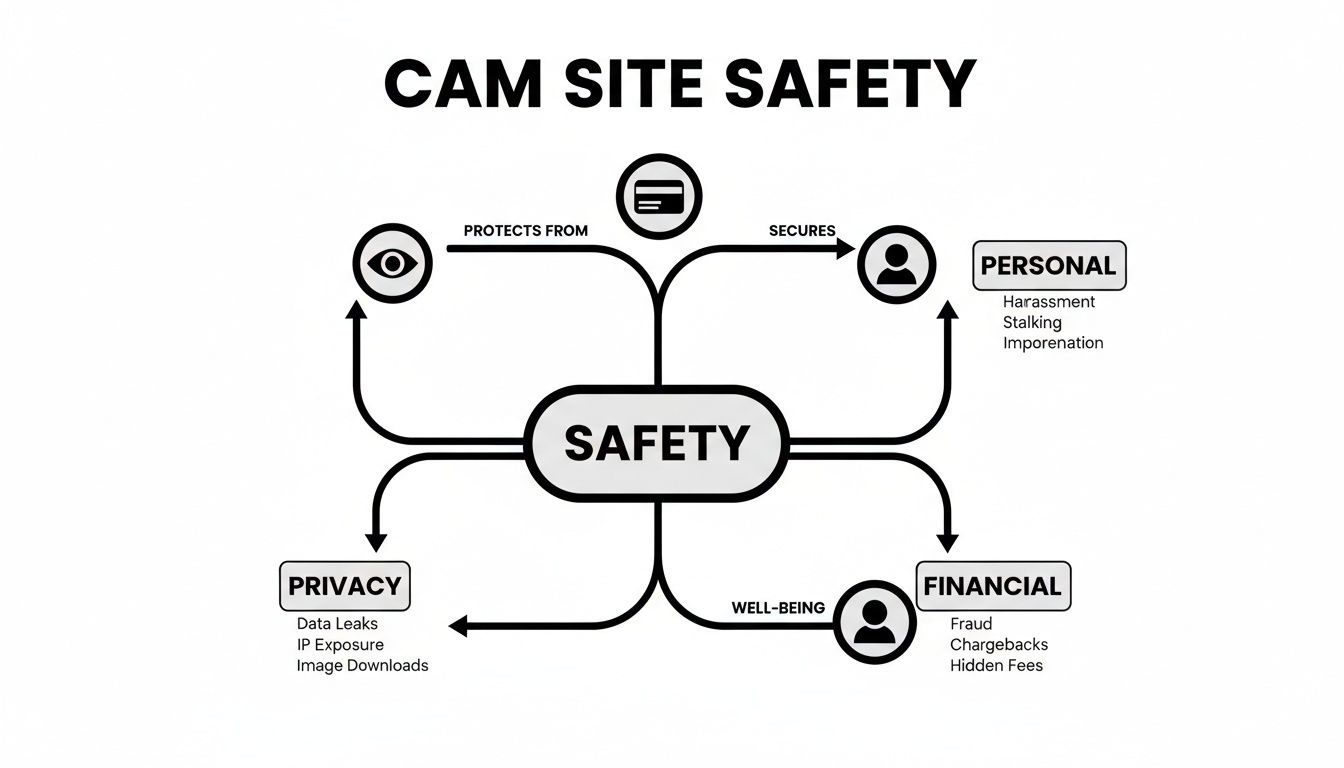
As you can see, safety isn't just one thing. It's a careful balancing act between protecting your real-world identity, keeping your financial details secure, and maintaining your online privacy.
Public vs. Private: What It Means for Your Privacy
Not all streams are created equal, and the type of show you're in dramatically changes the privacy game for everyone.
- Public Shows: Think of this as the free-to-enter shop window where creators build an audience and earn tips. Anyone can drop in and watch. It's a low-commitment way to browse, but offers zero privacy for anyone involved.
- Private Shows: This is a one-on-one session where a viewer pays a per-minute rate in tokens for a creator's undivided attention. It's far more intimate but also creates a direct, logged transaction between two specific user accounts.
- Spy or Voyeur Shows: Some platforms let people watch an ongoing private show for a reduced fee, but without the ability to interact. This just adds another layer of unseen observers to the mix, often without the primary viewer even knowing.
Knowing the difference is vital. A public chat is like shouting in a crowded pub, whereas a private show is a logged, timed, and recorded transaction between two people. If you want to dive deeper into the nuts and bolts, you can learn more about how webcam sites work in our separate guide.
The Reality of Verification: When a creator joins a site, they have to go through a fairly strict identity verification process, usually by submitting a government-issued ID. This is mainly done to satisfy legal requirements (like proving they're over 18) and payment processing rules. It confirms the creator is a real, legally-adult person, but it’s no guarantee of their behaviour, nor does it inherently protect viewers from being scammed.
At the end of the day, every single action on a cam site is tracked. The platform logs data on login times, IP addresses, viewing habits, and every single token you spend. This system is built for business, not for absolute anonymity. Recognising that trade-off is fundamental to staying safe.
Staying Safe as a Viewer: A Field Guide to Not Getting Burned
Let’s be blunt. As a viewer, the biggest risks aren’t shadowy hackers or complex viruses. The real danger usually comes from small, seemingly harmless decisions that can quietly expose your private and financial life. Consider this your practical guide to avoiding the common traps.
The golden rule is simple: keep your real life and your cam life completely separate. This is about more than just picking a clever username. It's about building a solid digital wall between the person who pays the council tax and the person who buys tokens. That separation is your number one safety tool.
Financial Hygiene: Discreet Billing and Secure Payments
Money is where your two worlds can collide most awkwardly. Every time you buy tokens, that transaction leaves a digital footprint. Knowing how to manage that footprint is essential if you want your activity to remain private.
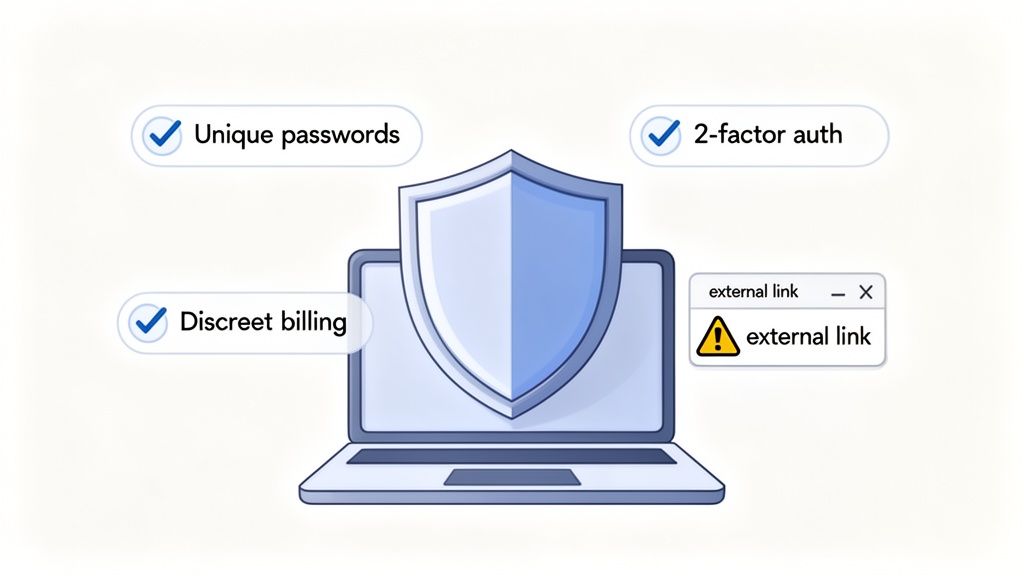
Thankfully, most reputable platforms get that discretion is a major selling point. They typically use generic billing descriptors on bank statements—things like "Online Services" or "Web Media"—to avoid raising eyebrows. Before you ever get your card out, do a quick search for what billing descriptor the site uses. If that information is hard to find, that’s a red flag.
When it comes to paying, you have options that add extra layers of privacy:
- Pre-paid Cards: A fantastic way to create a financial firewall. You load them with cash, and they have zero connection to your personal bank account.
- Dedicated E-Wallets: Using a service like PayPal (linked to a separate, non-personal email) can stop the cam site from ever seeing your direct card or bank details.
Whatever you choose, just don't use your main, everyday bank card. It’s an unnecessary risk.
Privacy Pitfalls: The Scams to Spot
For a deeper breakdown of the warning signs, see our guide to cam site scams.
The most common scams aren't sophisticated technical hacks. They’re clever social engineering tricks that play on your curiosity or the desire for a more personal connection.
The classic is the "private link" scam. A performer might message you saying, "Hey, my stream is glitching, but you can see my private show on this other site, just for you." That link will almost certainly lead to a phishing site designed to steal your login details or, worse, infect your device with malware.
Rule of thumb: If someone tries to pull you off the main platform, it's a scam 99% of the time. Genuine creators have a massive financial incentive to keep you right where they earn their money. Anyone pushing you towards an external link is almost certainly not who they say they are.
This same logic applies to any request for personal information. Never share your real name, where you live, or your social media accounts. Even details that seem innocent can be pieced together by someone with bad intentions to figure out who you are.
Your Digital Safety Checklist
Good digital hygiene isn't optional. Before creating an account, run through this basic checklist. It's the online equivalent of locking your front door.
- Use a Unique Email Address: Create a brand new email account on a service like Gmail or ProtonMail that you use only for cam sites. Don’t link it to your work, personal, or even your main spam account.
- Generate a Strong, Unique Password: Use a password manager to create a long, random password. Never, ever reuse a password from another site. If one platform gets breached, you don’t want hackers having the keys to your entire digital life.
- Enable Two-Factor Authentication (2FA): If a site offers it, use it. This adds a critical security layer by requiring a code from your phone to log in, making it incredibly hard for someone to access your account even if they steal your password.
- Consider a VPN: A Virtual Private Network (VPN) masks your real IP address, making it much harder to trace your activity to your physical location. It’s a simple and highly effective privacy booster.
- Review the Privacy Policy: I know, it's boring. But take two minutes to skim it. Look for what data they collect and, crucially, who they share it with. Understanding this helps you make an informed decision about whether you actually trust them with your information.
A Creator's Guide to Digital and Physical Safety
For creators, asking if cam sites are safe isn't an abstract question—it's a core condition of your workplace. While viewers need to protect their privacy, performers are juggling a much more intense set of risks covering their identity, finances, and even physical safety. This is where the wall between your online persona and your real life has to be built from reinforced concrete.
Your success in this industry hinges on your ability to build and maintain a fortress around your real-world identity. Every stream is a potential data leak, and your job is to plug those leaks before you go live. This means treating your digital footprint and physical space with the meticulous care of a crime scene investigator.
Securing Your Workspace and Identity
Often, your biggest vulnerability is sitting right behind you. The background of your stream can reveal countless clues about where you live, your lifestyle, and who you are. This is your first line of defence against doxxing—the malicious act of someone publishing your private information online.
Before you ever hit 'start stream', you need to scrub your environment of anything that ties back to your real self. This includes:
- Personal Mail and Parcels: Any visible address is a critical security failure.
- Distinctive Landmarks: A unique view from your window can be used to pinpoint your exact location.
- Family Photos or Personal Items: These create a direct link to your private life and the people in it.
- University Diplomas or Certificates: They literally have your name on them.
The aim is to create a sterile, anonymous backdrop. Many experienced creators use green screens, plain walls, or dedicated studio spaces to ensure nothing personal ever slips into frame.
Managing Your Digital Footprint
Your digital life is just as critical as your physical space. The internet has a long memory, and information you shared years ago can easily be used against you. A thorough digital audit isn't just a good idea; it's essential.
Start by Googling your real name and your performer name. What comes up? Are your personal social media profiles locked down tight? Have you ever used your personal email for a public account? Every connection is a thread that a determined person could pull on.
The stark reality is that doxxing is a real and present danger for online creators. It often starts with a single, seemingly innocent piece of information—a detail from an old social media post, a reflection in a mirror, or a pet's name—that can be used to uncover your entire identity.
To fight this, you need separate accounts for everything related to your cam work. That means a separate email, separate social media handles (if you use them for promotion), and a strict policy of never crossing the streams. You can get a better sense of how platforms handle your personal data by looking into the UK cam site verification process, which details what kind of information sites need from you.
Before going live, it’s worth running through a quick mental checklist to ensure you've covered all the bases.
Creator Safety Checklist
Here’s a practical rundown of steps to lock down your identity and workspace before you start streaming.
| Security Layer | Action Item | Why It Matters |
|---|---|---|
| Workspace | Perform a full background check for personal items, mail, or identifiable views. | Prevents viewers from using visual clues to identify your location or personal life. |
| Digital Identity | Use a separate, anonymous email address for all cam-related accounts. | Creates a firewall between your professional persona and your real identity. |
| Social Media | Set all personal social media accounts to private and remove connections to your performer name. | Stops people from linking your cam work to your family, friends, and personal history. |
| Technology | Use a VPN to mask your IP address. | Hides your general geographical location from the platform and potential bad actors. |
| Financial | Use payment methods that do not reveal your legal name to viewers. | Protects your financial privacy and prevents financial details from being compromised. |
This isn't just about ticking boxes; it's about building habits that protect you in the long run.
Using Platform Tools and Setting Boundaries
Your psychological safety is just as important. The tools platforms provide are your first line of defence against harassment and abuse, so you need to know them inside and out.
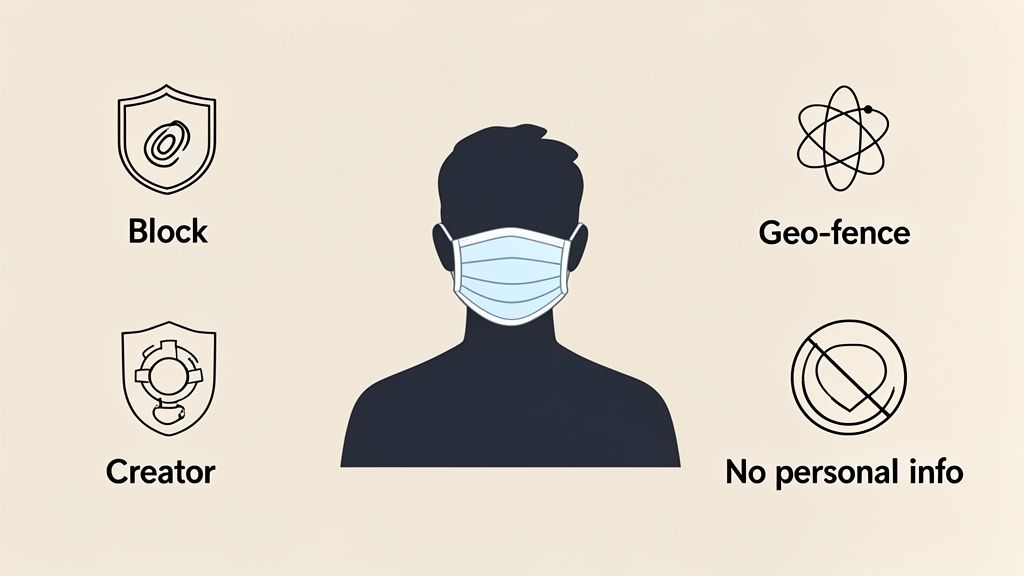
- Block and Mute: Use these features aggressively. You are not obligated to tolerate abuse. Blocking a user isn't rude; it's smart workplace management.
- Geo-fencing: Most platforms let you block entire countries or regions. If you want to stop people from your local area finding you, this is a crucial tool.
- Moderators: Some sites allow you to appoint trusted users as moderators to help manage your chat room, freeing you up to focus on your performance.
For UK-based creators, a major concern is having your content recorded and shared without consent. The UK has a pervasive culture of surveillance, with an estimated 7.3 million CCTV cameras across the country. In the context of camming, this means you must work on the assumption that everything is being captured. Even if a site bans recording, free screen-capture tools make it trivial for anyone to save your stream. It's vital to know that the redistribution of your private images can be a criminal offence under UK law.
Ultimately, your safety as a creator is an ongoing, active process. It’s about creating a clear, unbreachable line between your performance persona and your private self—and then defending that line relentlessly.
The True Limits of Platform Moderation and Support
Let’s be clear: the cam platform is not your personal bodyguard. Sites love to talk up their safety features and community standards, but you need to understand the very real limits of what their moderation teams can—and can't—do. Believing a platform will shield you from every problem is a recipe for disaster.
The truth is, nearly all moderation is reactive, not proactive. There isn’t a huge control room with staff monitoring every stream, 24/7, ready to intervene. The resources for that are unimaginable. Instead, the entire system relies on reports from users.
This puts the burden of flagging bad behaviour squarely on the shoulders of models and other viewers. Until someone clicks that "report" button, nothing happens. It's a system that's better than nothing, but it means the damage has often been done by the time moderators step in.
Why Moderation Is an Uphill Battle
Platforms are fighting a constant battle they can't always win. The sheer volume of content streaming at any moment is astronomical, making real-time moderation a logistical nightmare.
Then there are the complex legal grey areas. What you see as clear harassment, someone else might argue is edgy banter. Unless there's a blatant violation of the terms of service—like a direct threat or illegal activity—moderators often find their hands are tied.
You are your own first line of defence. Learning the reporting process, knowing what evidence to gather, and keeping your expectations realistic are far more effective than hoping a support team will sort everything out.
Dealing with rule-breakers is often a slow, murky process. If you're curious about the mechanics behind it all, our guide explains in detail how cam platforms moderate content and the hurdles they face.
The Screen-Recording Problem No Site Can Solve
This is the single biggest blind spot in platform safety. The moment your stream goes live, anyone can capture it using free, easy-to-find screen-recording software. You should always assume that whatever you broadcast is being saved by someone, somewhere.
Once that recorded footage ends up on other websites, forums, or messaging apps, the original cam site has almost zero power to help. They have no control over other platforms. Chasing down every stolen copy is an impossible game of whack-a-mole. It's a fundamental risk that no terms of service page can ever erase.
How to File a Report That Actually Works
Since you'll inevitably need the report function, make it count. Vague complaints like "this user is a creep" will be ignored. To get a moderator to take action, you need to give them a clear, evidence-based case.
- Be Specific: Pinpoint the exact rule they broke. Don't just say "they were rude"; say "they violated the hate speech policy by using a racial slur."
- Provide Timestamps: If you're reporting from a recorded show, note the exact time the incident happened.
- Take Screenshots: Your best friend. A screenshot of the chat log or user profile is undeniable proof. It’s the core of your evidence.
- Stay Factual: Leave the emotion out. Just present a clear, calm account of what happened.
Following these steps makes the moderator's job ten times easier. It turns your complaint from background noise into an actionable ticket they can deal with quickly.
So, What's the Final Verdict?
After all is said and done, it comes down to one question: are cam sites safe? The truth is, there’s no simple yes or no. Safety on these platforms isn’t something they give you; it’s something you have to actively create and maintain for yourself.
Engaging with cam sites will always carry some level of risk, just like any other corner of the internet. The goal isn't to find a platform with zero risk—that doesn't exist. It's about understanding what you're getting into, managing those risks intelligently, and deciding what you’re personally comfortable with. It means making a conscious choice, fully aware of how things work behind the screen.
Staying Safe is an Ongoing Job
The biggest mistake you can make is to treat safety as a box you tick once. It’s not a settings page you configure on day one and forget about. It's a habit, a constant process of being careful and aware every single time you log on.
This means regularly checking your privacy settings, being wary of anyone trying to get you to communicate off-platform, and fiercely guarding the boundary between your real life and your online persona. Safety isn't a destination you arrive at; it's how you conduct yourself on the journey.
It's like driving a car. You can buy the safest model on the market, with all the latest tech, but if you text while driving or ignore red lights, you're still going to get into trouble. The site gives you the car, but you're the one in the driver's seat.
The Core Rules of the Road
Whether you’re a viewer or a performer, a few key ideas should guide every decision you make. Let's boil it down.
For creators, your number one rule is separation.
- Your performer persona must be a completely separate identity, walled off from your real name, location, and personal life.
- Your setup—both the physical room and your digital accounts—must be sterile, scrubbed of any detail that could give you away.
- Use the moderation and blocking tools the site gives you. Use them early and often to protect your stream and your peace of mind.
For viewers, your guiding principle is discretion.
- Protect your financial details by using secure, preferably separate, payment methods. Use a unique username and password.
- Act as if everything you do could be logged. Never share anything that could tie your online activity back to your public or professional life.
- Always respect the performer's boundaries and the platform's rules.
In the end, you hold the power. By understanding the risks, knowing the trade-offs, and committing to smart, consistent safety habits, you get to navigate this world on your own terms. It's a calculated risk, and you're the only one who can decide if it's worth taking.
Frequently Asked Questions About Cam Site Safety
Got some lingering questions? Let's clear them up. Here are the most common things people ask when weighing up the safety of cam sites.
Can I Get a Virus from a Cam Site?
Just from watching a stream on a reputable platform? It's incredibly unlikely. The site is essentially just sending video data to your browser, not running programs on your machine.
The real risk isn't the stream itself but everything around it. The main road is safe, but the side alleys can be dodgy. The danger lies in clicking suspicious ads, downloading supposed "special viewers" (which are always malware), or following links to unvetted external websites shared in chat. Stick to the platform, never download anything, and you'll sidestep the vast majority of these threats.
Is It Illegal to Watch Cam Sites in the UK?
No, it is not illegal for an adult in the UK to watch consensual adult content on webcam platforms. As long as you are over 18 and the content involves consenting adults, you are well within the law.
The legal lines are crossed when you do things like record or distribute a performer's stream without their explicit permission. In the UK, actions like that can fall under laws related to voyeurism and the non-consensual sharing of private images. Your job as a viewer is simple: watch respectfully and play by the site's rules.
How Do I Know if a Cam Site Is Legitimate?
You can usually spot a legitimate site by looking for the same signs of a professional business you'd look for anywhere else online.
A trustworthy platform will have:
- Transparent Pricing: You should see exactly what you're paying for tokens and how much a private chat costs. No hidden fees.
- Clear Policies: Their Terms of Service and Privacy Policy should be easy to find and read.
- Secure Payments: They'll use recognisable and secure payment gateways, not some strange, unknown processor.
- Responsive Support: A real customer service team you can actually contact is a massive plus.
If a site is plastered with aggressive pop-ups, has vague rules, or makes promises that sound too good to be true, trust your gut and stay away. The well-established platforms have a reputation for a reason.
Does Using a Fake Name Make Me Anonymous?
Using a fake name is an excellent first step, but it’s more like a disguise than an invisibility cloak. It creates a valuable layer of separation, but it doesn't make you truly anonymous. Things like your IP address, payment details, and even your device's digital fingerprint could still potentially link your activity back to your real identity.
For a serious privacy boost, you need to add more layers. Think about using a reputable VPN to hide your location, a separate browser that you only use for these sites, a unique email address, and privacy-first payment options like pre-paid cards. Achieving complete anonymity online is nearly impossible, so the goal is to build as many protective walls as you can between your real life and your online one.