When you're a cam model, your anonymity is the most valuable asset in your business. Full stop. It's not an optional extra you can bolt on later. Building a solid wall between your performer identity and your real life from day one is non-negotiable. This means a unique alias, separate work-only accounts, and rock-solid operational security (OPSEC) both on and off stream. The secret isn't cleaning up messes; it's stopping the digital breadcrumbs from ever being dropped in the first place.
Understanding the Real Risk of Doxxing in Camming
Let's not beat around the bush: doxxing is a professional hazard for anyone with an online presence, but for those of us in adult streaming, the stakes are sky-high. This isn’t about scaring you; it’s about making sure you’re prepared. For a cam model, getting doxxed is so much more than a troll leaking your real name. It can quickly spiral into a full-blown harassment campaign aimed at your family, your day job, and your personal safety.
The generic privacy tips you'll find on Google just don't cut it for performers. Why? The relationship we build with our audience is incredibly intimate and interactive. Viewers aren't just watching a video; they're engaging, tipping, and sometimes developing intense parasocial relationships. Unfortunately, this dynamic can attract people with bad intentions or zero sense of boundaries.
How Anonymity Gets Compromised
Your identity can be put together from the tiniest, most innocent-looking details. It’s almost never one single, massive slip-up. Instead, think of it as a jigsaw puzzle that a determined person can piece together over time.
These clues can pop up from anywhere:
- Visual Leaks: That reflection in your mirror showing a family photo. A unique piece of art hanging on the wall. A letter on your desk with an address visible. Even the view out of your window can give away your location.
- Auditory Clues: The specific chime of a local ice cream van. A distinct accent that can be pinpointed to a small town. A family member shouting your real name from the next room.
- Digital Footprints: Using the same username on your cam site and an old gaming forum from ten years ago. Accidentally linking to a personal social media account. Using a payment processor that flashes your legal name to a client.
Doxxing is the malicious act of publishing someone's private information online. For sex workers, this risk is particularly sharp, with studies on technology-facilitated abuse showing that perpetrators often use this information to shame, exploit, and threaten their targets' physical safety and employment. You can discover more about these findings on technology-facilitated abuse to understand the full context.
Adopting a Security Mindset
Start thinking of your anonymity as a core business asset. This isn't about paranoia; it's about professionalism. Every single decision you make—from the performer name you choose to how you set up your streaming room—needs to be seen through a security lens.
So many performers don't realise just how much information they're leaking until it’s too late. The platforms have their own security and moderation, sure, but they can't protect you from what you accidentally show on camera. As you get more established, taking the time to understand the different types of adult streaming platforms and their specific safety features will help you make smarter choices.
Your goal is to build an impenetrable wall between your persona and your person. That's how you ensure your work stays safe, profitable, and empowering.
Building Your Digital Fortress Before Going Live
Your safety strategy starts long before you ever hit the ‘go live’ button. Think of it as building a digital fortress—a completely firewalled performer identity where your real life and your work life never, ever meet. This isn't just a good idea; it's a non-negotiable part of setting up your business safely and professionally.
First things first: your performer name. This needs to have zero connection to your real name, any nicknames you've ever had, your family, your pets, or even that obscure band you love. A truly unique alias is your first line of defence. It makes it exponentially harder for someone to connect your cam persona to your offline identity with a quick Google search.
Once you've settled on a name, everything else you build must be tied to it. That means creating a brand-new, dedicated email address using only that alias. Never, ever use your personal email for platform sign-ups or business enquiries. This simple separation is what stops a data breach on one website from blowing the doors off your entire personal digital life.
Creating a Clean Digital Slate
With your new alias and email ready, it's time to compartmentalise. You need to operate as if two completely separate people are using your computer: your performer self and your real self. They should never share accounts, tools, or digital spaces.
An easy way to manage this is by using different web browsers or browser profiles for each identity. For instance, you could use Chrome for all your personal stuff and keep Mozilla Firefox exclusively for work. This simple habit stops ad trackers and cookies from mixing up your identities, which is how you prevent an ad for your cam site from popping up on your personal Facebook feed.
This flow is a stark reminder of how seemingly small clues can snowball into a data leak and, ultimately, real-world harm.
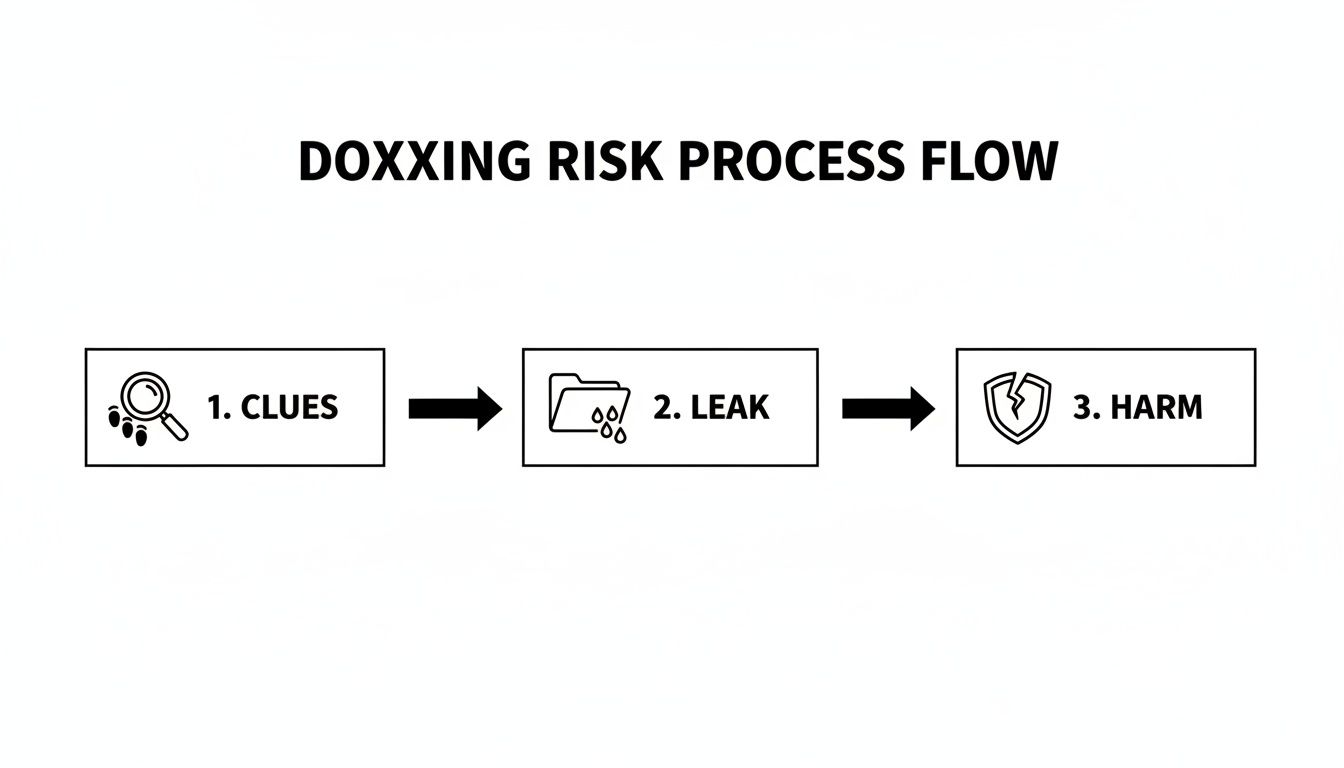
Looking at the process, it’s crystal clear that stopping clues from being collected in the first place is the most powerful way to break the entire chain.
Another absolute essential in your toolkit is a Virtual Private Network (VPN). A good VPN masks your real IP address, which otherwise gives away your approximate physical location. You should have your VPN running for all work-related activity, from logging into cam sites to checking your work email. It's a fundamental layer of security that costs very little but delivers huge protection.
Navigating Platform Verification Securely
All legitimate cam platforms will ask you to verify your age and identity, usually by submitting a photo of your ID. This is a standard and necessary legal requirement to ensure everyone involved is a consenting adult. You have to comply, but you can—and should—do it on your own terms.
Before you upload any verification documents, use an image editor to redact (black out) any information the platform doesn't strictly need. This almost always includes your address and driver's licence number. They just need to see your face, your legal name, and your date of birth. That's it.
By providing only the bare minimum, you dramatically reduce your risk if that platform ever suffers a data breach. It's about being compliant while still controlling your data.
This pre-launch phase is where you build the foundation for a secure career. The following checklist covers the essentials you should have in place before you even think about creating your first account.
The Performer's Pre-Launch Security Checklist
| Security Measure | Why It's Critical | Recommended Tool or Method |
|---|---|---|
| Unique Performer Name | Your first and most important firewall. Avoids easy links to your personal life. | Brainstorming session. Check social media and cam sites to ensure it's not already taken. |
| Dedicated Work Email | Prevents a breach on one site from exposing your personal accounts. | Use a secure provider like Proton Mail or Tutanota, created with your performer name. |
| Separate Browser Profile | Stops cookie/ad tracking from connecting your two identities. | Use different browsers (e.g., Chrome for personal, Firefox for work) or set up separate user profiles within one browser. |
| Reliable VPN Service | Hides your real IP address, concealing your general location. | Paid, reputable services like NordVPN or ExpressVPN. Avoid free VPNs. |
| 2-Factor Authentication (2FA) | Adds a crucial security layer, making it much harder for someone to hack your accounts. | Use an authenticator app like Authy or Google Authenticator. Avoid SMS-based 2FA if possible. |
| Secure Password Manager | Allows you to create and store unique, strong passwords for every single site without having to memorise them. | Reputable options include Bitwarden (free) or 1Password. |
Getting these things sorted from day one gives you the confidence to focus on what you do best—performing—without constantly looking over your shoulder. Your safety is your responsibility, and it starts right here.
Mastering On-Stream Operational Security
Think of your streaming room as a stage. Every prop, every sound, and every reflection is part of the performance—and a potential security risk. Mastering on-stream operational security, or OPSEC, is about training yourself to see your own broadcast through the eyes of someone trying to piece together your identity. It’s a skill, and like any other, it gets sharper with practice.
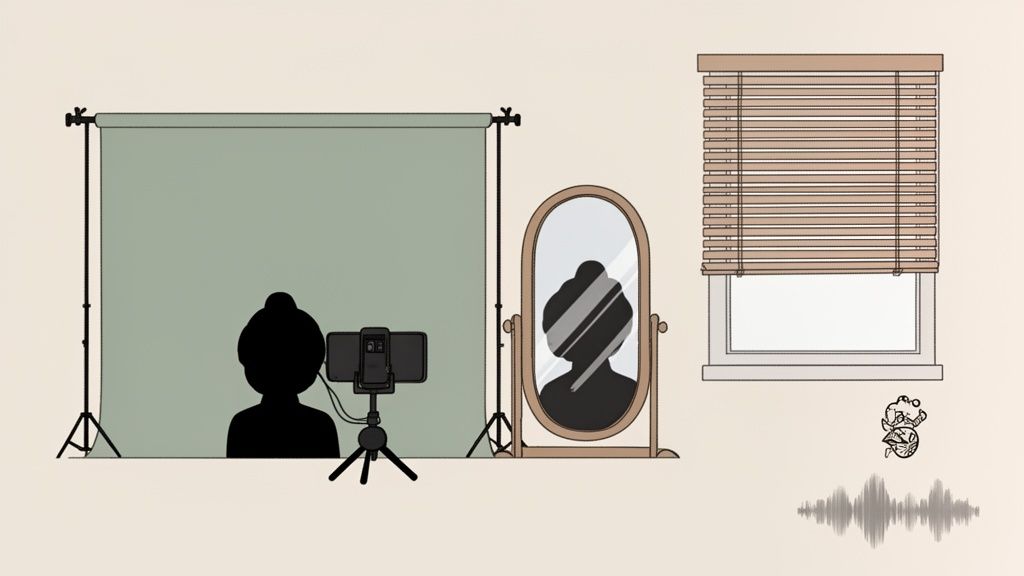
The classic mistakes are almost clichés because they happen so often. A reflection in a mirror or a shiny picture frame can easily reveal family photos, the layout of your flat, or even your computer screen. That cool, unique poster you bought at a local festival? It’s a fantastic clue for anyone digging. Even a delivery box in the corner or a pile of mail on a desk are goldmines for someone looking for your address.
And then there's the view from your window. This can be a catastrophic leak. A determined individual can use the position of the sun, architectural details, and specific landmarks to triangulate your location with surprising accuracy. It sounds like something out of a spy film, but it's a very real technique.
Controlling Your Visual Environment
The most effective way to avoid doxxing as a cam model is to meticulously control what your viewers see. Your background should be as sterile and non-descript as you can make it.
- Go Neutral: A plain, painted wall is your best friend. Avoid unique wallpaper patterns or distinctive architectural features like oddly shaped windows or built-in shelving.
- Invest in a Backdrop: A simple photography backdrop or, even better, a greenscreen, gives you complete control. It erases your real environment and lets you swap in anything you like, completely severing the link to your physical location.
- Declutter Ruthlessly: Before every single stream, do a sweep of your space. Look for anything that gives away hints about your life: books with specific titles, university memorabilia, or items that suggest a particular hobby or interest.
One of the smartest habits you can develop is to regularly watch back your own VODs (Video on Demand). Scrutinise them not for performance, but for security leaks. You'll be amazed at what you spot when you're not focused on being live.
This isn’t just about tidying up; it's about building a secure set. This mindfulness extends to your own appearance, too. Distinctive tattoos can be easily reverse-image searched, so consider covering them with makeup or clothing if they are particularly unique. For more on what platforms do on their end, you can read about how cam platforms moderate content and what that means for your on-stream safety.
Muting Auditory Clues
What viewers hear is just as crucial as what they see. Sound travels, and it can carry a shocking amount of personal information with it.
Think about the ambient sounds in your home. Is there a specific train line that rumbles past on a schedule? A nearby church that chimes on the hour? The siren from a local ambulance service with a unique pattern? These auditory signatures can help narrow down a location to a specific neighbourhood.
Even your own voice can be a clue. While you shouldn’t try to fake an entirely different personality, be conscious of using hyper-local slang or referencing specific local places. And the cardinal sin: letting a family member or flatmate yell your real name from another room. Believe me, it happens more than you'd think. Using a good quality microphone that isolates your voice can help minimise background noise, but the ultimate responsibility for what goes out over the airwaves is yours.
Managing Your Digital Footprint Beyond the Stream
One of the biggest mistakes performers make is thinking their cam site is the only place they need to be careful. The hard truth is that doxxing rarely happens because of one massive leak from your stream. It’s almost always a death by a thousand cuts, with an obsessive person piecing together tiny clues scraped from all over the internet.
Your digital footprint is your biggest vulnerability. You need to manage it with the same discipline you bring to your on-stream OPSEC.
The first, and frankly non-negotiable, step is to build an impenetrable wall between your performer persona and your personal life. This means locking down your real-life social media accounts until they are completely watertight. Your personal Facebook, Instagram, LinkedIn—anything linked to your legal name—needs to be cranked up to the highest possible privacy settings. Go through them right now and scrub any public-facing photos, check-ins, or personal details that could give someone a thread to pull on.
Breaking the Chain of Connection
The real danger is cross-contamination. That profile picture you used on a personal account five years ago? If you use the same one for your performer Twitter, a simple reverse image search can connect your two identities in seconds. The same goes for usernames, background details in your photos, and even the unique way you phrase things.
A determined person will hunt for these tiny overlaps. Here’s how you can find and destroy them before they do:
- Audit Yourself: Open a private browser window and Google your real name in quotation marks. Do the same for any old usernames you can remember. What comes up? Be prepared to dig through years of search results.
- Reverse Image Search Your Face: Use tools like Google Images or TinEye to upload your common profile pictures from both your personal and performer lives. See where else they pop up online. You might be shocked to find them on old forums or forgotten accounts you need to delete.
- Scrub People-Search Sites: Data brokers and people-search websites scrape public records and sell your information for a few quid. Look into UK-based services that help you request the removal of your data from these databases. It's a tedious job, but it’s a vital part of the clean-up.
The goal is a completely clean break. No shared photos, no similar usernames, no overlapping content. Your performer identity and your real identity should exist in entirely separate digital universes.
Think of it this way: every public photo of your face, every geotagged post, every public comment is another piece of source material for someone trying to unmask you. The less you give them to work with, the safer you are.
The Emerging Threat of AI and Deepfakes
This process of scrubbing your public footprint has become even more critical with the rise of AI. The intersection of artificial intelligence and image-based abuse is a growing threat, and cam models are right in the crosshairs.
Since AI tech became widely accessible, there's been a documented 550% increase in deepfake videos online between 2019 and 2023. About 98% of these are deepfake pornography, and a staggering 99% specifically target women. This explosion in AI-generated abusive content creates a compounding risk for us. Legitimate work can be repurposed and manipulated to create synthetic abuse material, which is then weaponised in doxxing campaigns. The UK government report lays out the frightening scale of this issue.
Limiting the amount of public source material of your face is one of the most powerful defensive moves you can make. The fewer high-quality, clearly lit photos and videos of you that exist online under your real name, the harder it is for someone to create a convincing deepfake. This is the modern, urgent reason for avoiding doxxing as a cam model: keep your personal accounts completely private and separate from your work.
Your personal life is not content. Protect it.
Securing Your Finances and Your Devices
There's a reason "follow the money" is the oldest trick in the book. If someone is trying to dig up your real identity, your payment trail can be a brightly lit path leading right to your front door. Protecting your financial privacy isn’t just good business practice; it's an absolutely essential part of avoiding doxxing. At the same time, the devices you rely on for work—your laptop, your phone—are potential windows into your entire private life if they aren't properly locked down.
This isn't about being paranoid. It’s about treating your financial and digital security with the same professionalism you bring to your performances. A single slip-up, like a payment processor accidentally showing your legal name to a tipper, can unravel all the hard work you’ve put into creating your anonymous persona.
The goal here is simple: create a complete and total separation between your personal finances and your work earnings. That means never using your personal bank account for payouts and never linking your performer identity to any financial product that has your real name on it.
Keeping Your Money Anonymous
Most cam platforms pay out to bank accounts or third-party e-wallets. The trick is to choose methods that won't expose your legal name to anyone on the other side of the transaction.
Here’s a practical way to approach this:
- Business Accounts Are a Lifesaver: Set yourself up as a sole trader or a limited company here in the UK. This lets you open a proper business bank account under your business name, creating a clean break from your personal finances. When a platform pays you, the money goes to "Your Brand Name Ltd," not "Your Real Name."
- Use Creator-Friendly Wallets: Some e-wallets and payment processors are built specifically with creators in mind and fully understand the need for privacy. Do a bit of research to see which ones let you receive payments without plastering your legal name on statements.
- Never, Ever Accept Direct Payments: Stay well away from direct bank transfers, PayPal "Friends & Family," or any method that operates outside the platform's official tipping system. These methods almost always leak your real name and email address, handing over a massive clue to anyone digging around.
Think of your payment setup as another layer of your costume. You wouldn't stream with your driver's licence hanging on the wall behind you, so you shouldn't handle your money in a way that reveals your true identity. It’s all part of maintaining the illusion.
For a deeper dive into the mechanics of getting paid, take a look at our complete guide on how cam models get paid, which breaks down the different payout systems in more detail.
Locking Down Your Work Devices
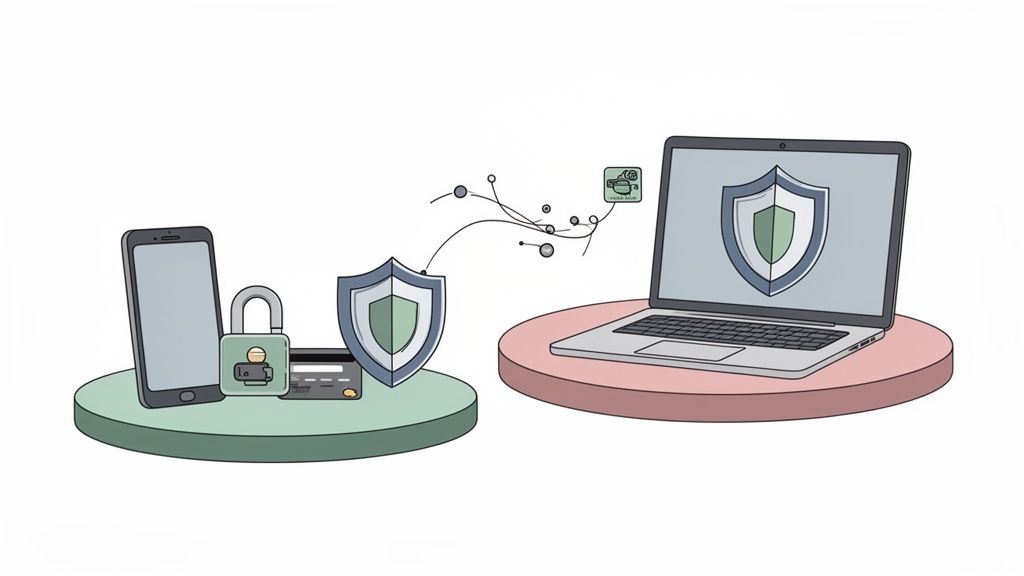
Your work computer and phone are more than just tools; they're potential security liabilities. A compromised device doesn't just mean someone could hack your accounts. It could mean they're actively watching you through your own camera or tracking your location.
This isn't a hypothetical threat. Technology-facilitated surveillance is a major and often overlooked step that comes before doxxing attacks. Research has documented plenty of cases where perpetrators used tracking software on mobile devices before escalating to online harassment. This makes preventing surveillance a critical first line of defence. To get a better sense of the threat, you can discover more about these findings on technology-facilitated abuse and see how serious it is.
The most effective rule is total separation. If you can swing it, use a laptop and phone exclusively for work. Don’t use them to log into your personal social media, check your personal email, or message your family. This strict compartmentalisation stops any digital crossover and contains any potential breach to just your work persona.
If separate devices just aren't an option right now, the next best thing is to create a separate user account on your computer just for work. Combine this with the separate browser profiles we talked about earlier, and you've built a pretty strong digital wall.
Finally, some basic digital hygiene is absolutely non-negotiable:
- Keep Everything Updated: Software updates often contain critical security patches. Make sure you enable automatic updates for your operating system, browser, and all your applications.
- Run Strong Antivirus: Use a reputable antivirus program and keep it running in the background. Think of it as your first defence against malware and spyware.
- Learn to Spot Phishing: Be suspicious of any unexpected emails or messages asking you to log in or provide information. Scammers love to target creators with fake "account verification" or "payout issue" emails to steal login details.
By securing your money and your machines, you're shutting down two of the most common and dangerous routes for a doxxing attack.
FAQ: What To Do When Things Go Sideways
When you're building a career in camming, security questions are going to pop up. It's totally normal. Let's tackle some of the most common "what if" scenarios with some straightforward, no-nonsense advice.
"I accidentally leaked something on stream. What now?"
First off, take a breath. Panicking won't help, but acting fast will. If you're still live, end the stream. Immediately. Your next move is all about damage control.
Pinpoint what got out. Was it a glimpse of a letter with your address on it in the background? Get it out of your streaming space for good. Did you accidentally say your real name or mention a local landmark? Make a note of it and commit to never letting it slip again.
The absolute most critical step is to delete the VOD (Video on Demand). Get it off the platform before anyone has a chance to download, clip, or share it. The quicker you are, the better your chances of containing the leak.
If it was a serious breach, like your full legal name or home address, it's time to be proactive. Search your performer name on Google and across social media to see if the information is already spreading. If you find posts with your private data, report them to the platform for harassment and privacy violations without delay.
"Is it okay to use my real first name?"
Honestly, I'd strongly advise against it. It might feel harmless, but even a first name is a breadcrumb that a determined person can follow.
Think of it as giving someone the first piece of a jigsaw puzzle. On its own, the name "Sarah" doesn't reveal much. But what happens when you combine it with other little details you might unknowingly share over time? Your home city, a niche hobby, the university you went to—suddenly, someone can start cross-referencing public profiles on LinkedIn or Facebook, and your anonymity starts to crumble.
Your safest move is always a completely unique alias that has zero connection to your real life. Treat it like an actor's stage name. If you've already been using your real first name, it's seriously worth considering a gradual rebrand to a new persona for your long-term security.
This isn't about being paranoid. It’s about building a strong wall between your public and private lives, making it as difficult as possible for anyone to connect the dots.
"How do I promote myself on social media without risking my privacy?"
Social media is essential for growing your brand, but you have to be smart about it. The golden rule is strict separation.
Set up dedicated social media accounts under your performer alias, using your anonymous work email. Never, ever let them intersect with your personal accounts. Don't follow your friends, and don't let your friends follow your work profile.
You need to be ruthless about what you share. That means:
- No Crossover Content: Never post a picture from your family holiday or a photo of your distinctive pet. Keep anything that shows the inside of your home confined to your controlled streaming setup.
- Lock Down Your Location: Never tag your location in real time. Ever. If you want to post about a cool place you visited, wait until you're long gone.
- Stay in Character: When you're chatting in DMs or replying to comments, you are your performer persona. Don't slip up and share personal opinions or details about your real life.
When it comes to receiving gifts from fans, always use a third-party wishlist service like Throne or Wishtender. These platforms are designed to be a privacy shield, letting fans treat you without ever seeing your shipping address.
The whole game is about building a strong, engaging brand around your performer identity while keeping an unbreakable firewall between that persona and the real you. Your private life is not part of the content. Keeping that line crystal clear is the cornerstone of your safety.