That little three or four-digit number on the back of your bank card? That’s the CVC (Card Verification Code), and its entire job is to prove you're physically holding the card when you buy something online. Think of it as a digital bouncer, giving your card a quick pat-down before letting you into the club.
The Secret Handshake of Online Payments
Every time you tip a creator, subscribe to their channel, or pay for a private show, the payment form will ask for that little number. It's a simple but surprisingly effective security check. While your main card number, name, and expiry date might have been nicked in a data breach, the CVC is the one thing merchants are forbidden from storing after a transaction.
This makes the CVC on cards a vital piece of the security puzzle. For a fraudster who's only managed to get hold of a stolen list of card numbers, the CVC is the missing key.
What’s in a Name? CVC, CVV, and All That Jazz
You’ve probably seen this code called a few different things depending on your card, but don't let the alphabet soup confuse you. They all do the exact same job; it's just a matter of branding.
- CVC (Card Verification Code): This is the term Mastercard uses.
- CVV (Card Verification Value): This is what Visa calls their version.
- CID (Card Identification Number): You'll find this on American Express cards.
Whether it’s a CVC, CVV, or CID, its function is always the same: to confirm you have the physical card in your hand during a "Card-Not-Present" transaction—which is just banking jargon for any online or over-the-phone payment.
This code acts as a one-time-use key for each purchase. Its presence confirms that the person initiating the transaction isn't just using scraped data from a dark web forum but is likely the legitimate cardholder.
Understanding how these payment systems work is the first step towards feeling safer online. If you're curious about the bigger picture, you can dive deeper into the mechanics of these platforms in our guide explaining how webcam sites work.
For any platform in the creator economy, this simple check is the first line of defence. It helps protect both the fan making the payment and the creator who needs assurance that the funds are legitimate. Without it, the whole system would be wide open to fraud, making it tougher for everyone to connect safely.
How Reputable Platforms Handle Your Payment Details
Ever wondered what happens to your card info after you hit 'Confirm Tip'? It doesn't just get stored in a simple spreadsheet somewhere. Top-tier platforms treat your financial data like a state secret, using a multi-layered security system to protect it from the moment you type it in. This keeps both you and the creator you're supporting safe.
This isn’t just about good business sense; it's a non-negotiable requirement. Any site that wants to process payments from giants like Visa or Mastercard must adhere to a strict set of rules called the Payment Card Industry Data Security Standard (PCI DSS). Think of it as the digital equivalent of a bank vault's minimum-security standard.
Being PCI DSS compliant means a platform has proven it has the defences to prevent data breaches. This covers everything from encrypting your details as they travel across the internet to severely limiting who internally can even get near sensitive info. If a platform isn’t compliant, handing over your CVC is a massive gamble.
The Magic of Tokenization
So if they're not storing your card number, what are they doing? This is where a clever bit of tech called tokenization comes into play. It's a game-changer for online security.
When you enter your card details on a secure site, the payment processor doesn't save your 16-digit number. Instead, it immediately swaps it for a completely unique, randomly generated string of characters—a 'token'. This token is essentially gibberish to a hacker. It can't be reverse-engineered to reveal your actual card number and is tied only to that specific platform for your transactions.
This is exactly why you can save your card for future tips or subscriptions without worrying. The site isn't holding onto your precious card number. It's just storing a useless token that only its payment partner can make sense of. Crucially, your CVC is never stored.
This process slashes the risk. In a worst-case scenario where a platform’s database is compromised, the thieves would just find a pile of worthless tokens, not a treasure chest of active credit card numbers.
The diagram below makes it easy to find your CVC, which you'll need for almost any online purchase.
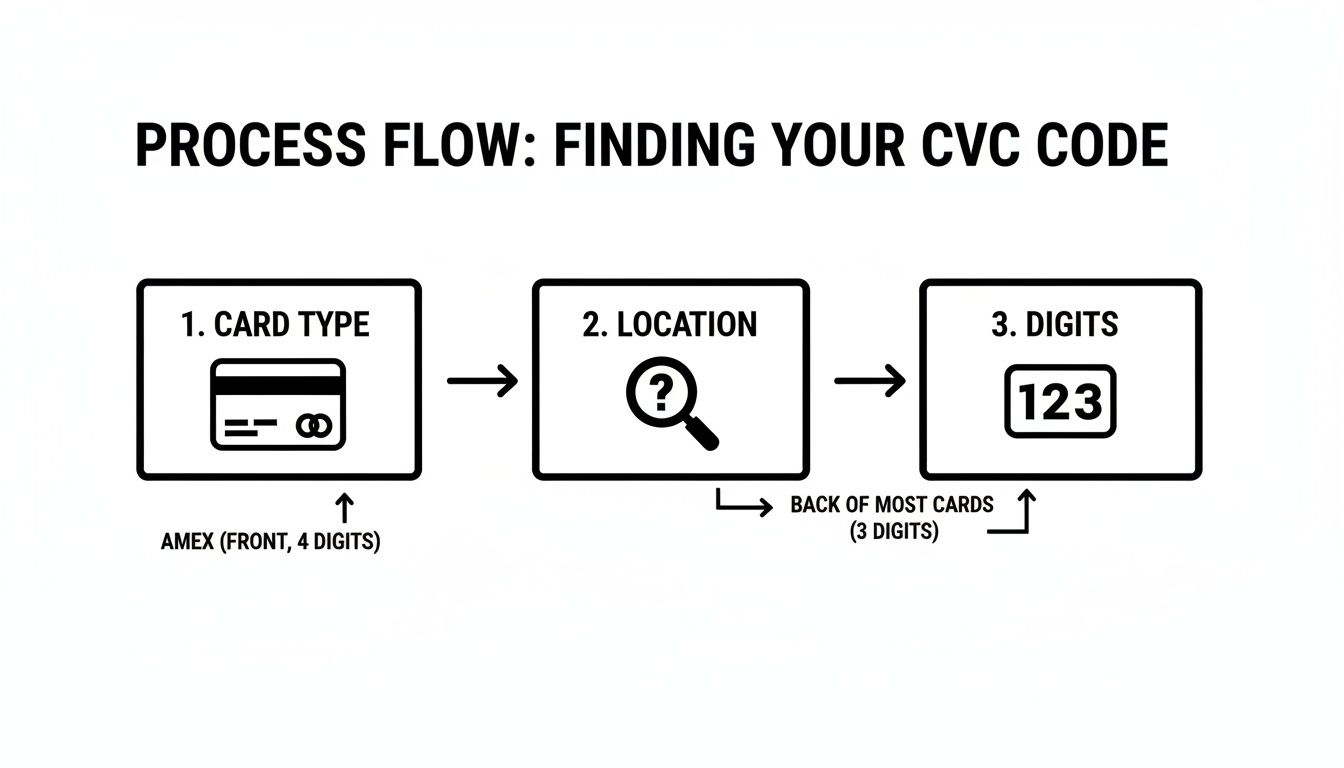
Knowing where this little number is helps verify that you are the one holding the card, adding that essential physical check to an online transaction.
Adding an Extra Lock with 3D Secure
You've almost certainly run into this before. It's that pop-up window from your bank that appears after you've entered your card details, asking for a password, your fingerprint, or a one-time code sent to your phone. That's 3D Secure in action, often branded as 'Visa Secure' or 'Mastercard ID Check'.
It’s a powerful anti-fraud measure because it shifts the final verification step from the website over to your own bank. It’s like your bank is leaning over and asking, "Is this really you?" This proves you not only have the card details but also have access to the phone or app linked to your bank account.
For creators, this system is just as vital. It drastically cuts down on chargebacks from fraudulent payments, giving them peace of mind that the tips and payments they receive are legitimate. If you’re interested in the financial logistics for performers, our guide on how cam models get paid breaks it all down.
The Real Risks When Your CVC Is Exposed
Alright, let's get down to it. What actually happens if a scammer gets their hands on your full card details, including that all-important CVC? This isn't just a theoretical threat; it's the final piece of the puzzle that enables a specific type of crime costing people real money.
This is what the industry calls ‘Card-Not-Present’ (CNP) fraud. It’s the official term for any dodgy transaction made when you aren't physically there to swipe or tap your card. Think about it – every online purchase you make, from your weekly shop to tipping a favourite creator, is a CNP transaction.
The CVC is your first line of defence against this. When fraudsters buy lists of stolen card numbers on the dark web, they often get the long number, your name, and the expiry date. But without the CVC, that data is pretty much useless for an online shopping spree. With the CVC, however, they've got the complete package.
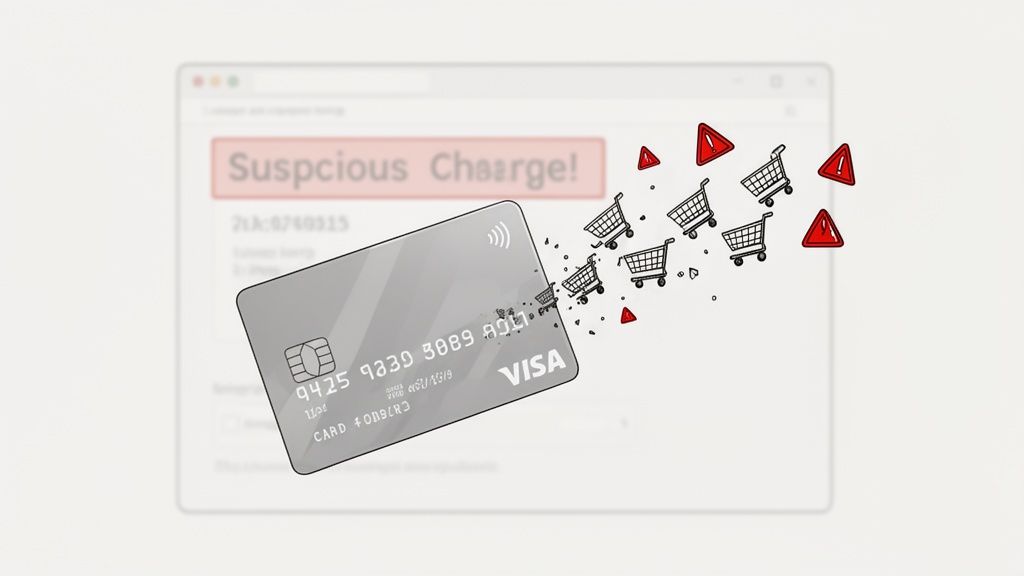
From Your Wallet to a Scammer’s Shopping Cart
So, how does this play out in the real world? Let’s say a fraudster nabs your details from a dodgy, unsecured website where you bought something months ago. With your full card number, expiry, and that CVC, they can head off on a virtual shopping trip.
Their first stop probably won't be a huge purchase that your bank would flag immediately. Instead, they'll often test the waters with small, insignificant buys from sites with weak security. A £5 digital gift card here, a small online subscription there. If those go through, they know the card details are live and working.
That's when they strike. The goal is to max out the card on high-value, easily resold items like electronics or designer goods before you or your bank have a chance to notice. By the time you get that dreaded notification, the damage is already done.
This isn’t some rare event, either. Data from UK Finance revealed that fraud losses on UK-issued cards hit a staggering £556.3 million in 2022. A massive 65% of that came from CNP fraud, where a stolen CVC is almost always the key. The numbers also show that in 2023, 123 out of every 1,000 people in the UK were affected by credit card fraud—a rate far higher than in many other European countries. You can dig deeper into these fraud statistics and their business impact if you're curious.
The Cleanup and the Headache
The good news? UK banks are generally very good at refunding victims of fraud. Thanks to strong consumer protection laws, you're not usually left out of pocket.
The real cost, however, is the sheer hassle. You'll spend hours on the phone freezing your card, disputing transactions, and then waiting for a new one to arrive in the post. In the meantime, all your legitimate subscriptions and recurring payments tied to that card—from Netflix to your phone bill—will fail. This creates a domino effect of administrative headaches you have to sort out one by one. It’s this monumental disruption that makes protecting your CVC so vital.
What We Can Learn from Major Data Breaches
History has some pretty stark lessons when it comes to data security. We don't need to dream up worst-case scenarios to understand why protecting your CVC is so vital; we just need to look at what happens when big, trusted companies get it wrong. These events aren't just abstract stories—they show that absolutely no one is too big to be a target.
Even household names can slip up, which is why the platforms you choose and your own security habits matter so much. A data breach isn't just a news headline; for thousands of people, it becomes a real-world nightmare of cancelled cards, stolen money, and a mountain of stress.
When cybercriminals go after a business, they’re not just grabbing random data. They're hunting for the full set: your name, card number, expiry date, and, of course, the CVC. That combination is the skeleton key for committing massive online fraud.
A Look at the British Airways Hack
One of the most high-profile UK data breaches in recent memory was the attack on British Airways. This wasn't a simple case of hackers finding a way into an old, forgotten server. They used a far more cunning method known as "skimming," planting malicious code directly onto the British Airways website and mobile app's payment pages.
Think of this code as a digital spy. It sat there, invisible, quietly copying every detail customers typed into the payment form. For months, it scooped up the complete payment information from every single transaction it touched. The consequences were huge.
The British Airways data breach, which ran from June to September 2018, exposed the payment details of around 500,000 customers. Crucially, this included sensitive CVC numbers along with names, email addresses, and full card details—giving criminals everything they needed on a silver platter.
This incident was a brutal wake-up call, showing just how vulnerable even a simple online payment form can be. At the time, UK Finance reported that this type of "card-not-present" (CNP) fraud—the kind made possible by stolen CVCs—accounted for a staggering 65% of all credit card fraud losses in the UK, adding up to over £400 million a year. If you're interested in the wider impact, this insightful data breaches report offers more detail on how these events have shaped UK security.
The Real Takeaway for Creators and Fans
So, what’s the lesson here? First, even the biggest, most reputable companies can have security weak spots. Second, the criminals are always getting smarter. They specifically target the exact moment you enter your CVC because they know it’s the most valuable and fleeting piece of information in the puzzle.
This is exactly why it’s so important to stick with platforms that take security seriously—the ones that shout about their PCI DSS compliance and use modern tech like tokenization. The message for both fans and streamers is clear: your financial security is only as strong as the weakest link in the chain. Deciding where you spend your money or set up your creator business is a security decision in itself.
Practical Safety Tips for Fans and Creators
Alright, knowing the theory is one thing, but putting it into practice is what really counts. Let's shift from the "what if" scenarios to what you can actually do to keep your financial details safe, whether you're supporting a creator or getting paid for your work.
This isn't about becoming overly paranoid; it's just about being smart. A few simple, conscious habits can make a huge difference in avoiding the nightmare of online fraud.
For Fans Supporting Creators
When you're tipping or subscribing, your main goal is to protect your payment details right at that checkout moment. Think of your CVC as the key to your digital wallet—you wouldn't just leave it out in the open. A little bit of awareness goes a very long way.
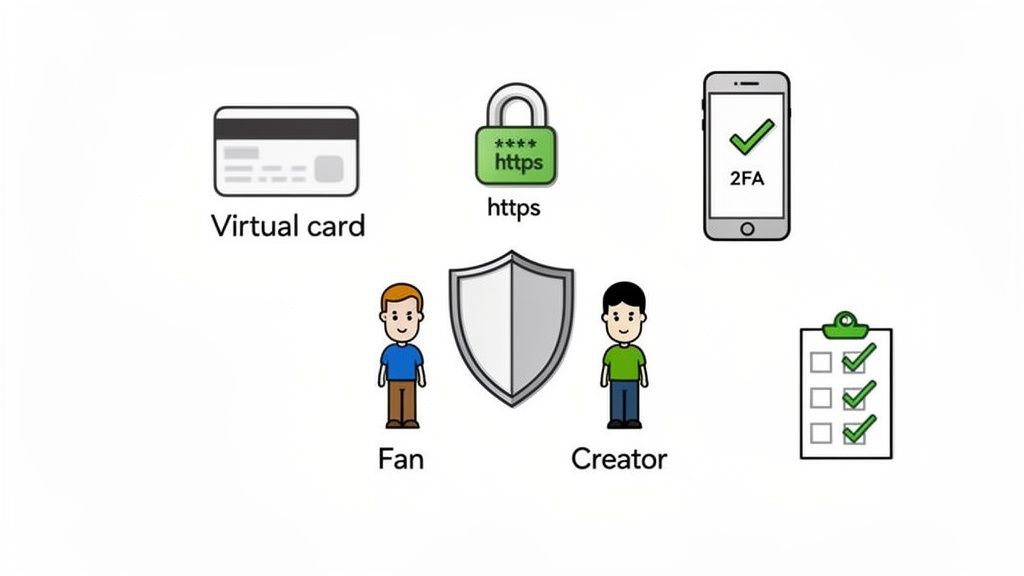
- Look for the Lock: Never, and I mean never, punch in your card details on a website that doesn’t have that little padlock icon and "https://" in the address bar. This is your most basic sign that the connection is encrypted and your data is scrambled during transmission.
- Use Virtual or Disposable Cards: Many modern banking apps and services like Revolut let you create single-use virtual cards. You can load it with just enough money for your payment, use it once, and poof—the card details become useless to any fraudster who might get their hands on them later.
- Spot the Red Flag: If a platform ever asks to save your CVC on cards for "convenience," that's your cue to leave. Immediately. No legitimate, PCI-compliant website will ever store that number. It's a massive security no-no and a blaring alarm bell that something is seriously wrong.
A platform has a duty to protect its users, but you are always your own first line of defence. If a payment page looks a bit off or the site just feels untrustworthy, listen to your gut and close the browser tab.
For Creators Receiving Payouts
As a creator, you're not just making content; you're running a business. Protecting your earnings is mission-critical. Your focus should be on vetting your partners and properly securing your accounts.
- Choose Platforms Wisely: Only partner with platforms that are upfront and clear about their PCI DSS compliance. This is your non-negotiable guarantee that they handle fan payments—and your hard-earned payouts—according to strict, industry-wide security standards.
- Enable Two-Factor Authentication (2FA): Always, always turn on 2FA for your creator account, especially for logging in and changing payout details. It adds an essential layer of security that can stop a thief in their tracks, even if they somehow manage to steal your password.
- Review Your Statements: Make it a regular habit to check your earnings dashboards and payout records. If anything looks unfamiliar—a transaction you don't recognise, or a sudden change to your payout info—report it to the platform's support team right away.
We've learned hard lessons from major security incidents. The infamous 2017 Equifax breach, which exposed the data of 15 million UK customers, was a huge wake-up call. In its aftermath, rules like GDPR forced companies to be far more transparent about how they store data and to report serious breaches within 72 hours. This has made robust security not just good practice, but a legal requirement. You can read more about the rise of first-party fraud risk and how the financial world has adapted.
Ultimately, creators and their supporters are two sides of the same coin. Taking these small but crucial steps helps make the entire online space safer for everyone. For a closer look at another vital security measure, check out our guide on how age verification apps work to protect platforms and their communities.
What to Do If You Suspect Your Card Is Compromised
It's a horrible, sinking feeling—that moment you spot a transaction on your statement you know you didn't make. The good news is, while panic is a natural reaction, a few calm, swift actions will make all the difference. If you think your card details have been stolen, here’s your immediate game plan.
First things first, don't wait around hoping it’s a mistake. The single most important thing you can do is contact your bank or card issuer right away. Every bank has a 24/7 fraud hotline, and most banking apps let you freeze your card with a single tap.
Do this immediately. Freezing the card instantly blocks anyone from using it, giving you the breathing room to sort things out without any more money leaving your account.
Your Three-Step Action Plan
With the card safely frozen, you can take a moment. Now it’s just a matter of a little admin to secure your accounts and get everything back to normal.
-
Review and Report: Pull up your recent transactions and go through them with a fine-tooth comb. Fraudsters often test a stolen card with a small, seemingly insignificant purchase before making larger ones, so look for anything that seems out of place. Make a note of every single charge that isn't yours and report them to your bank.
-
Contact Action Fraud: In the UK, it’s also crucial to report the incident to Action Fraud. They are the national reporting centre for fraud and cybercrime. Your bank will handle the financial side of things, but reporting it officially helps the police track fraud patterns and protect others.
-
Change Your Passwords: This is the step people often skip, but it's essential. If your card details were stolen from a website you used, your login for that site might be at risk too. Change your password there immediately. And if you’ve reused that password on other sites (we all know we shouldn't!), you need to change those as well.
Remember, consumer protection laws here in the UK are robust. You are very unlikely to be held responsible for fraudulent transactions on your account. The main goal here is to stop the fraud, secure your accounts, and minimise the hassle for you.
Dealing with a compromised card is always stressful, but the recovery process is well-practised. By acting quickly and following these steps, you shut down the problem and prevent a minor headache from turning into a major one.
Frequently Asked Questions About CVCs and Payments
Still got a few questions buzzing around about how payments work? Let's tackle some of the most common ones that come up when you're supporting creators online.
Is It Safe to Save My Card on a Site?
On any trustworthy site, the answer is yes. It's a bit of a misconception that when you "save" your card, the website is just keeping your card number in a digital folder somewhere. That's not what happens at all.
Instead, they use a clever process called tokenization. Your real card number is swapped out for a completely random, single-use "token" – a string of characters that's meaningless to anyone except their payment processor.
But here's the key part: they are strictly forbidden from ever storing your CVC. That's a huge no-no in the payment world. It’s precisely why you often have to pop those three or four digits in again for a new purchase; it’s the final check to prove you still have the physical card in your hand. If a site ever offers to save your CVC, that's a massive red flag.
Why Did a Site Charge Me £1?
Seeing a surprise £1 charge can be a bit jarring, but don't worry – it's not a real charge. It’s what’s known as a temporary authorisation hold. Think of it as the payment system politely knocking on your bank's door to ask, "Hello? Is this card legitimate and is there money in the account?"
This quick check confirms the card is valid before any real payment is processed. The £1 hold is then automatically released, usually vanishing from your statement within a few business days. It’s a standard security measure that helps filter out fraudulent card details right from the start.
Can a Streamer See My Real Card Details?
Absolutely not. On any legitimate platform that follows industry security standards (like PCI compliance), a creator can't see any of your payment information. All they see is your username and the amount you've contributed.
The whole payment process is managed by a secure, third-party payment processor. Your sensitive details are encrypted and kept behind layers of security, completely walled off from everyone – including the platform's own team and, of course, the creators you're supporting. Your financial privacy is baked into the very foundation of how these systems work.