
When you hear the term PCI compliant, think of it as a business following a super-strict set of security rules for handling credit and debit card information. It's the digital version of a bank vault, designed by the big card companies like Visa and MasterCard to keep financial data locked down and safe from thieves. For anyone making a living in the creator economy, this isn't just tech jargon—it’s the absolute foundation of getting paid safely.
Unpacking PCI Compliance: The Digital Bank Vault
Let's cut through the technical nonsense. At its heart, being PCI compliant is all about creating a fortress-like environment for every single payment that goes through. The official rulebook is the Payment Card Industry Data Security Standard (PCI DSS), and for any business that wants to take card payments, it's non-negotiable.
Think about a real bank for a moment. They don't just stick a single padlock on the door and call it a day. They use layers of security:
- Thick Vault Walls: This is the digital equivalent of a platform's secure network firewall, acting as the first line of defence to block unauthorised access.
- Security Guards: These are the powerful encryption protocols. They scramble card details as they travel across the internet, making the data completely unreadable to anyone trying to intercept it.
- CCTV Cameras: This represents the round-the-clock monitoring of all systems to spot suspicious activity instantly, just like security staff watching for a break-in.
- Keycard Access: This is like having strict access controls, ensuring only a handful of authorised people (or verified systems) can ever get close to sensitive customer data.
A PCI compliant platform weaves all these layers together in the digital world. It's a rock-solid promise that when a fan buys tokens or tips you for a private show, their card details are treated with the same seriousness as a bank handling a bag of cash. This isn't just a good idea; it's a mandatory security standard for any UK business that handles card payments, specifically designed to protect cardholder data from disastrous breaches. You can discover more insights about PCI compliance in the UK on securious.co.uk.
To make it even clearer, here’s a quick summary of who's who in the zoo of secure payments.
PCI Compliance At a Glance
| Who Is Involved? | Their Role in Keeping Payments Safe |
|---|---|
| The PCI Security Standards Council | The organisation (founded by Visa, MasterCard, etc.) that creates and manages the security rules (PCI DSS). |
| Your Webcam Platform | The business responsible for implementing all the PCI DSS rules to protect the payment process on their site. |
| Payment Processors (e.g., Stripe) | The third-party companies that actually handle the transaction. They must also be fully PCI compliant. |
| Creators | You! Your main role is to partner with a compliant platform and never handle card data yourself. |
| Fans & Viewers | The customers whose data is being protected by all these layers of security. |
This table shows how security is a shared effort, but the heavy lifting is rightly done by the platform and its payment partners.
Why This Really Matters for Creators and Their Fans
For you as a creator, this is your financial safety net. A compliant platform takes on the enormous and costly responsibility of securing every payment, which means you don't have to. You get to focus on what you do best—creating content and connecting with your audience—safe in the knowledge that the complicated world of payment security is being handled by pros. It's the system that ensures your hard-earned tips and token sales actually arrive in your bank account without a hitch. You can learn more about how cam platforms make money in our detailed guide.
For your fans, it all comes down to trust. Typing in your card details online requires a massive leap of faith that the website isn't going to leak your information. PCI compliance is the technical, verifiable proof that a platform has invested heavily in protecting its users. It’s the crucial difference between a dodgy market stall with a flimsy cash box and a secure online retailer with a digital vault. Without that trust, the entire system of online tipping, subscriptions, and private shows would simply fall apart.
How PCI Compliance Works on Cam Platforms
So, when a fan decides to tip you during a show or buy a block of tokens, how does this whole PCI compliance thing actually work in practice? The good news is, for creators, it's mostly invisible—and that’s exactly how it should be. The cam platform you use effectively steps up to be the official ‘merchant of record’.
This means the platform takes on the immense legal and technical burden of handling sensitive card data. They are the ones who build the digital vault, manage the encryption, and undergo the expensive audits. This is a massive weight off your shoulders. As long as you stick to the platform's built-in payment system, you generally don't have to worry about becoming PCI compliant yourself.
The entire system is designed to create a strict separation between you, the creator, and the fan's raw payment details. The money follows a very specific, secure path that intentionally keeps you out of the loop on the sensitive stuff.
The Journey of a Single Tip
Let’s trace the journey of that £20 tip from your biggest fan's bank account to yours. It’s a multi-step process where the platform acts as a secure middleman, ensuring sensitive data is never exposed.
- The Fan Pays: Your fan clicks 'Tip' and is taken to a secure payment page. This page is often a separate, heavily encrypted environment (sometimes called an iframe) hosted by the platform or its payment processor. They enter their card number, expiry date, and CVC code here, not in the chat window.
- The Platform Processes: The platform’s system, which must be PCI compliant, securely transmits this encrypted data to its payment processor (like Stripe or a specialised high-risk processor). At no point are the raw card details stored on the same servers that run the chat rooms or host your profile videos.
- The Creator Gets Paid: Once the transaction is approved, the platform credits your account with the value of the tip (minus their fee, of course). You see the earnings pop up in your dashboard, but you never see the card number that paid for it. Payouts are then bundled and sent to you via secure methods like a bank transfer.
To help visualise this, here’s a simple breakdown of the secure payment flow from fan to creator.
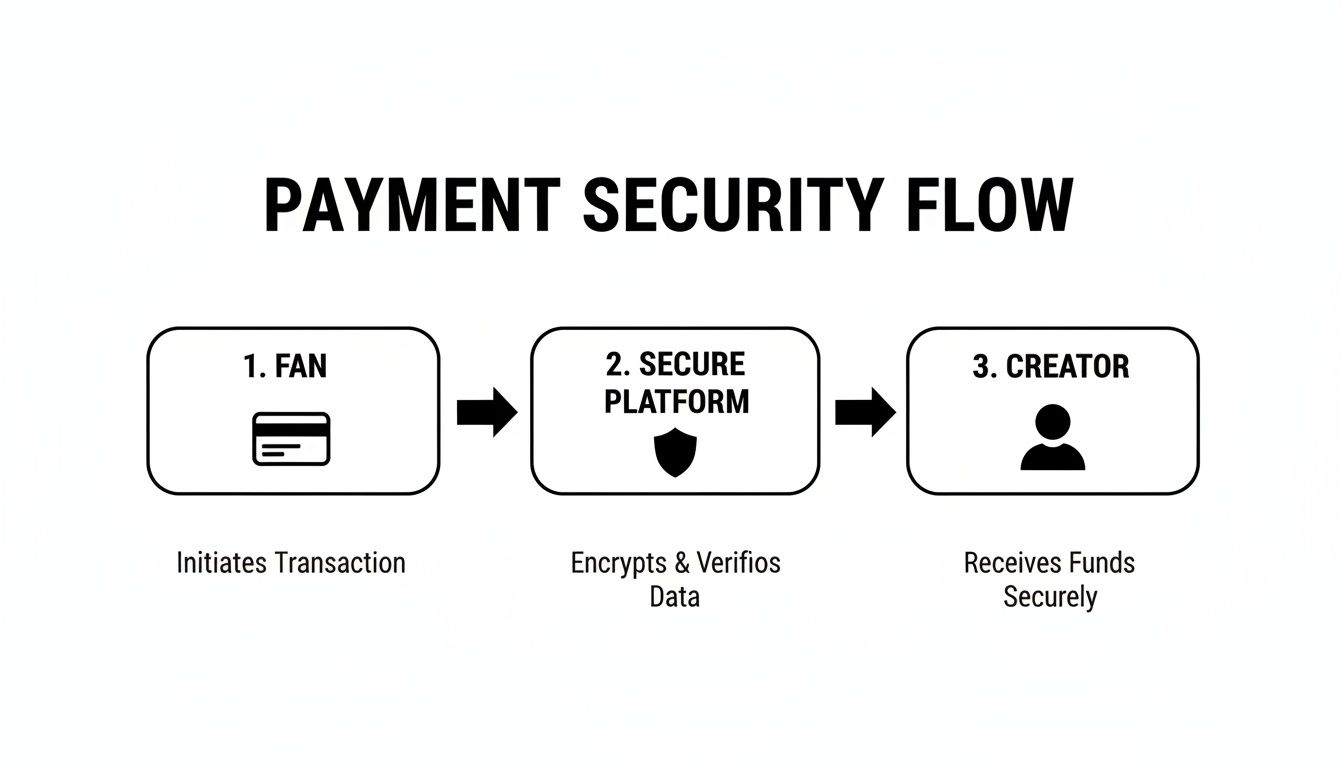
This flow highlights the essential role of the platform as a protective barrier, keeping your business separate from the fan's sensitive financial data.
Keeping Payments in Their Lane
In the world of data security, there's a crucial concept called ‘PCI scope’. Think of it like this: a platform's entire digital operation is a huge building, but only a few specific rooms—the payment processing systems—are allowed to handle cash.
PCI scope defines the parts of a network that must be secured. A smart platform designs its systems to make this scope as small as possible, building a digital wall between the payment environment and everything else.
This means your chat logs, DMs, profile pictures, and stream archives are kept completely separate from the systems that handle card numbers. This intentional separation is a cornerstone of good security. If one part of the site (like a forum) were to be compromised, the payment data would remain safe and sound behind its own fortified walls.
This is precisely why you should never, ever be tempted to handle payments outside the platform's official channels. If a fan offers to send you their card details directly for a private show, it’s a massive red flag. By directing them back to the platform's tipping or private show feature, you're not just following the rules—you're protecting both of you from enormous financial and legal risk. To understand more about the specifics of receiving funds, check out our guide on how cam models get paid.
The Different Levels of PCI Compliance
When it comes to handling card payments, not everyone plays by the same rulebook. The PCI DSS standards aren't a one-size-fits-all document; they're broken down into four distinct levels. As a business processes more transactions, the security demands get exponentially tougher. Getting your head around this is the key to understanding why major cam platforms are built the way they are.
A good analogy is building security. A small corner shop might just need a decent lock and an alarm system. But a major international airport? That requires a whole different world of security, from baggage scanners and biometric checks to round-the-clock surveillance teams. The same logic applies to protecting payment data.
A company's PCI compliance level is almost entirely dictated by how many card transactions it handles each year. In the UK, any merchant that processes, transmits, or even just stores card data has to comply, even if they use a third-party payment processor. The tiers range from Level 1, for businesses handling over 6 million transactions a year, down to Level 4 for those with fewer than 20,000. You can get a deeper dive into the specifics of UK PCI compliance on securious.co.uk.
Level 1: The Big Leagues
This is the top tier, the most demanding category imaginable, and it's reserved for the absolute giants of online commerce. Any business processing millions upon millions of card payments annually will find itself in this bracket.
- Who it applies to: All major cam platforms, massive online retailers, and global subscription services.
- What it requires: An incredibly rigorous annual Report on Compliance (ROC). This isn't just a simple checklist; it's a full-scale, on-site audit performed by an independent, certified expert called a Qualified Security Assessor (QSA). They will literally go through the platform's systems with a fine-tooth comb.
- The reality: Achieving and maintaining Level 1 status is eye-wateringly expensive and requires a dedicated, full-time security team. It’s the gold standard for a reason. This is precisely why using an established, reputable platform is so much safer—they have the resources, the expertise, and the legal obligation to meet these intense requirements.
For any creator, seeing that a platform is Level 1 compliant is a massive green flag. It’s a clear signal that they are investing serious time and money into protecting your income and your viewers' sensitive data.
Levels 2, 3, and 4: The Rest of Us
As the number of transactions drops, the compliance burden shifts from expensive external audits to rigorous self-assessment.
For smaller businesses, the heart of compliance is the Self-Assessment Questionnaire (SAQ). This is essentially a detailed checklist from the PCI Council that forces a business owner to scrutinise their own security measures against the official standards.
An independent creator who decided to sell their own merchandise from a personal website, for example, would almost certainly fall into Level 4. Instead of that costly on-site audit, they would need to complete the right SAQ to demonstrate they're handling payments securely.
This might sound a lot easier, but it's still a weighty responsibility. There are several different versions of the SAQ, and picking the correct one and filling it out accurately demands a proper understanding of how card data moves through your system.
And this is where the trade-off becomes crystal clear. While going it alone and selling directly might seem tempting, it means you personally shoulder the full responsibility for PCI compliance. One slip-up could have devastating consequences. For the vast majority of creators, it's simply smarter, safer, and far more practical to rely on a Level 1 compliant platform to do the heavy lifting. It frees you up to focus on creating great content, not on becoming a part-time cybersecurity expert.
What Happens When Payment Security Fails
This is where the dry, technical stuff gets very real, very quickly. It’s a massive mistake to think of PCI compliance as just a box-ticking exercise. When a platform drops the ball on security, the fallout isn't a mere slap on the wrist. It’s catastrophic for everyone, from the company owners right down to a creator trying to cash out their weekly earnings.
To really grasp the stakes, just look at what happens when big retailers get hit with a data breach. While a cam site and a high-street shop operate in different worlds, the digital nuts and bolts of a payment failure are exactly the same. The cyber-attacks that rocked UK retailers in recent years are a perfect, if painful, example. Breaches at household names like Marks & Spencer and Harrods exposed millions of customer records, completely shattering public trust. For anyone in the webcam world, these events offer vital lessons on why a platform’s security is non-negotiable. You can learn more about the critical lessons from these retail cyber-attacks on 360advanced.com.
When a platform is found to be non-compliant, particularly after a breach, the penalties are designed to be crippling. We're not talking about a small fine here. It's a multi-pronged assault that can destroy a business entirely.
The Crushing Weight of Non-Compliance Penalties
The first wave of punishment comes straight from the payment card brands themselves—Visa, MasterCard, and the others. They really don't appreciate businesses that put their customers' data at risk.
- Crippling Monthly Fines: Penalties can range from £5,000 to over £100,000 per month, depending on the scale of the failure and the platform's compliance level. These fines keep coming until the security holes are plugged and verified, bleeding a company dry.
- Increased Transaction Fees: Acquirer banks can hike up the processing fees on every single transaction, punishing the platform for being a higher risk. This eats directly into the platform's—and potentially the creators'—profit margins.
- Forensic Audits: The platform will be forced to foot the bill for a costly and intrusive forensic investigation by a QSA to figure out exactly what went wrong.
These direct financial hits are often just the opening act. The real knockout blow is what comes next.
The ultimate penalty for a serious PCI compliance failure is having your merchant account terminated. This means the platform is blacklisted by the card brands and can no longer process credit or debit card payments. For any online business, this is a death sentence.
Just picture it: a cam platform suddenly unable to accept tips, token purchases, or subscription payments. The entire business model collapses overnight. This isn't just a theoretical risk; it’s the ultimate consequence hanging over any company that gets lazy with its security.
The Domino Effect on Creators and Fans
When a platform's security fails, it's not just the owners who suffer. The fallout cascades downwards, hitting the creators who rely on it for their income and the fans who trusted it with their details.
For a creator, a platform's PCI failure can be devastating. If the site loses its ability to process payments, your income stream simply evaporates. All those hard-earned tips and loyal subscribers become meaningless if there's no way to actually get paid. Payouts can be frozen, accounts locked, and the entire community you've built can vanish in an instant, leaving you high and dry.
For fans, the consequences are just as severe. A data breach means their personal and financial information could end up for sale on the dark web, leading to fraud, identity theft, and an incredible amount of personal stress. Trust is the currency of the creator economy, and once a platform loses it, it's almost impossible to earn back. This is why understanding what is PCI compliant isn't just a technical detail—it’s the critical defence that protects everyone in this ecosystem. It’s the invisible shield that makes this whole industry possible.
How to Spot a Secure Payment Platform
Alright, so how can you tell if a platform is actually taking its security seriously, or if it's all just talk? The good news is you don’t need to be a cybersecurity guru. There are some classic, easy-to-spot signals that separate the legitimate operations from the dodgy ones.
Think of this as your practical, no-nonsense checklist for vetting any site before you get paid or pull out your wallet.
Check the Browser Bar Basics
Before your fingers even touch the keyboard to enter payment details, just glance up at your browser's address bar. This is your first and fastest security check.
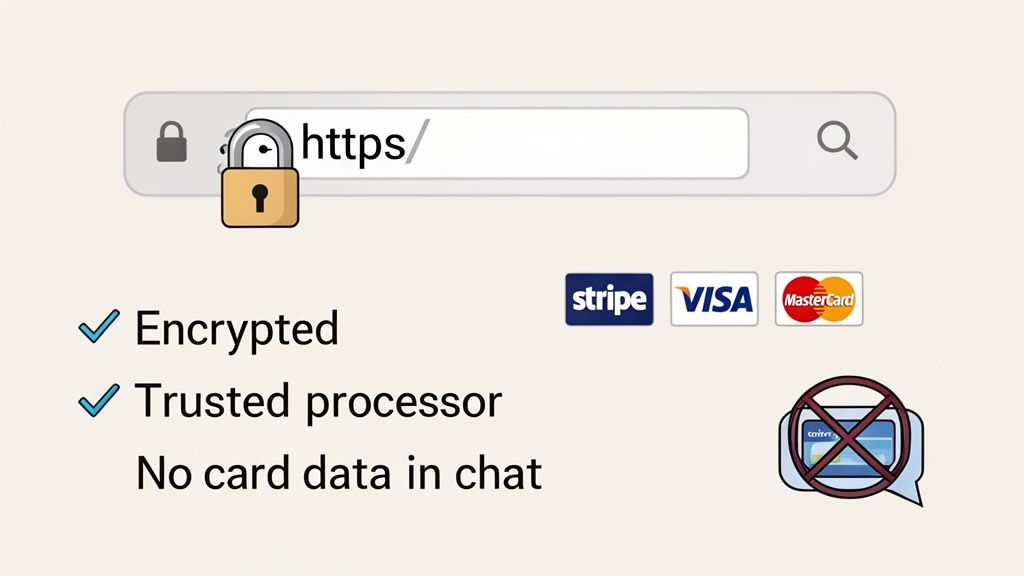
- Look for 'https://': That little 's' stands for 'secure'. It means the connection between your browser and the website is encrypted, scrambling the data so eavesdroppers can't read it. If you only see 'http://' on a payment page, that's a gigantic red flag. Stop right there.
- Find the Padlock Icon: Next to the address, you should see a small padlock symbol. Clicking on it will usually show you details about the site's security certificate, confirming who owns the site and that the connection is private.
These two signs are the absolute bare minimum. If a site is missing them on its payment or checkout pages, you should treat it with extreme suspicion.
The Golden Rule for Creators: Never Handle Card Data
This one is simple, non-negotiable, and will keep you out of a world of trouble. Your number one job—besides being brilliant on camera—is to never, ever handle a fan's raw credit card details directly.
If a viewer offers to give you their card number in a private message, over email, or via a third-party chat app to pay for a private show, the answer is always a polite but firm "no". It doesn't matter how trustworthy they seem or how big the offer is.
Redirect them to the platform's official tipping or private show function. Every single time. This isn't just about following rules; it's about protecting yourself from immense legal and financial liability. A truly PCI compliant platform is designed so you can't handle this data, shielding you from that risk.
By insisting all transactions go through the secure gateway, you protect your fan's data and ensure your own business stays on the right side of the law. This approach also helps you learn how to avoid payout delays on cam sites, as official channels are the only ones that guarantee payment.
Look for Signs of Trust
Beyond the browser bar, scan the payment page for other visual cues that show the platform is working with reputable partners. These are often called 'trust seals'.
You should be able to see logos from well-known payment processors or card brands. Seeing icons for Visa, MasterCard, or established payment gateways like Stripe is a good sign. It shows the platform is integrated with the official, secure financial system. If the payment options look obscure or unfamiliar, it's worth a moment of caution.
A secure platform is proud of its PCI compliant partners and will usually display their logos clearly.
A quick visual check can save you a lot of headaches. Before you enter any details, just run through this mental checklist. It only takes a few seconds and is one of the smartest habits you can build online.
Quick Security Checklist Before You Pay or Get Paid
| Security Signal | What It Means | Red Flag to Watch For |
|---|---|---|
| HTTPS & Padlock | The connection is encrypted and secure. | The address starts with only 'http://' or the padlock is broken/missing. |
| Clear Payment Gateway | The platform uses a known, secure service to process payments. | You're asked to enter card details directly on the main site, not in a secure frame. |
| Professional Design | The payment page looks polished and consistent with the rest of the site. | The page has spelling errors, broken images, or looks hastily thrown together. |
| No Direct Data Requests | You are never asked for card details in chat, email, or direct messages. | A creator or viewer insists on handling payment "off-site" or through DMs. |
| Recognisable Logos | You can see familiar logos like Visa, MasterCard, or other known brands. | The only payment options are obscure, unknown, or involve complex crypto transfers. |
Think of this table as your go-to guide. If you see more than one red flag, it’s probably best to find a more reputable platform for your transactions. Your financial safety is always worth the extra moment of diligence.
The Future of Payment Security with PCI DSS v4.0
The world of cybercrime never stands still, so the rules protecting our money can't afford to, either. The main rulebook, PCI DSS, has recently had a major update to version 4.0, which is a big leap forward in making online payments even safer. For creators and their fans, this isn't just some boring administrative update; it’s a welcome upgrade to the digital fortress protecting everyone's financial data.
This new version completely modernises the approach to security. It's moving away from a simple, once-a-year check-up to a model of continuous, ongoing vigilance. Think of it like swapping a building's single annual inspection for having guards on patrol 24/7.
A Shift to Continuous Security
The single biggest change in PCI DSS v4.0 is its focus on security as an ongoing process, not a one-off event. Before, a platform could pass its annual audit and then potentially let standards slip. Now, the rules demand that security measures are monitored, tested, and maintained around the clock.
This proactive stance is brilliant news for anyone using a cam platform. It means the site is required to be constantly on the lookout for new threats and vulnerabilities, adapting its defences in real-time. It’s a far more realistic way to tackle the ever-changing tactics of online criminals.
More Flexibility Without Sacrificing Safety
Another key part of v4.0 is that it gives businesses more flexible ways to meet their security goals. Instead of a rigid, one-size-fits-all checklist, it introduces a "customised approach". This allows platforms to use newer, more modern security technologies to achieve the same protective outcomes, so long as they can prove their methods are rock-solid.
Think of it like this: the old rules might have said, "You must use this specific brand of padlock." The new rules say, "Your door must be impossible to break open, and you must prove to us how you've achieved that." This encourages innovation while keeping the security standard incredibly high.
For the creator economy, this is a really positive development. It means platforms can adapt to new payment methods and technologies more quickly, all while being held to an even stricter standard of continuous protection. This evolution shows that the people setting the rules are actively working to stay one step ahead of the bad guys, giving everyone more confidence in the system.
This push for better security is already becoming mandatory. As of 2025, the updated PCI DSS v4.0.1 rules became enforceable, pushing businesses to segment their systems more effectively and avoid storing any unnecessary data—a move that directly safeguards the privacy of streamers and their viewers. This new framework helps experienced creators maximise their earnings securely, while fans can tip with greater peace of mind. You can find out more by reading some of the excellent UK compliance guides on securious.co.uk. This ongoing evolution is a clear sign that when you ask what is PCI compliant, the answer is a constantly improving standard of safety.
Your PCI Compliance Questions, Answered
Let's finish up by tackling some of the most common questions that pop up around payment security. No jargon here, just straight answers to help you feel confident navigating the world of tips, tokens, and payouts.
As a Creator, Do I Need to Worry About PCI Compliance?
For the vast majority of creators, the answer is a simple no. As long as you stick to your platform's built-in payment system and never, ever handle a fan's card details yourself, the platform carries the full weight of PCI compliance.
Think of it this way: they are the shop, and you are the talent. Your one big responsibility is to use their secure system and steer clear of any "off-platform" payment requests.
Can I Save a Fan’s Card Details for a Recurring Tip?
Absolutely not. You must never write down, type out, or store any part of a fan's payment information. This goes for the card number, the CVC code on the back, or the expiry date—even for your most loyal supporter.
Storing this kind of data would instantly put you in the scope of PCI DSS, opening you up to a world of legal and financial headaches you really don't need. Reputable platforms manage recurring payments using a secure method called "tokenisation". They save a special, unusable token—not the actual card data—to process future payments safely. Let them handle it; that’s their job.
What if I Only Take Payments Over the Phone?
Even if you were to take card details over the phone (which, as a creator, you really shouldn't be doing), the rules of PCI DSS would still apply. Any business that handles cardholder data, no matter how they receive it, falls under its scope. This is just one more reason why pushing everything through a secure online platform is always the safest move.
The golden rule is simple: if you can hear, see, or touch cardholder data, you are responsible for protecting it according to PCI DSS. It’s a massive responsibility best left to the experts.
Is an SSL Certificate (That Padlock and HTTPS) Enough for Compliance?
Not even close. Seeing 'https' and a little padlock in the browser bar is a great start, but it's just one piece of a much larger security puzzle. It's a crucial piece, sure—it encrypts data as it travels across the internet—but it's only one of the 12 core requirements of PCI DSS.
Full compliance covers everything from network firewalls and secure data storage policies to physical security measures and regular staff training. An SSL certificate is the absolute bare minimum, not the finish line.
My Platform Uses a Third-Party Processor. Does That Mean They're Compliant?
Using a well-known payment processor like Stripe doesn't give a platform an automatic pass on compliance. While processors like Stripe are incredibly secure, the platform itself is still responsible for making sure its own systems—the website, the servers, and all the code that connects to that processor—are also completely locked down.
The responsibility for securing the entire payment journey, from start to finish, ultimately lies with the platform you’re using.
What’s the Biggest Myth About PCI Compliance?
The most common and dangerous myth is that it’s only a problem for huge corporations. The truth is, PCI DSS applies to any business that accepts card payments, from the world's biggest streaming sites right down to the smallest independent online shop.
In fact, hackers often go after smaller businesses precisely because they assume their security will be weaker. This is exactly why relying on a major, Level 1 compliant platform gives you, your fans, and your business such a vital layer of protection.