

Ever stared at your payout and thought, "Hang on, where did the rest of it go?" That gap between what your fans paid and what actually lands in your bank isn't the platform being shady; it's the cost of moving money online. For most UK creators, that cost has a name: the Stripe credit card fee.
Think of it as a tollbooth on the digital highway connecting your fans' credit cards to your account. It's a standard, non-negotiable part of the game, but understanding exactly how it works is the first step to truly owning your finances and not letting them own you.
How Stripe Fees Break Down
When a fan throws a tip your way, the money doesn't just teleport into your account. It gets routed through a payment processor like Stripe, which handles the secure card transaction. For that service, they skim a little off the top before passing the rest on.
For most creators on UK-based platforms, the standard Stripe fee is a simple formula: 1.5% + 20p for every successful payment from a standard UK card.
It’s made of two parts, and you need to get your head around both:
- The Percentage (1.5%): This bit scales with the payment size. The bigger the tip, the bigger this slice of the fee. Simple.
- The Fixed Fee (20p): This is the sneaky one. It's a flat charge slapped on every single transaction, no matter how small. It’s why a blizzard of tiny £1 tips is way less profitable than a few bigger ones—that 20p gets taken out each and every time.
This diagram shows the flow. A fan pays, Stripe takes its cut, and what's left is your gross earning, which then gets passed to the platform you're using.
Once you nail this basic flow, you can predict your earnings with unnerving accuracy and start making smarter calls on your pricing and tip goals.
To see what this looks like in the real world, let’s run the numbers on some typical payments you’d see during a stream.
Stripe UK Standard Fee on Typical Creator Earnings
| Fan Payment | Stripe Fee (1.5% + 20p) | Your Gross Earning (Before Platform Cut) |
|---|---|---|
| £5.00 | £0.28 | £4.72 |
| £10.00 | £0.35 | £9.65 |
| £25.00 | £0.58 | £24.42 |
| £50.00 | £0.95 | £49.05 |
| £100.00 | £1.70 | £98.30 |
As you can see, that fixed 20p hits the smallest payments hardest. Understanding this is key to figuring out the real value of every interaction.
These processing fees are just the first haircut your money gets. For the full picture of the journey from fan to your bank account, check out our guide on how cam models get paid.
Decoding What's Inside Each Stripe Fee
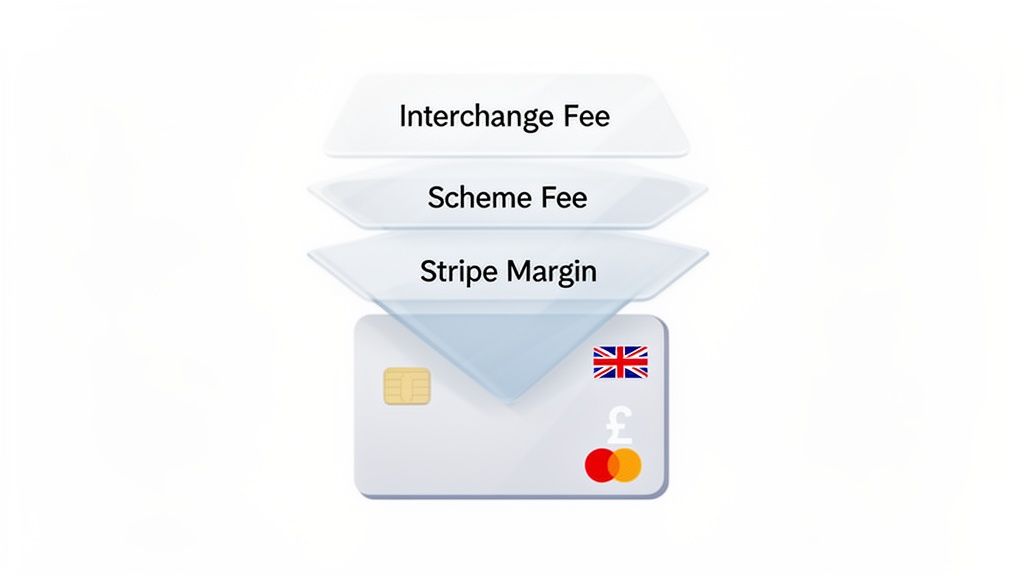
When you see a rate like 1.5% + 20p, it’s tempting to just shrug and write it off as the cost of doing business. But if you want to get smart with your money, you need to know what you're actually paying for. That fee isn't just pure profit for Stripe; it's a bundle of different costs paid to different players in the financial system.
Think of it like the service charge on a restaurant bill. Part goes to the server, part to the kitchen, and another chunk covers the restaurant's running costs. Every time a fan’s card gets dinged, the money is carved up in a similar way before it even gets close to your account. Let's lift the bonnet.
The Interchange Fee
This is the biggest slice of the pie, and surprise—it doesn't even go to Stripe. The interchange fee is what the fan’s own bank (the card issuer, like Barclays or HSBC) charges for letting them use their card network. It's their cut for taking on the financial risk, covering potential fraud, and guaranteeing the payment.
For you as a creator, this is the bedrock cost of every card payment. No matter which processor you use, you can't escape it.
The good news for UK-based creators is that we have regulations capping these fees on domestic consumer cards. This is a massive advantage compared to places like the US, where interchange fees can be much higher and wildly unpredictable.
This cap gives you a stable financial baseline, meaning more consistent earnings from your UK fans.
The Scheme Fee
Next up is the scheme fee. This is a much smaller cut that goes directly to the card networks themselves—the big dogs like Visa and Mastercard. They charge this for using their financial 'rails', the global infrastructure that connects the fan’s bank to your platform’s payment system.
It's a tiny, non-negotiable toll on the payment highway that helps them maintain and secure their worldwide networks.
The Processor Margin
Finally, we get to Stripe's piece of the action. The processor margin is what Stripe charges for its services, layered on top of the other two fees. This is what pays for the whole ecosystem they provide:
- Technology: The secure payment gateway, the checkout forms your fans use, and all the backend wizardry that makes it work.
- Security: Top-tier fraud detection tools (like Radar), PCI compliance to keep card data locked down, and all the secure server infrastructure.
- Service: Your dashboard for tracking payments, 24/7 support when things go wrong, and the systems that manage your payouts.
Stripe bundles all these messy, variable costs into that one, predictable rate. UK regulations cap interchange fees at 0.2% for debit and 0.3% for credit cards on domestic transactions. This forms the base of the 1.5% + 20p, with Stripe adding the scheme fees and its own margin on top.
This bundled pricing is why Stripe is so popular—it turns a financial headache into a single number. But it's vital to remember that Stripe's fee is totally separate from the cut your cam platform takes. You can get the full story on that in our guide explaining how cam platforms make money.
The Hidden Costs That Can Tank Your Payouts
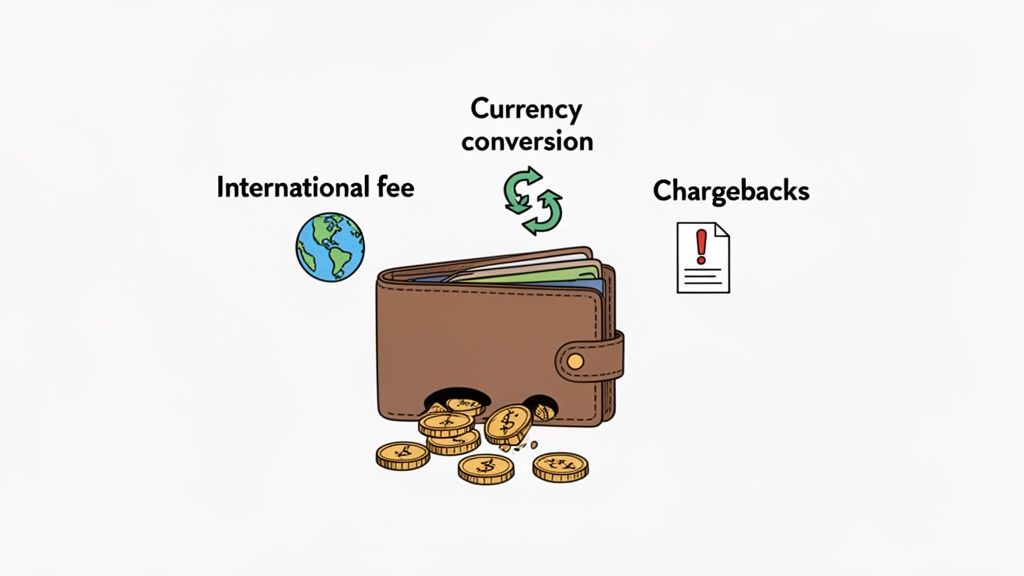
So, you’ve memorised the standard 1.5% + 20p fee. You might think you're financially sorted, but that headline rate is a bit like a car's sticker price—it’s just the starting point. A few other Stripe credit card fees can quietly chip away at your earnings, turning what looked like a brilliant week into a surprisingly average one.
These aren't exactly secret charges; they're costs for specific situations that most creators don't even know exist until they see a payout that feels lighter than it should. Let’s expose the most common extra costs you’re likely to face.
The International Fan Tax
One of the best things about camming is having a global audience. It's a buzz to get tips from fans in Toronto, Tokyo, or Texas. The catch? Every time a payment comes from a card issued outside the UK, that familiar Stripe credit card fee gets more expensive.
Why? Because banks and card networks see international payments as a slightly higher risk, so they charge more to process them. It's not your fault, but it's a cost you absorb.
Here’s what that looks like for payments on non-UK cards:
- European Cards: The fee rises to 2.5% + 20p.
- All Other International Cards (e.g., US, Canada, Australia): The fee jumps to 3.25% + 20p.
That might not seem like a huge leap, but if a good chunk of your audience is in North America, those extra percentage points will make themselves known. For example, a generous £100 tip from a US fan will actually cost you £3.45 in fees, more than double the £1.70 you'd pay for the same tip from a UK fan.
The Premium Card Penalty
Another cost that often flies under the radar is the surcharge for "premium" cards. We're talking about those slick American Express cards or high-end corporate cards that come loaded with points and perks. Processing these is simply more expensive for everyone in the payment chain.
While Stripe’s standard UK pricing often rolls this into the main fee, certain premium cards can still trigger a higher rate. This is less of an issue for typical fan-to-creator tips, but it can pop up now and then, especially if a fan is using a business card.
You have zero control over what card a fan uses, so just think of this as a small, unavoidable cost of doing business.
The Currency Conversion Cut
This is the one that really catches people out. If your platform lets fans pay in their local currency (like USD or EUR) but pays you out in GBP, an extra step happens behind the scenes: currency conversion. And yes, Stripe charges for that service.
This currency conversion fee is an additional 2%, and it's charged on top of the transaction fee.
Imagine a fan in the US sends you $50. First, the payment is processed with the higher international card fee. Then, Stripe takes another 2% from what's left just to convert it from dollars to pounds before it ever reaches you. It's a real double-whammy on your earnings from international fans.
To make this crystal clear, let's look at how these extra costs stack up against the standard rate.
Stripe Fees Beyond the Standard Rate (UK)
This table shows a side-by-side comparison of the standard fee versus the extra costs that can bite you, especially if you have an international audience.
| Fee Type | Typical Cost (2026) | When It Applies |
|---|---|---|
| Standard UK Cards | 1.5% + 20p | When a fan pays with a standard card issued in the UK. |
| European Cards | 2.5% + 20p | When a fan pays with a card issued in Europe (but outside the UK). |
| International Cards | 3.25% + 20p | When a fan pays with a card from outside Europe (e.g., USA, Canada). |
| Currency Conversion | 2% | When a payment in a foreign currency needs to be converted to GBP for your payout. |
Getting a firm grasp of these other Stripe credit card fees is genuinely important. It lets you forecast your income more accurately, especially if you’ve built a global following. Knowing these numbers means no more disappointing surprises when you check your balance.
How Chargebacks and Refunds Impact Your Earnings
Few words will make a creator’s stomach drop faster than "chargeback." It gets thrown around a lot, and many people think it’s just another name for a refund. It’s not. A chargeback is a whole different—and far more damaging—problem you need to understand to protect your income.
A chargeback happens when a fan bypasses you and the platform, going directly to their bank to dispute a payment. They claim it was fraudulent or unauthorised, kicking off a stressful, expensive process that sucks you right into the middle of it.
The Painful Cost of a Chargeback
When a fan files a chargeback, Stripe instantly yanks the full amount of the original payment from your balance. But it doesn't stop there. They also slap you with a non-refundable dispute fee of £20. Think of it as a penalty for the hassle.
Here's the kicker: you pay that £20 fee even if you win the dispute. Stripe's logic is that the fee covers their admin costs for managing the case, whatever the outcome. It's a blunt, frustrating reality of doing business in our industry.
This means that for every single chargeback, you’re guaranteed to lose at least £20, not to mention the time and energy you’ll sink into fighting it. For smaller transactions, you can easily end up losing more money than the original payment was even worth. This is exactly why preventing chargebacks should be a top priority.
Fighting the Good Fight: Your Defence Strategy
Once a dispute is filed, the clock starts ticking. You usually have a very short window to submit evidence proving the transaction was legit. This is where being organised and keeping good records really pays off. Simply saying "they bought a video" won't cut it; you need to provide cold, hard proof.
Think of it like building a case file for a small claims court. Your response needs to be professional, clear, and leave no room for doubt.
Here’s your evidence-gathering checklist:
- Communication Logs: Screenshot any DMs, emails, or on-site chats where you discussed the purchase. This is absolutely critical for custom content.
- Proof of Delivery: For custom vids or private shows, show that the content was delivered. Can you provide timestamps, download confirmations, or logs showing the user accessed the file?
- User History: Point out if the user has a history of successful, undisputed payments. A chargeback from a brand-new account is far more suspicious than one from a long-time regular.
- Clear Explanations: Write a short, professional summary of the situation. Explain exactly what was purchased and how you delivered it. No emotion, just facts.
Honestly, it's a grim process, and the odds are often stacked against merchants because banks tend to side with their customers. That said, a well-documented case significantly boosts your chances of winning and getting the original payment back. Keeping detailed records isn't just good admin; it's a crucial part of defending your earnings from "friendly fraud" and buyer's remorse. For more on securing your income, learn how to avoid payout delays on cam sites in our detailed guide.
Practical Strategies to Minimise Your Stripe Fees
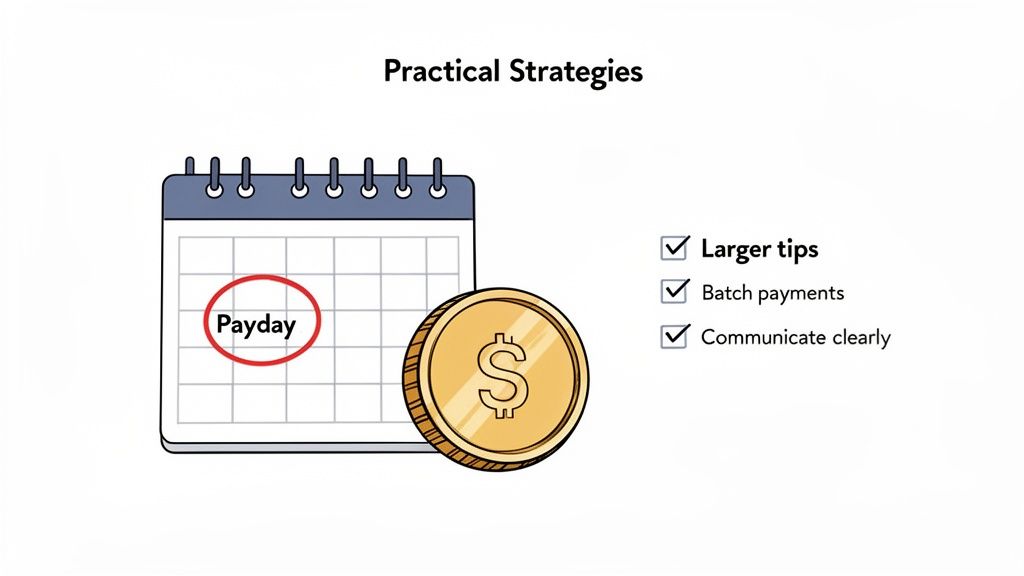
So, we know these fees are an unavoidable part of the job. But that absolutely doesn't mean you're powerless. You don't have to just sit back and watch them shave money off your earnings. By being clever about how you manage payments, you can genuinely influence how much cash lands in your bank account.
This isn't about some secret hack or trying to outsmart the system. It's about using what you know about how Stripe credit card fees work to your advantage. A few small, strategic shifts in how you operate can add up significantly, keeping more of your hard-earned money right where it belongs.
Encourage Bigger, Less Frequent Tips
That little 20p fixed fee on every transaction? It’s the quiet killer of profit on small payments. Stripe applies it to every single charge, whether it’s a tiny £1 tip or a £100 private show. This is where you can make a real difference.
One of the most effective tactics is to gently nudge your fans towards larger, less frequent payments. Think about it: one single £20 tip is far more fee-efficient than ten separate £2 tips scattered throughout a stream.
Let's look at the maths:
- Ten £2 Tips: 10 x (£0.03 + £0.20) = £2.30 in fees
- One £20 Tip: (1.5% of £20) + £0.20 = £0.50 in fees
That's a saving of £1.80 on the exact same amount of money, just by consolidating the payments. You can steer fans this way by setting higher tip goals, giving a special shout-out for bigger contributions, or just explaining that it helps you keep more of their generous support.
Pro Tip: Look at your token package prices. By setting a minimum top-up of, say, £5, you immediately cut out the flood of tiny, fee-heavy transactions that eat into your bottom line. A loyal fan who wants to support you will get it.
Look for Payout Options and Schedules
Your webcam platform is the middleman here, and they have a big say in how your money moves. While you can’t change the fundamental Stripe fees they pay, the platform itself might have different options that can help you manage your finances better.
Some platforms let you choose payout schedules, like weekly versus monthly, or even offer different providers for the final transfer to your bank. This doesn't cut the initial processing fee, but a predictable payout schedule makes a world of difference for managing your budget. It's always a good idea to dig around in your platform’s payment settings to see what control you have.
Negotiate Better Terms (For the High Earners)
Okay, this one isn’t for beginners, but it's a crucial goal for anyone serious about making this a career. Once you're consistently processing a high volume of payments—we're talking five figures a month—you stop being just another user. You become a valuable client.
At this level, some platforms (or even Stripe directly, if you ever run your own site) may be willing to discuss custom pricing. This is often called volume-based pricing. If you can prove you bring in significant, reliable business, you can sometimes get a better deal on the percentage fee.
To even start this conversation, you'll need a solid track record of high earnings over several months. If that's you, it never hurts to open a polite, professional dialogue with your platform's support team. The worst they can say is no, but a "yes" could literally save you thousands a year in Stripe credit card fees.
Your Creator-Focused Summary for Stripe UK Fees
So, what’s the bottom line? We’ve pulled apart the confusing world of Stripe credit card fees, from the standard rates to those nasty hidden costs. If there's one thing to take away, it's this: getting your head around these fees isn't just boring accounting—it's a vital business skill for any creator who's serious about their income.
Think of it as financial self-defence. Knowing how these percentages and fixed costs chip away at your earnings is the difference between being confused by a payout and feeling in control of your finances. It turns confusing jargon into a real strategy for protecting the money you've worked so hard for.
The Essential UK Creator Checklist
To keep it simple, here’s a quick mental checklist. Run through this every time you look at your earnings or think about your pricing.
Your Starting Point is the UK Rate: The standard 1.5% + 20p for UK cards is your best-case scenario. Use this as your benchmark, but remember it’s rarely the whole story.
Where Your Fans Are Matters, A Lot: A global audience is fantastic, but it comes with a price tag. Remember that payments from European fans cost you 2.5% + 20p, and anyone paying from the US, Canada, or further afield will trigger a 3.25% + 20p fee.
The 20p Fixed Fee Hates Small Tips: That flat charge is the biggest enemy of frequent, low-value tips. Gently encouraging fans to make larger, less frequent payments is one of the most powerful ways to slash your processing costs.
Chargebacks Are a Financial Gut Punch: A chargeback isn’t just a refund; it’s a direct penalty. You'll be hit with a £20 dispute fee that you won't get back, even if you prove the charge was legit. Your only defence is keeping meticulous records of every private show and custom video.
Think of these fees as the unavoidable cost of using a secure, professional payment system that fans know and trust. The goal isn't to magically erase them. It's to run your business so intelligently that you minimise their impact and keep more of what you earn.
Turning This Knowledge Into Profit
Hopefully, you now see that Stripe credit card fees aren't just a passive line on a statement. They're an active part of your business that you have some control over. By encouraging bigger tips, you fight back against the fixed fee. By keeping perfect records, you build a shield against the painful cost of disputes.
This insight gives you the power to look at your rate card, your tip menu, and even how you talk to your fans in a completely new way. You can now make smart, informed decisions that directly boost your take-home pay. This is what it means to go from a hobbyist to a pro.
Frequently Asked Questions About Stripe Fees
Let's cut through the noise. When you're dealing with online payments, it's easy to get lost in jargon. Here are straight-to-the-point answers to the most common questions we hear from creators about Stripe credit card fees.
Why Do My Stripe Fees Seem Higher in Some Months?
This question comes up all the time, and the answer is almost always about your audience's location. If you have a month with a big influx of fans from outside the UK, you’ll see a spike in your fees.
Payments from US-based fans, for instance, are processed at 3.25% + 20p. That's more than double the standard UK rate. The other big factor is transaction type. A month packed with lots of small, frequent tips means that fixed 20p fee is charged over and over, eating a bigger chunk of your total earnings compared to a month with fewer, higher-value payments.
What Is the Difference Between Stripe's Fee and My Platform's Fee?
Getting this straight is vital for understanding your money. These are two completely separate fees, taken out one after the other.
- Stripe's Fee: This is what it costs to process the credit card transaction. Think of it as the price for using their secure payment tech. Stripe takes its cut first.
- The Platform's Fee: This is the percentage your cam platform charges for its service—the website, audience, moderation, and streaming tools.
Here's a simple way to look at it: A fan pays £100. First, Stripe takes its processing fee (e.g., £1.70 for a UK card). From the £98.30 that’s left, the platform then takes its share (e.g., 30%). Your final payout is what remains after both deductions.
Is It Cheaper to Get Paid in a Different Currency Like USD?
It might seem tempting, but it almost never saves you money. Seeing a bigger number in US dollars can feel like you’re earning more, but it’s easy to forget about the hidden cost of currency conversion.
When you transfer that USD balance from your platform to your UK bank account, Stripe will add a currency conversion fee of around 2%. This is on top of the already higher international transaction fee. For most UK-based creators, keeping it simple is the most cost-effective route: have fans pay in GBP and get your payouts in GBP. It’s cleaner, more transparent, and you won’t get stung by that extra conversion charge.
Can I Refuse Certain Cards to Avoid Higher Fees?
In a word, no. As a creator on a platform, you have no say over the types of cards a fan uses. The payment system is built to be as smooth as possible for the customer, which means accepting all major cards (Visa, Mastercard, Amex) from anywhere in the world.
This is part of the deal. In exchange for a platform that handles the complexities of global payments, you absorb the variable costs that come with different cards and fan locations. The platform manages payment acceptance; you see the net result in your earnings.